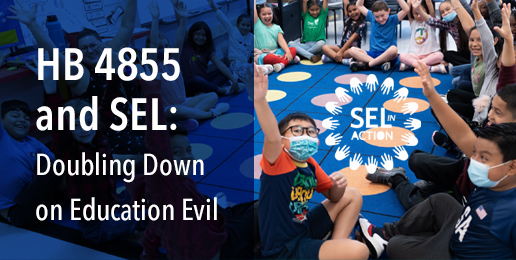
The Illinois General Assembly is working on an education bill that doubles down on something called “social and emotional learning” (SEL). House Bill 4855 intensifies how public schools apply SEL techniques, and also sends consultants to ensure that the new regulations are being obeyed.
Why this enthusiasm for SEL? Does the teachers lobby have malicious intent, wanting to hurt their charges? Because diligently applying SEL has these effects on students:
- They learn that more racism, not less, is the answer to our social ills.
- They don’t learn to be good citizens. Rather, they’re encouraged to be social activists, tearing down our culture and society.
- They learn to disregard their parents’ advice, trusting the school instead.
SEL is an under-the-radar thing, introduced to the Illinois school regulations in 2021. But outside of school staff, nobody seems to know or care much about it. But we should care, because through it we’re paying our schools to teach this generation to destroy everything we’ve dreamed of and worked for.
What is social and emotional learning?
Social and emotional learning is an educational fad. The main advocate for this is the Collaborative for Academic, Social, and Emotional Learning, known as CASEL.
The Illinois Teaching Standards requires using SEL in the classroom. But the standards don’t actually define what SEL means. The Teaching Standards leave that to CASEL. So whatever CASEL says SEL is, the public school teachers are being increasingly obligated to promote in their classrooms.
In my prior article Remove SEL programs from the schools! I wrote all about SEL, CASEL, and their friends. What follows is a short and to-the-point review of SEL.
SEL is largely progressive activism
In the CASEL video SEL as a Lever for Equity and Social Justice Karen Niemi, the CASEL President and CEO, says this about SEL and racism:
We believe that there is no system more important than education to fighting against racism. And we believe that our work in social and emotional learning must actively contribute to anti-racism. SEL has the potential to do a lot of things. It has the potential to help people move from anger, to agency, and then to action.
… These are really all important things that matter. And we see SEL as a tool for anti-racism.
The NPR article How social-emotional learning became a frontline in the battle against CRT said that SEL is always about activism.
Dena Simmons, the founder of LiberatED, an organization which aims to center racial social justice in social and emotional learning, says being able to talk about social-emotional learning without talking about identity is an example of white privilege.
“You can’t have those conversations without talking about identity … Social-emotional learning is so that people can get along better. We also have to talk about why people don’t get along,” Simmons says.
“If we don’t apply an anti-racist, abolitionist, anti-oppressive, anti-bias lens to social-emotional learning, it can very easily turn into white supremacy with a hug.”
SEL also teaches students to hate “white people.” Robert Jagers, CASEL’s VP of Research, wrote an editorial Framing Social and Emotional Learning among African-American Youth: Toward an Integrity-Based Approach. In it Jagers intends that SEL incorporate the world of “critical race theory” and push back against the “dominant culture.”
He even hints that students trained in SEL ought to try an actual revolution!
As a result, SEL work can be understood with regard to what ways it advances resistance to oppression and collective well-being for a range of disenfranchised groups. Briefly, oppression entails a state of asymmetric power relations characterized by domination and subordination, such that dominating persons or groups exercise their power to restrict access to material resources and convince both the dominant and subordinated groups that such arrangements are justified.
Resistance can lead to freedom to determine, pursue, and attain collective economic, educational, and health-related well-being.
From this sample of quotes, we see that SEL isn’t meant to simply help students focus and learn. Its big picture shows the intent to create social activists, unhappy with America and willing to break society.
SEL and anti-racism
You’ve read that the promoters of SEL think highly of anti-racism. But that doesn’t mean “no more racism.” Rather, it means “when you act racially that is evil, but when we act racially that is dandy.” Ibram Kendi is perhaps the most prominent proponent of anti-racism. He justifies anti-racism with these words:
“… The defining question is whether the discrimination is creating equity or inequity. If discrimination is creating equity, then it is antiracist. If discrimination is creating inequity, then it is racist. Someone reproducing inequity through permanently assisting an overrepresented racial group into wealth and power is entirely different than someone challenging that inequity by temporarily assisting an underrepresented racial group into relative wealth and power until equity is reached. The only remedy to racist discrimination is antiracist discrimination. The only remedy to past discrimination is present discrimination. The only remedy to present discrimination is future discrimination.”
Kendi is at odds with Dr. Martin Luther King and his dream:
I have a dream that my four little children will one day live in a nation where they will not be judged by the color of their skin but by the content of their character.
Kendi intends that society must have reverse-discrimination racism until “equity” is reached. But anti-racism trains people to believe that actual racism is always fine. Because of that, society never learns how to be non-racist.
The Bible hates racism. We’re supposed to be judging individuals fairly, not by their race, wealth, or influence (Leviticus 19:15, Deuteronomy 1:16-17). We can’t make a righteous society through additional racism, no matter how well intentioned we think it is.
SEL and equity
Unlike King’s call for equality and color-blindness, Kendi calls for “future discrimination” until the right kind of equity is created. However, equity doesn’t mean equality.
- Equality is treating every individual by the same rules.
- Equity insists on lumping people into groups, arbitrarily determined by race, income, etc. Each group will fight against the others, seeking advantage or favor.
In his blog, William Cathcart explains equity and some of its consequences:
You’ll note perhaps the newest of the identifying terms, “equity.” Often confused with, or assumed to actually be, “equality.” Not the case at all. Equality means equal opportunity, as we’ve all long known. Equity, however, refers to, and strives for, equal outcomes. That’s completely different. Rather than championing learning, hard work, persistence, and commitment to achieve, ‘equity’ essentially implies skipping all of those traditional factors on the American pathway to success, and, instead, doing whatever is necessary (think government influence and assistance) for underachievers to become just as successful reaching a goal as those who worked their butts off to make it. And that could mean lowering academic standards, holding achievers back through lack of advanced course offerings, bringing the slow learners up and holding the excelling learners back, to the end of creating a homogenous, middle-level (if not, mediocre) learning experience imposed on all. That’s equity. Achieving a bizarre form of socialist equality, now achieved through the back door, by boosting the weak and hog-tying the strong, so they all reach the perceived finish line together.
Political commentator Scott Johnson chooses to summarize government-dominated equity like this:
“Equity is not equality (i.e., equal rights). It is a substitute for equal rights. Equity requires the authorities to determine who gets what according to the race, the ethnicity, or other status of the beneficiaries. It is updated Marxist claptrap in which race replaces class.”
He concludes:
“The mania for perfect equality of results and conditions is never to be satisfied. It provides a permanent rationale for perfect tyranny.”
In other words, government must step in to assure equity of outcomes, likely by pressure, and then remain involved, since the equity task can never be satisfactorily completed!
Suppose that an anti-racist remedy actually fixes something. Could that remedy be removed once a measurable equality or fairness has been achieved? I doubt it. Do you believe for a moment that the people of a favored group will accept losing their preferential treatment? Thomas Sowell doesn’t think so, either:
When people get used to preferential treatment, equal treatment seems like discrimination.
SEL vs. parents
We already know that the teacher associations have a low opinion of parents who seek to safeguard their children in school. The SEL concept continues in that vein, asserting that the school is meant to replace the parent in the student’s life.
SEL advocates go on at length about how SEL will team with parents, bringing school success for all.
… CASEL has long asserted that family-school-community partnerships are essential to realizing the potential of systemic SEL. With our revisions and transformative SEL, we now separate families from communities as distinct contexts for SEL. This provides for a more focused and nuanced approach to our work in the family context. Families play an integral role in the social, emotional, and academic development of children and youth and are essential to creating, informing, and sustaining educational equity initiatives—including transformative SEL. Parents and other primary caregivers value the development of these life skills and view the home as the first place SEL occurs. …
By using phrases like “the first place SEL occurs,” the SEL advocates show that they need the parents to play the part of lapdogs. Parents are meant to yield their parental oversight, handing off their children to the “second place SEL” teachers. After that, they merely reinforce those SEL lessons from school.
Jagers, that VP at CASEL, thinks of parents merely as the “first teachers.”
As children’s first teachers, families bring deep expertise about their lived experiences, their culture, and the issues they care about.
According to CASEL’s Develop and Strengthen Family and Community Partnerships, the parents role is to model at home what the schools are teaching. The parents become outsiders in the growth of their own children.
Family and community partners are situated to model, reinforce, and sustain SEL. When young people see peers and adults outside of school modeling the same social and emotional skills they are learning about and practicing in the classroom, these skills become more than just the answer to a teacher’s question. They see social and emotional skills as central to the way they process events and interact in the world.
If schools using SEL want to actually work with parents then why is this “exposing them to different worldviews” requirement in the Teaching Standards?
Self-Awareness and Relationships to Others – Culturally responsive teachers and leaders are reflective and gain a deeper understanding of themselves and how they impact others, leading to more cohesive and productive student development as it relates to academic and social-emotional development for all students. The culturally responsive teacher and leader will: …
4) Include representative, familiar content in the curriculum to legitimize students’ backgrounds, while also exposing them to new ideas and worldviews different from their own.
This “different worldviews” requirement is how “drag queen shows” get into the classrooms.
Schools using SEL rob the parents of their children’s affection. But there are consequences to telling the parents that their guidance is superfluous. They’ll stop caring what their children are doing, and the children won’t care what the parents don’t allow. And all of society will experience the dysfunction seen daily in the Chicago slums.
SEL teaches a Marxist worldview
I bet you didn’t intend to pay taxes so that your children would become devoted Marxists. But this is happening through SEL-enabled teaching. CASEL sometimes calls this Marxist content “Transformative SEL,” but it’s still SEL because CASEL says it is.
Through SEL, students learn to look at life through a “lens of equity.” This means learning a Marxist worldview, replacing the worldview their parents have been modeling for years.
Writing at The Inclusion Solution, Adrian Mack asserts that a color-blind society is a fiction. Rather, society must always be racial, all the time.
Identity blindness, including racial “color blindness,” harms marginalized and underrepresented groups by diminishing the very characteristics that are often central to their own sense of self…
Identity blindness is when one claims to not see different forms of identity, like race, gender, or sexual orientation, instead arguing that they simply strive to treat everyone the same.
Having “identity blindness,” or being racial all the time, amounts to “class consciousness,” a core Marxist concept.
In Marxism, class consciousness is the set of beliefs that a person holds regarding their social class or economic rank in society, the structure of their class, and their class interests. According to Karl Marx, it is an awareness that is key to sparking a revolution that would “create a dictatorship of the proletariat, transforming it from a wage-earning, property-less mass into the ruling class”.
The website New Discourses criticizes SEL as Marxist rot:
Transformative SEL is wholly (neo)-Marxist. Its primary agenda is, in fact, to use the five competency areas to raise and foster a critical consciousness through social and emotional education. This fact is unsurprising to all who understand that “transformative” is a term employed by all of the Dialectical Left, most notably including Marxists, to describe their goal of making the world and man into something suitable for Communism. Transformative SEL “social awareness” lessons are unabashedly rooted in neo-Marxist social Theories like Critical Race Theory, Gender Theory, Queer Theory, Postcolonial Theory, Fat Studies, and Disability Studies, and “Trans SEL” in that regard is a vehicle and coordinating hub for programming (literally, as in thought reform or brainwashing) into the perspectives of these Critical Theories. The goal of Transformative SEL is to program children to see their world through the lenses provided by those Critical Theories and train them to be “change agents” (that is, activists) on their behalf. Systemic Transformative SEL, which is what CASEL currently promotes, is designed to rearrange the entire school-related life of every child so that it reinforces this programming in a fully immersive way.
What can we do about SEL in the schools?
If enraged parents can be influential enough to force the public schools to abandon SEL then we wouldn’t need these “fire alarm” conversations. But until that influence arrives, we must be watchful for our children’s sake.
We also need to be watchful for society’s sake. Other parents’ children are learning their worldview through SEL, and they’ll be sharing the future with your children. We must care about removing SEL, and countering it, for the sake of our society’s future.
George Barna, the famous pollster and researcher, says that a child’s worldview is almost completely formed by age 13. That highlights the importance of guarding children at an early age from outside influences.
Parents should watch what their children say and do, and examine their schoolwork. Look for thoughts, attitudes, and behaviors that seem foreign to your values.
For example, in January 2026 the state of Illinois published proposed changes to its Teaching Standards. In pages 1396-1414 of its PDF we see how they’d change its SEL goals. Parents should be very interested in how SEL could affect their children’s’ behavior. Here are some examples for you to ponder.
Page 1399, Indicator 1C.1.2: Identify a trusted adult as a resource or support outside of the family.
Indicator 1C.1.2 refers to grades K-2. So the state thinks that a seven year old child shouldn’t trust his or her own family? Or is this “trusted adult” business all about “child grooming”? Tell your child that school must have no secrets, even if the teacher insists on it.
Page 1399, Indicator 1C.2.1: Identify a change they want to see in their community and create a goal to accomplish it.
Indicator 1C.2.1 refers to grades 3-5. Why should a ten year old child think about how to change the world? In my experience they have a “comic book physics” concept of what is going on. Perhaps the teacher is feeding the student things to be dissatisfied about? If your child is becoming upset about rather adult topics, then the teacher is likely abusing your trust.
Page 1404, Indicator 3A.4.2: Demonstrate empathy and humility by actively listening to and supporting diverse viewpoints, especially those different from their own.
Indicator 3A.4.2 refers to grades 9-10. These lessons are for early teenagers. This goal sounds like “the traditional American culture is nothing special.” That is, the students should feel comfortable in any of these others, displacing American and Christian values at a whim. Go through the student lessons, looking for promotion of American citizenship, common American values, and positive aspects of American life.
Page 1406, Indicator 3B.5.2: Advocate for self, others, or groups who are marginalized, experiencing distress, or societal inequities in culturally and contextually considerate ways.
Indicator 3.B.5.2 is for late teenagers. Is your teen trying to be an activist? And is this genuine concern for the topic, or artificially getting worked into a political frenzy? Yes, your teens are almost grown. But it’s not too late for them to listen to some adult guidance, and even moderation, about the activism they’re embracing.
Your public school’s teachers might be sweet and nice, but remember that they’ve consented to delivering this SEL poison. So be sweet and nice to them in return. And also create all of the roadblocks and obstacles you can devise, to frustrate their indoctrination.
Do your children go to a private school? Don’t presume that your children are safe from SEL indoctrination.
Many schools purchase teaching systems that implement SEL. For example, the Second Step program. No matter what school your children are in, you must remain wary and watchful concerning what they learn.