HB 5295 Finishes What the Repeal of Parental Notification Started…
Even Abortion-Rights Supporters Should Be Concerned
On April 16, 2026, the Illinois House passed HB 5295 — the “Reproductive Health Records Privacy Act” — on a 73–34 party-line vote. Every Democrat present voted yes. Every Republican voted no.
House Speaker Emanuel “Chris” Welch, who rarely votes, cast his own Yea. The public pitch: stop hostile red-state prosecutors from reaching into Illinois to punish women seeking abortion care.
That is not what it does. And there is no evidence that such protections are even needed.
HB 5295 rewrites Illinois’ electronic health networks so that by July 1, 2027, abortion-related records are segregated from the rest of a patient’s chart, blocked from crossing state lines, and automatically denied to any out-of-state user. The bill contains no clear carve-out for parents of minors, child-protection agencies, law enforcement investigating child sexual abuse or trafficking, or federal prosecutors. The sole carve-out, added by House Floor Amendment #1, allows the patient to opt in to share her records with a specific out-of-state treating provider.
A thirteen-year-old who has been trafficked is not going to invoke that opt-in. Neither is a fifteen-year-old who is pregnant by her mother’s boyfriend. Neither is a runaway brought across the state line by the man who impregnated her.
At a minimum, this consequence was foreseeable. If this bill is about adult privacy, why are minors treated exactly the same way?
Background
HB 5295 is the fifth and final layer of a legal structure Illinois has built since 2021 — a system that severs every external link by which a child predator’s crime can be discovered after the fact.
I find it very hard to believe that was the sponsors’ intent, but that is the effect. Can they not see it? Can you?
As of April 2026, Illinois abortion laws function as a five-layer shield that can obstruct the discovery of abuse. Each layer was enacted separately, and the combination is cumulative.
Layer 1 — Minor-consent statute (410 ILCS 210/3). A pregnant minor of any age has the same legal capacity as an adult to consent to an abortion. There is no age floor. No guardian check.
Layer 2 — 2021 repeal of parental notification. For thirty years, Illinois required a physician to give 48 hours’ notice to an adult family member before performing an abortion on a minor. HB 370, the “Youth Health and Safety Act,” fully repealed that requirement, effective June 1, 2022. Today, no one outside the clinic — not parents, grandparents, guardians, pediatricians, schools, or home-state child-protection agencies — is entitled to notice when an abortion is performed on a minor in Illinois.
Layer 3 — HIPAA personal-representative exception (45 C.F.R. 164.502(g)(3)). Generally, The Health Insurance Portability and Accountability Act (HIPAA) treats a parent as the personal representative of an un-emancipated minor, with control over the minor’s health records. However, when state law does not require parental consent or involvement for a service, the parent is not the personal representative for that service. Because Illinois removed parental consent and notice requirements for a minor’s abortion, the parents haave no federal right of access to their daughter’s abortion records. HHS guidance confirms this. This is not an accident. Illinois chose Layers 1 and 2, knowing exactly how the federal regulation reads.
Layer 4 — 2023 Patient and Provider Protection Act (HB 4664 / PA 102-1117). Signed January 13, 2023, this is Illinois’ shield law. It bars Illinois courts and police from cooperating with out-of-state criminal or civil investigations targeting abortion care provided in Illinois, restricts information sharing with outside authorities, and creates civil remedies for those who attempt to do so. The doors of the Illinois government are closed to any outside investigator seeking information about an Illinois abortion.
Layer 5 — HB 5295: the data layer. Layer 4 denies outside investigators cooperation from the Illinois government. Layer 5 denies them access to the records themselves. After July 1, 2027, abortion records must be segregated from the rest of the chart, kept from crossing state lines, and automatically blocked from any out-of-state user. No subpoena exception. No child-protection exception. No federal-trafficking exception. No parental-access exception.
Every one of these laws leaves a child more vulnerable to exploitation.
What now appears as a unified five-layer system was enacted in stages over five years by the same core group of legislators. Rep. Kelly Cassidy was the chief sponsor of the 2023 Patient and Provider Protection Act (Layer 4) and a central architect of the 2021 repeal of parental notification (Layer 2), which she had pursued since her work on the 2019 Reproductive Health Act.
Speaker Welch was a named co-sponsor of Layer 4 and took the rare step of voting on the floor for Layer 5. State Representatives Robyn Gabel and Dagmara Avelar are co-sponsors of both Layer 4 and Layer 5. State Representative Anna Moeller, the primary sponsor of the House repeal of Layer 2, was part of the same caucus coalition that carried Layers 4 and 5. State Senator Celina Villanueva carried Layer 4 in the Senate.
Governor JB Pritzker signed every legislative layer placed before him. The minor-consent statute (Layer 1) was the foundation they inherited and chose to build on — knowing, because lawyers in this group understood federal regulation, that Layers 1 and 2 together would automatically trigger the HIPAA personal-representative carve-out in Layer 3.
These are not five independent policy decisions made by five different groups in five separate sessions.
They are five laws enacted by an interconnected group of legislators and advocates who should have understood, at each stage, what the preceding layers had already done — yet failed to carve out any protection for minors.
If they understood what the earlier layers had already done, why was no protection for minors added in the fifth? And if they did not understand it, why should anyone trust them with a bill this sweeping?
Five layers. One result for any minor obtaining an abortion in Illinois:
- A minor of any age can consent to an abortion. (Layer 1)
- No one outside the clinic is entitled to notice. (Layer 2)
- Her parents have no federal right to access the records. (Layer 3)
- Her home state’s courts, police, and child-protection agencies cannot obtain Illinois’ cooperation. (Layer 4)
- The bill stops those records from crossing state lines electronically. (Layer 5)
Many of the ordinary external pathways by which an abuser’s crime might be discovered after the fact — parental review of medical records, a home-state pediatrician receiving a chart transfer, a prosecutor’s subpoena, a child-protection worker’s file request, or a federal trafficking task force pulling interstate records — are cut. When those pathways are gone, who is left to discover the abuse?
The only remaining safeguard is the Illinois clinician’s duty to file a mandated report at the time of the clinic visit. On paper, it’s required. The data indicate it is not being met.
Abortion travel to Illinois post-Dobbs saw a significant increase. In 2019, about 8,500 out-of-state patients traveled to Illinois for an abortion. In 2023, that number was 37,300, a 4.4-fold increase over four years. Out-of-state patients accounted for 41 percent of all Illinois abortions.
A 2025 Ohio State University analysis of two large Illinois providers found a 191 percent increase in out-of-state patients in the year after Dobbs, compared with the year before. By 2024, Illinois received 35,470 out-of-state abortion patients — roughly one in four of all interstate abortion patients in the United States.
Those patients disproportionately came from states where abortion is restricted or banned and from states that still require parental involvement for a minor’s abortion.
A minor from Indiana or Missouri can be driven to Illinois and receive an abortion with no notice to anyone back home.
Three percent of all Illinois abortions are performed on minors. Applied to 2023’s total of 72,143, that is approximately 2,164 abortions on minors in a single year — about 1,693 in 2022. Over two years, nearly 3,857 abortions were performed on minor girls. Every one of those minors had been sexually active below the state’s age of consent. Every clinician who treated them was, by statute, a named mandated reporter.
Illinois’ own numbers show the abortion count going up. The DCFS numbers show a decline in reports.
The DCFS numbers
The Illinois Department of Children and Family Services publishes a Six-Year Statistics report on reported sexual-abuse victims statewide. These are DCFS’s own numbers, current through March 31, 2026:
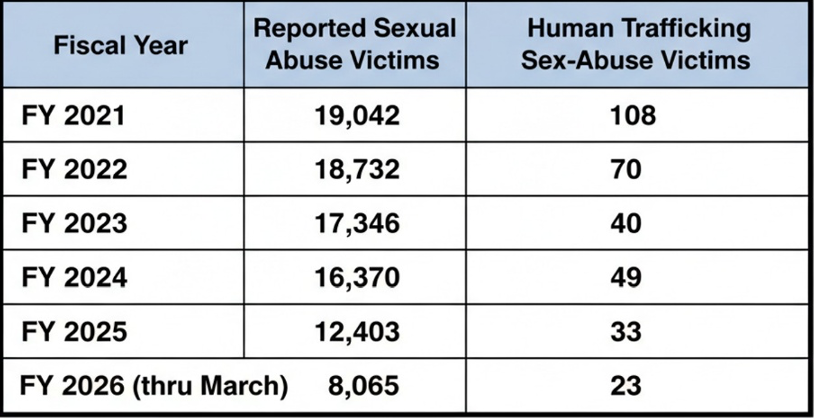
Between FY 2021 and FY 2025, reported child sexual-abuse victims fell by 35 percent. Human-trafficking sexual-abuse victim reports fell from 108 to 33 — a 70 percent decline — with the steepest drop occurring immediately after the June 2022 parental-notification repeal took effect and the 2023 shield law was enacted.
2023 shield law was enacted.
The rate at which reported abuse was subsequently indicated — meaning credible evidence was found — remained flat at roughly 20–24 percent across the same period. That is a critical detail. A genuine decline in abuse would reduce both the number of reports and the number of substantiated cases. The indicated rate would fall. Here, the indicated rate held while the number of reports collapsed. That pattern is more consistent with a reporting collapse than with a real decline in abuse.
Four defenses will be offered. The available data do not support them.
“Child sexual abuse is decreasing.” If it were, the indicated-victim rate would have dropped. It did not. Fewer reports were filed; the same proportion of those filed was confirmed.
“Better prevention explains the drop.” Illinois did not launch a new prevention program in June 2022. It repealed parental notification, so the policy went in the opposite direction.
“DCFS changed its methodology.” DCFS’s Six-Year Statistics document uses consistent intake coding throughout the period. What changed in June 2023 was IDPH, which stopped publishing county-level abortion data and non-Illinois-resident home-state breakdowns. That eliminated the only public cross-reference available to investigators. It did not change how DCFS codes its reports.
“Other mandated reporters account for the drop.” DCFS aggregates reports from everyone — teachers, pediatricians, emergency-room staff, police, social workers, counselors, and abortion-clinic personnel. Those groups did not shrink in 2022. School enrollment, pediatric practice volume, emergency room traffic, and police activity all remained within normal ranges. The category that saw a 4.4-fold surge in out-of-state pregnant-minor patients was abortion clinics — the one category added to the reporting chain by Illinois’s policy changes.
The surge and the collapse are happening simultaneously in the same state, along exactly the axis the statutes created.
Illinois’ Abused and Neglected Child Reporting Act, 325 ILCS 5/4, identifies abortion-clinic personnel with more statutory precision than most other professions on the mandated-reporter list:
“any physician, physician assistant, registered nurse, licensed practical nurse, medical technician, certified nursing assistant, licensed social worker, licensed clinical social worker, or licensed professional counselor of any office, clinic, or any other physical location that provides abortions, abortion referrals, or contraceptives.”
The reporting threshold is “reasonable cause to believe” that a child known to them may be abused or neglected.
Illinois’ age of consent is seventeen. A pregnancy in a patient under seventeen is, by statutory definition, the product of sexual contact to which she could not lawfully consent. For a thirteen-year-old or eleven-year-old, the abuse concern is obvious; even for an older minor, pregnancy presents reasonable grounds to suspect abuse, coercion, or exploitation and therefore triggers the reporting duty. This means the reporting trigger is satisfied the moment she walks in the door.
The report is owed to law enforcement as a criminal offense—possibly a felony, but at least a misdemeanor sex offense. If not to law enforcement, where such reports of suspected crimes should be made, it must be made to DCFS.
With more than 2,000 abortions involving minors annually, a compliant mandated-reporter network operating inside Illinois abortion facilities should result in hundreds of referrals to police or DCFS each year. There is no public evidence that such reports exist at any scale. No DCFS press release. No annual-report line item. No claim from any advocacy organization. No peer-reviewed study documenting it. The record is silent.
If Planned Parenthood Illinois were generating hundreds of mandated reports annually about abused minors, it would say so. It is not shy about claiming credit for its public-health role. It has said nothing.
The silence is its own kind of evidence.
Illinois is not operating in isolation. The documented record of abortion-provider noncompliance with mandated-reporting laws spans two decades and seven states, and appears in peer-reviewed journals, state health inspections, congressional testimony, and sworn depositions.
Pennsylvania, 2013. State Department of Health inspectors at a Planned Parenthood facility in Philadelphia found that at least six minor patients had disclosed sexual activity beginning at ages eleven and twelve. Clinic staff neither inquired about possible abuse nor filed the mandated reports required by Pennsylvania law. This is from a state government inspection.
Loyola University Chicago, 2014. The Beazley Institute for Health Law and Policy published a peer-reviewed study on the health consequences of sex trafficking. It found that Planned Parenthood was the most-visited clinical facility for trafficking victims after hospital emergency rooms. Survivors reported being taken there “because they didn’t ask any questions.” This is not a conservative think tank. It is a Jesuit university in the state whose Senate is about to vote on HB 5295.
Iowa, sworn testimony. Sue Thayer, a former Planned Parenthood clinic manager in Iowa, testified under oath that employees were “discouraged” from reporting suspected abuse and were told,
“No, that is not reportable. You don’t need to call it in.”
Texas, internal training. A former manager in Texas testified that after Live Action‘s 2011 undercover footage compelled the organization to pledge staff training on abuse indicators publicly, the training she actually received focused on how to detect whether a clinic was being filmed.
Congress, 2018. Fifty-four members of the U.S. House and two U.S. senators wrote to HHS requesting an investigation into Planned Parenthood for:
“routinely performing abortions on children as young as 12 and 13 years old and then returning the children to their abusers without notifying authorities.”
Alliance Defending Freedom. ADF compiled adjudicated court cases — not undercover footage — that document Planned Parenthood performing abortions on sexually abused minors and failing to report across seven states.
Peer-reviewed literature. Maureen Kenny‘s 2004 study in Child Abuse & Neglect and its subsequent replications established that medical providers systematically underreport suspected child abuse relative to the “reasonable cause” statutory threshold — a standard of near-certainty that providers set for themselves. Reproductive health providers fall into the lowest compliance tiers.
Twenty years. Multiple states. State inspections. Court records. Congressional testimony. Academic literature. This is a pattern.
It’s clear that when a pregnant minor walks into an abortion clinic, the mandated-reporting duty is often not fulfilled.
Illinois has not investigated its clinics for this.
HB 5295 would make it nearly impossible to investigate after the fact because the electronic records required for any retrospective review would be firewalled and blocked from out-of-state access.
The sponsors present HB 5295 as protection for adult women against hostile red-state prosecutors. That argument collapses under scrutiny.
First, every state with a post-Dobbs abortion ban exempts the pregnant woman from criminal liability. The laws apply to the provider, not the patient. HB 5295 does not address a flood of women being prosecuted.
Second, the constitutional right to interstate travel forecloses prosecution of a woman for traveling to Illinois for lawful care. Justice Kavanaugh made this explicit in his Dobbs concurrence:
“May a State bar a resident of that State from traveling to another State to obtain an abortion? In my view, the answer is no based on the constitutional right to interstate travel.”
State-level attempts to reach women who traveled for lawful abortions, or the helpers who assisted them, have fared poorly in court.
Third, the 2023 Patient and Provider Protection Act already did the heavy lifting. It denies out-of-state governments the cooperation of Illinois courts, police, and agencies. It protects adult women from extradition, employer subpoenas, and civil bounty-hunter suits. Her privacy is already protected by law.
HB 5295 adds nothing to the protection of adult women beyond what was already in place. What it uniquely adds is the blocking of electronic records transfers — and the patient for whom that records pathway is most critical is not a thirty-year-old adult exercising private choice. It is the trafficked thirteen-year-old whose home-state child-welfare worker might have found her through a routine records query. The “protecting women” argument is being deployed to justify a bill whose real effect falls on exploited minors.
So, what is the purpose of this bill?
This is not the work of inexperienced legislators.
- Rep. Mary Beth Canty, the chief sponsor, holds a J.D. from the University of Arizona and practices complex civil litigation. She understands statutory interpretation.
- Rep. Robyn Gabel, the Majority Leader and co-sponsor, spent 22 years as Executive Director of the Illinois Maternal and Child Health Coalition. Her command of Illinois maternal and child health law exceeds that of nearly any sitting legislator.
- Rep. Kelly Cassidy, Assistant Majority Leader and co-sponsor, was the chief sponsor of HB 40 in 2017 and drove the 2021 repeal of parental notification. She is the most knowledgeable legislator in the House on Illinois abortion statutes.
- Speaker Emanuel “Chris” Welch chairs the House Reproductive Health Working Group, which shaped this agenda and took the rare step of voting for HB 5295 on the floor.
Between them, they had every tool needed to chart the five-layer system and see what it does to a trafficked minor. At the only House committee hearing, public opposition was 13 to 1: 263 opponents, 19 proponents. The committee advanced the bill 9–4 on the same day. The House passed it on a straight party-line vote.
The sponsors had three procedural opportunities to carve out minors: at the bill’s introduction, during the drafting of House Floor Amendment #1, and on the floor. None were taken. The Governor’s office, Personal PAC, and Planned Parenthood Illinois Action all publicly framed the bill as protecting “patients” from hostile governments, without once acknowledging that the same design blocks parents, child-protection workers, and trafficking investigators from learning what happened to a minor child.
The intent to shield adult abortion records is explicit in their rhetoric. But the bill’s design has the effect of shielding child predators. Across three procedural opportunities, the failure to separate the two was either a missed opportunity or intentional.
If this bill is not intended to shield abusers, why refuse an amendment to protect minors?
If you believe adult women should be protected from hostile prosecution for seeking lawful care, the 2023 shield law already answered that concern. You don’t need HB 5295 to protect those women.
What HB 5295 does that the shield law does not is seal the medical records of trafficked minors and statutory-rape victims from their home-state child-protection agencies, their home-state law enforcement, and the parents who are trying to find them. The privacy interest the sponsors keep invoking belongs to those minors only in the most trivial, nominal sense — and it is “privacy” that serves predators’ direct material interest in secrecy.
A minor-protection carve-out would not compromise the privacy of any adult Illinois patient. The sponsors had three chances to draft one. Any senator, of any party, who accepts that a thirteen-year-old brought across state lines by her abuser should not be treated the same as a thirty-year-old exercising private choice can vote no on HB 5295 without abandoning any other commitment to abortion rights.
Before any committee vote, three things should be done by the Senate:
1.) Subpoena the DCFS reporter-type breakdown. DCFS codes reporter type at intake. The data on how many mandated reports were filed by abortion-facility personnel in FY 2021–2026 exists. Demand it. If Illinois abortion providers are reporting at the rate their patient volume implies, HB 5295’s proponents should be eager to prove it. They have not. The Senate should not vote without that number in the record.
2.) Require IDPH to explain the June 2023 data change. The Illinois Department of Public Health stopped publishing county-level abortion data and non-Illinois-resident home-state breakdowns in June 2023, citing “patient privacy.” There is no privacy interest in concealing which Indiana county her abuser drove her from. That change was made for a reason. The Senate should hear that reason in open session before adding another layer of concealment.
3.) Attach a minor-protection amendment before any floor vote. HB 5295 should not leave the Senate committee without a carve-out that preserves access for child-protection agencies, law enforcement in abuse investigations, and parents for minors. If the sponsors oppose that amendment, they will have said, on a roll call, what they intend the bill to do.
HB 5295 does not create the predator-protection problem. It extends, consolidates, and seals it — ensuring that after July 1, 2027, that effect will be undetectable and uncorrectable through any outside records pathway that does not originate with the patient herself.
That is, with the thirteen-year-old whose abuser drove her to Illinois in the first place.
The stated purpose is to protect the abortion records of adults. The bill does little to advance that purpose. Instead, it further shields predators, extending the shield our legislators provided to Illinois predators in the 2021 act to predators from other states, even other countries.
Rep. Canty and her co-sponsors had the legal expertise to see that this would be the outcome. Did they not look? Was it willful blindness? Was it indifference? I don’t know.
What I do know is that Illinois has chosen to become a sanctuary for abortion.
The Senate is about to decide exactly who that sanctuary is for. Adult women seeking lawful care? Or the men who count on secrecy after exploiting a child?
I would prefer that all five of these bills be repealed.
At the very least, HB 5295 should be defeated in the Senate. Click HERE to contact your state senator and urge a NO vote on HB 5295. Tell your friends and enlist their involvement to oppose it as well.

Don’t wait.