
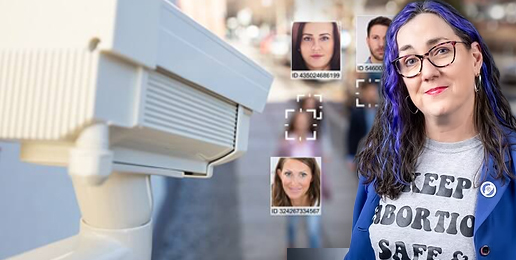
The “cloak of anonymity” offered by modern city life is a privilege the nineteenth-century citizen never experienced—and one that the modern criminal exploits with deadly efficiency. On February 6, 2026, State Representative Kelly Cassidy (D-Chicago) introduced House Bill 5521, the Illinois Biometric Surveillance Act. The bill is set to have its first committee hearing before the House Judiciary–Civil Committee on Wednesday, March 25. While presented as a safeguard for civil liberties, the legislation could strip Illinois law enforcement of the essential tools needed to restore the “watchful neighbor” in our increasingly anonymous urban environment.
Facial recognition technology has already proven itself to be an essential investigative tool—not a replacement for detective work, but a force multiplier for it. The question before the Judiciary–Civil Committee is not whether Illinois values privacy. It is whether Illinois will abandon victims of violent crime in the name of a principle that can be protected through regulation rather than prohibition.
HB 5521 proposes a near-total prohibition on law enforcement’s use of biometric identification systems.
The bill broadly defines “biometric identification system” as any combination of hardware, software, or tools used to obtain, process, store, compare, or otherwise handle biometric identifiers—such as retina or iris scans, fingerprints, voiceprints, and scans of hand or face geometry. The scope of that definition cannot be overstated.
Take ACTION: Click HERE to file a witness slip in OPPOSITION to HB 5521.
More ACTION: Click HERE to send your state representative a message urging him/her to VOTE NO to HB 5521 when it comes up for a vote. Ask your representative to protect both public safety and civil liberties by supporting reasonable regulations — not an outright ban on tools that help identify violent offenders.

Background
Under the proposed Act, no law enforcement agency in Illinois can obtain, retain, possess, access, request, or use a biometric identification system. Nor can any agency agree with a third party, another state, or local government entity, or any federal agency to do so. The bill only allows very limited exceptions: fingerprinting during an arrest or conviction, collecting forensic evidence at a crime scene, and an officer’s use of a personal or work device to verify his or her own identity for authentication purposes.
Critically, the bill would amend both the Illinois Identification Card Act and the Illinois Vehicle Code to prevent the Secretary of State from providing facial-recognition search services to any outside government agency or third party. The Secretary could only use facial recognition narrowly, such as when verifying a person’s identity during the issuance of a mobile driver’s license or ID card. This effectively closes off one of the most useful investigative databases for Illinois police: the Secretary of State’s collection of state ID and driver’s license photos.
The enforcement mechanism is rigorous. Any violation of the Act would constitute a legally cognizable injury, thereby enabling a private right of action. Prevailing plaintiffs could recover $1,000 for each negligent violation or $5,000 for each intentional or reckless violation, plus attorney’s fees and costs. The Illinois Attorney General would have the independent authority to initiate or intervene in civil lawsuits against agencies believed to be violating the law. For smaller municipal police departments with limited budgets, the total potential liability could be devastating.
What the bill notably omits is just as revealing. DNA—the ultimate biometric identifier—is not mentioned at all. This omission raises the question: if the sponsor supports using DNA evidence to identify and convict violent offenders, on what logical basis does she oppose facial recognition technology that provides the same kind of support?
Debates about surveillance technology may lead to interesting theoretical discussions. But in the streets of Chicago, or anywhere else in the real world, the real question is: would these crimes have been solved without facial recognition?
The Murder of Dominique Pollion. In January 2026, 37-year-old Dominique Pollion was stabbed to death, and his body was left on a Blue Line train in the Loop. Detectives uploaded high-quality CTA surveillance images into the Secretary of State’s database of state ID and driver’s license photos. The system returned possible matches, including 21-year-old Demetrius Thurman. The facial recognition result was not the end of the investigation—it was the start. Investigators later recovered video from Thurman’s own phone, allegedly showing him committing the crime. Under HB 5521, detectives would not have had any lawful way to generate that initial lead.
The Pink Line Christmas Shooting. Two days before Christmas 2025, someone shot and killed 44-year-old Raymond Harrison during an altercation aboard a Pink Line train near Washington–Wells. A second person was also shot. CTA cameras captured the sequence: a knife appeared, then a gun was drawn, dropped, picked up, and used to shoot both victims. Detectives reviewed the surveillance footage with facial recognition software, which identified Pedro Villareal as a possible suspect. The surviving victim later recognized Villareal from a photo lineup. Multiple officers and civilians also identified him from surveillance images. Days later, Cicero police arrested Villareal and allegedly recovered a .380 caliber handgun from a bag he was carrying—tests confirmed it was the murder weapon. Villareal is awaiting trial. Without facial recognition, the initial identification of a stranger in a crowd of millions would have relied solely on chance.
The Hunt for Walter Yovany-Gomez. In May 2011, Walter Yovany-Gomez, a member of the MS-13 street gang in Plainfield, New Jersey, took part in the murder of a fellow gang member. When local police closed in a month later, Gomez jumped out a second-story window and disappeared. Federal prosecutors indicted more than a dozen members of the Plainfield MS-13 clique for racketeering, murder, and related offenses.
By the end of 2016, all defendants had been apprehended and convicted—except Gomez. In April 2017, the FBI added him to its Ten Most Wanted Fugitives list with a $100,000 reward. Months later, the Bureau received a tip.
Agents at the FBI’s Washington Field Office used facial recognition technology to match images linked to the tip to Gomez, who had changed his appearance and was living under a false identity in Northern Virginia. Confirming the match through traditional surveillance and investigative methods, agents arrested Gomez in a gym parking lot in August 2017. He was then transferred to New Jersey, where he pleaded guilty to racketeering conspiracy and admitted to the murder.
The case, reported in detail by NPR, demonstrates the technology at its best: a dangerous fugitive who had avoided capture for six years, identified through facial recognition and caught only after traditional investigative work confirmed the lead.
Operation ICMEC: 110 Child Victims Identified. In March 2024, the International Centre for Missing & Exploited Children, working with Homeland Security Investigations and law enforcement agencies from ten Latin American countries, carried out an international operation targeting previously unidentified victims of online child sexual exploitation. Over one week, investigators examined 2,198 photographs and 995 videos from 74 confiscated devices—all containing child sexual abuse material in which neither the victims nor the offenders had been identified.
Using facial recognition technology as the primary identification tool, the operation resulted in the identification of 110 previously unknown child victims, the arrest of 8 perpetrators, and the rescue of 51 children. ICMEC reported the results in an official press release dated July 2, 2024. For anyone who has worked on child exploitation cases, the significance of those numbers requires no explanation.
Each of those 110 identifications represents a child whose abuse had been documented, distributed, and consumed—whose identity was unknown to law enforcement until facial recognition technology uncovered the case. Under the restrictions imposed by HB 5521, that tool would be unavailable to American investigators involved in these kinds of international operations.
Miami: 450 Searches Annually, Multiple Murders Solved. The Miami Police Department provides a case study of how regulated, institutionalized facial recognition is used in practice. In 2023, Assistant Chief of Police Armando Aguilar publicly stated that his department’s investigators used Clearview AI’s facial recognition platform about 450 times each year, and that the technology helped resolve several murder cases. Importantly, Aguilar stressed that Miami detectives do not make arrests based solely on facial-recognition matches. The department considers every match only an investigative lead that must be confirmed through traditional investigative methods before any arrest occurs. This distinction—lead generation versus definitive identification—serves as the boundary that separates responsible use from misuse, as highlighted by wrongful-arrest cases cited by civil liberties groups.
Miami’s approach shows that the choice isn’t between banning the technology and unchecked surveillance. It’s between responsible use and not using it at all. HB 5521 would force every law enforcement agency in Illinois to abstain.
The deepest irony of HB 5521 lies in the career of its sponsor. Representative Kelly Cassidy is familiar with the complexities of the justice system. Before her 2011 appointment to the Illinois House, she spent a decade as the Director of Programs and Development for the Cook County State’s Attorney’s Office. In that role, she managed about $20 million in grant funding. She helped develop programs addressing domestic violence, hate crimes, human trafficking, and—most notably—the increased use of DNA evidence to solve crimes.
Cassidy has developed an impressive legislative record in support of crime victims. She sponsored Karina’s Law, which enhances protections for domestic violence survivors by allowing courts to remove firearms from dangerous individuals who have protective orders against them. She also championed legislation that permits incarcerated survivors of gender-based violence, whose abuse was not considered at trial, to seek resentencing. In October 2025, she received the Legacy Award from The Network: Advocating Against Domestic Violence for her advocacy on behalf of survivors.
Her legislative philosophy, by her own account, is captured in the motto “nothing for us without us”—a commitment to including stakeholders in policy design. Yet HB 5521 seems to exclude the most important stakeholders of all: the victims of violent crimes committed by anonymous offenders. The families of Dominique Pollion and Raymond Harrison, the woman kidnapped at gunpoint in Wrigleyville, the riders assaulted on CTA trains—these are the people whose interests the bill fails to consider.
The inconsistency in reasoning is hard to understand. If Representative Cassidy supported expanding the use of DNA evidence at the State’s Attorney’s Office—and since DNA is the most invasive biometric identifier available, capable of revealing ancestry, health risks, and family connections—on what logical grounds does she now seek to ban facial recognition, which compares one photograph to another and reveals nothing beyond a potential visual similarity? DNA evidence and facial recognition serve similar supporting roles in criminal investigations. Moreover, you can’t compare DNA samples unless you have a suspect to compare the samples. The former is accepted; the latter, under HB 5521, would be banned.
Intellectual honesty requires recognizing that the civil liberties issues motivating this legislation are legitimate. The cases of wrongful arrests due to facial recognition misidentification—disproportionately impacting Black Americans—are concerning. Research from the National Institute of Standards and Technology has revealed that some facial recognition algorithms have significantly higher false positive rates for individuals with darker skin tones. At least seven confirmed misidentification cases have led to wrongful arrests nationwide, six of which involved Black individuals.
These failures are serious.
But these are failures of implementation and oversight, not inherent flaws in the use of technology to generate investigative leads. All the documented wrongful arrest cases involved officers who treated a facial recognition match as definitive rather than investigative, failing to verify the lead with independent evidence before arresting. The issue in those cases was not the software; it was the neglect of essential detective work.
We do not ban surgical tools because of medical malpractice; we raise the standards for surgeons. We do not eliminate forensic laboratories because of contaminated samples; we impose quality controls and accreditation requirements. The appropriate response to misuse of investigative technology is regulation, training, and accountability—not prohibition.
The opposition to this bill isn’t about tracking citizens or creating a surveillance state. It’s about recognizing a simple truth: our communities have become so large that the traditional “beat cop” can no longer know every face.
In the nineteenth century, a stranger in a small town was noticed immediately. The social fabric itself acted as an informal identification system. Today, a killer can board a CTA train, commit a murder in full view of surveillance cameras, and disappear into a metropolitan area of nearly ten million people. Facial recognition technology is not an unfamiliar intrusion into private life. It is a digital revival of the community awareness that urbanization destroyed. It gives detectives a better chance to identify the stranger who just committed a violent act and walked away.
Instead of a complete ban, Illinois should develop a regulatory framework that safeguards civil liberties while maintaining public safety. Such a framework could include:
Required Forgetfulness. Mandate that the biometric data of any person not identified as a suspect or a witness in an active investigation be purged within 24 to 48 hours. This prevents the accumulation of mass surveillance databases while preserving the tool’s investigative utility.
Mandatory Corroboration. Codify what responsible departments already practice: that no arrest may be predicated solely on a facial recognition match. Require at least one independent form of corroborating evidence—a victim identification, physical evidence, witness testimony, or digital forensics—before an arrest can proceed.
Transparency and Audit. Require annual public reporting on the number of facial recognition searches conducted, the demographics of individuals searched, the rate of confirmed matches, and any complaints or findings of misidentification. Subject the process to periodic independent audit.
Training and Certification. Require that only officers who have completed certified training on the capabilities, limitations, and civil liberties implications of facial recognition technology be authorized to request or interpret searches.
This approach is neither new nor untested. The Detroit Police Department, following its own wrongful-arrest cases, adopted many of these safeguards as part of a landmark settlement. The question isn’t whether such a framework is possible. It’s whether Illinois lawmakers have the will to create one.
As the Judiciary–Civil Committee meets this week, its members must decide whether Illinois will prioritize the absolute “right to be a stranger” over the right of violent crime victims to see their attackers identified and held accountable. That is the real choice in HB 5521. It is not a dilemma between privacy and no privacy, but a choice between sensible regulation and complete prohibition.
Representative Cassidy’s career shows she understands the complexities of victim services and the justice system. Her work at the Cook County State’s Attorney’s Office, her advocacy for DNA evidence, her sponsorship of Karina’s Law, and her recognition by domestic violence organizations all demonstrate a genuine commitment to protecting vulnerable people. HB 5521 goes against that record. It removes a proven investigative tool from detectives working on cases that Cassidy’s career has been dedicated to solving.
We should ask Representative Cassidy to leverage her expertise in victim services to help create a regulatory framework that protects our biometric data while making sure no criminal can ever truly be a “stranger” to the law.
Illinois does not need a ban. It needs a standard.