It’s been 10 years since we all saw the photo of the White House lit up in rainbow colors.
I remember how appalled I was at the U.S. Supreme Court’s 2015 decision in Obergefell v. Hodges, which overturned thousands of years of our legal and cultural heritage respecting God’s design for marriage. For as long as our civilization can remember—that is, Genesis chapter 1—a man has been designed to become one flesh with his wife.
But once we decided to all change our minds, we began hurtling down the path to a new normal.
Last June, a survey produced by three polling groups found that (when given no neutral option) 72% of Americans either strongly or somewhat agree that same-sex “couples” should have the “right to marry.”
When the poll gave the option to remain neutral on the issue, 61% of Americans still said the same thing.
So look around you the next time you’re out around town. By these numbers, the next person you meet on the sidewalk is more likely than not to think that a man and a man have a right to “get married.”
Even within the political camp that we hope would more strongly uphold God’s design, the lies are wreaking havoc.
According to the study, 51% of Republicans now support the Respect for Marriage Act, which codified same-sex so-called “marriages” on the federal level.
One quick note before we proceed. Like all attempts to survey popular opinion, this study cannot claim to tell the whole story. For example, a recent Gallup poll reported that only 41% of Republicans think that the law should recognize same-sex partnerships as so-called “marriages.”
Yet, we can still speak to the fundamental trends identified in these polls, because we know they are at least present in America, even if the numbers are debated. Even if you take the numbers with a grain of salt, take the trends seriously.
One of the most serious trends I see in this data is that homosexuality is not just here. Homosexuality is becoming normal. The poll reports that a sobering number of Americans (about 7 out of 10) are “satisfied with the legal status” of same-sex partnerships in America today.
The June poll reports that it has been particularly persuasive when advocates refer to same-sex “marriage” as a settled issue. For example,
“It has been legal for 10 years and it is time to move on.” (p. 20)
Now, it’s one thing for people to believe that their side of an issue is correct. It’s another thing to believe that the issue itself is settled. When this happens, people are less likely to even take opposing views seriously anymore:
“C’mon guys, didn’t we already decide this?”
Christian truth often has the high ground in a sense—after all, Scripture accurately describes the truths imprinted on man’s conscience. Thus, the truth gets extra persuasive power from that inward witness inside each of us.
But when a sinful position is entrenched as a “settled issue,” everyone now gets an excuse to stop listening to that inward witness!
“We already decided it, and I’m not listening anymore.”
And then Christian truth must fight an uphill battle to even be taken seriously in the first place.
There’s another important lesson to learn from this poll. It also asked people how their views have changed over their lifetime. For most (57%), their views are the same as before. But among those whose views have changed, over twice the number of people have become more supportive of homosexuality compared to the number of people who have become more opposed.
Among those who were susceptible to persuasion, homosexuality has been more than twice as persuasive as God’s truth.
For those who have become more supportive, some of the top reasons were “social change and acceptance” and “personal experience.” Interactions with same-sex “couples” (friends, neighbors, etc.) have prompted people to agree more than before.
Unsurprisingly, religious beliefs are one of the top reasons why others have changed to become more opposed. So the poll sums it up this way:
“More supportive through more exposure; more opposed primarily driven by religion.”
Here’s the key takeaway: when we allow something to be present in society, it will automatically become a more normal part of society.
Culture, laws, and institutions all have a role in teaching us what is acceptable. Homosexuality was shocking not too long ago. Now, it’s becoming shocking to oppose it. The cultural affirmations of Christian truth are withering away and being replaced by lies.
Never give up on the culture war. Culture is one of the primary ways we teach the people around us what is good and true. It should never be divorced from our religious beliefs, which are the source of what is good and true.
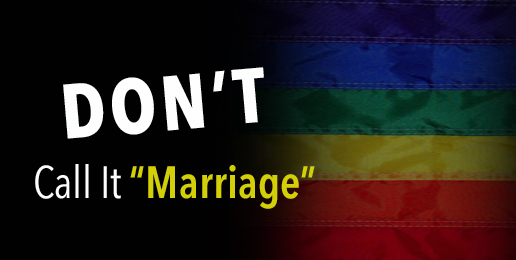
So then, are you ready for a challenge? Here’s a habit I’ve been working on: Don’t call it “marriage.”
“Gay marriage” does not exist.
There’s a reason I’ve put it in quotes every time I’ve used the term in this article. This is because two men cannot get “married.”
Marriage is, by definition, between one man and one woman. It is not “a general category for various romantic relationships, of which man-woman pairs are merely one option.”
Saying “gay marriage” is like saying “dry water.”
Why does it matter so much whether you use this word correctly? Because vocabulary is a critical part of culture.
When something is very strange, there’s a reason we might say “I don’t have a word for it.” But when a word enters our vocabulary, it is instantly considered more reasonable, familiar, and accepted.
Your words teach the people around you what you believe.
So unless you believe that two men can get “married,” don’t ever call it “gay marriage.”