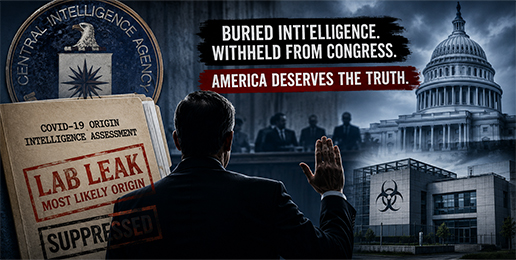
A senior CIA whistleblower told senators last week that U.S. intelligence leaders buried internal reports identifying a laboratory leak as the most likely origin of COVID-19. His account is driving new calls on Capitol Hill for a Church Committee-style investigation into the intelligence community’s power, secrecy, and lack of  accountability.
Testifying under subpoena before the U.S. Senate Homeland Security and Governmental Affairs Committee, longtime CIA operations officer James E. Erdman III said analysts inside the agency and across the broader intelligence community concluded again and again, between 2021 and 2023, that a lab leak best fit the evidence. Those findings, he said, “never shaped the official narrative.” They were kept from Congress and the public.
For lawmakers already skeptical of the government’s pandemic response, Erdman’s testimony offers something the COVID-19 debate has been missing. He provides an insider account that intelligence was reshaped to dodge any finding that might point to U.S. shared blame, and that no senior officials have paid a price. The question, he says, was not what the agencies knew. It was what they chose not to admit.
In the early days of the outbreak, Beijing tried to shift the blame by suggesting the virus might have started in the United States. At the same time, Chinese officials cut off access to key data and sites in Wuhan. Most Americans did not know that U.S. agencies under Dr. Anthony Fauci had helped pay for gain-of-function and related coronavirus research with Wuhan-based scientists. That gave U.S. officials a stake in the answer they were now asked to judge. The funding ties did not prove a lab accident. They did raise the stakes on any finding that SARS-CoV-2 may have escaped from work funded by American tax dollars. That is the shared blame, Erdman says, senior officials wanted to keep off the books.
On paper, Washington had learned its lesson about dangerous virology after 2014, when the government announced a pause on funding certain gain-of-function experiments that could turn ordinary viruses into pandemic threats. The pause was not a clean break. In 2017, it was quietly replaced by a review framework that allowed officials to decide, behind closed doors, which projects were “too risky” and which were not. By narrowing the official definition of “gain-of-function” and routing money through groups like EcoHealth Alliance, NIH could keep backing Wuhan-linked coronavirus research and still say it followed the rules.
That is how Fauci could tell Congress that U.S. agencies had not funded gain-of-function research in Wuhan, even though American tax dollars helped pay for experiments that altered bat coronaviruses and tested whether they could infect human cells and animals. Years later, NIH leaders admitted that some of those experiments do fit what most people would call gain-of-function. That admission sharpens Erdman’s broader point. When the same small group of insiders controls both the definitions and the oversight, risky research can keep going in the shadows long after the public has been told it was banned.
Erdman told senators that CIA technical staff passed around internal papers as early as 2020, saying the facts were “consistent with a lab leak.” Those early papers, he said, did not claim hard proof. They leaned toward a lab origin based on the virus’s features, available reporting on work at the Wuhan Institute of Virology, and other classified clues.
By August 12, 2021, Erdman said, the agency was close to publishing language stating that a lab leak was the most likely origin of COVID-19. Within days, he testified, that language was gone. The CIA shifted to a “no conclusive judgment” line, treating the question as unsettled. No new intelligence had come in to justify the change, Erdman told the panel, and there is no written record of who ordered it or why.
The whistleblower described a later “COVID re-look” in 2022 and 2023. Ten CIA analysts (seven of them scientific or technical experts) were asked to start over on the origin question. He said eight of the ten chose a lab-leak conclusion. Only two backed a natural-origin answer. When their work reached senior managers, it was rewritten again. The final agency line went back to a neutral claim that “we may never precisely know the origins of SARS-CoV-2.” That wording, Erdman said, reflected what the bosses wanted, not where the evidence pointed.
Erdman rejected the widely repeated claim that CIA analysts had been bribed to change their views. He called the charge wrong and unfair to those involved. The real problem, he said, was built into the system. Analysts knew that certain conclusions would cause political and diplomatic trouble. Managers stepped in to keep those conclusions from becoming the agency’s official line. The result was not a true “no consensus.” It was a fog the bosses created on purpose, one that protected them and left the public and Congress in the dark.
The whistleblower also described what he called a “closed loop” of scientists, grant-makers, and intelligence officials whose overlapping jobs and funding ties created deep conflicts of interest in the COVID-19 origin debate. Instead of drawing on a wide, independent group of experts, he said, the intelligence community kept going back to a small circle of advisers who had their own money and careers tied up in the very research a lab leak would put under a microscope.
Erdman paid special attention to the Biological Sciences Expert Group, an advisory panel under the Office of the Director of National Intelligence that provides scientific advice on biological threats. Members of that group, he said, included outside researchers who had received large U.S. grants for gain-of-function coronavirus experiments and had worked with the Wuhan Institute of Virology. Yet those same scientists were asked whether a lab accident in Wuhan could have caused the pandemic.
That meant some of the people asked to judge whether a lab leak was likely had a personal stake in the answer, Erdman said, and those conflicts were never fully shared with Congress or the public. The conflicts alone, he said, should have made officials and reporters far more careful before treating any pushback against the lab-leak theory as neutral science.
He also pointed to the influential “Proximal Origin” paper, published in early 2020. It argued strongly against a lab origin and was quickly used to dismiss lab-leak concerns. Erdman noted that at least one of its authors privately raised lab-origin concerns before publicly backing a natural-origin theory, and later received a $9 million grant from Fauci’s agency. He did not call the grant a quid pro quo. He did call the sequence one more sign of a system in which money, access, and public messaging traveled in the same small circle.
Erdman told senators that Fauci played a quiet but powerful role in deciding which experts the National Intelligence Council would hear from on the origins of COVID-19, even as Fauci publicly called the lab-leak idea a conspiracy theory. Some intelligence officials, he said, warned against leaning so heavily on a man who was both a top policymaker and a possible target of any honest review. Their warnings were brushed aside.
Erdman’s testimony went beyond the origin question. He described an intelligence bureaucracy that fights oversight and shields itself from outside review. From March 2025 to April 2026, he led the Director’s Initiatives Group (DIG) investigation into the origins of COVID-19 and related issues. He told senators he had seen firsthand how hard it was to get people within the system to cooperate.
According to his testimony, the CIA refused to fully comply with lawful congressional oversight requests tied to the DIG investigation. That blocked the Director of National Intelligence from carrying out executive orders meant to tighten oversight of risky biological research. Erdman alleged that CIA officials went so far as to illegally monitor the computers, phones, and communications of DIG staff, including their contacts with whistleblowers. A contractor who helped the group was fired shortly after meeting with investigators, he said.
Erdman also told senators that after his group shut down, the CIA pulled back about 40 boxes of classified JFK and MK Ultra files that had been set for release, reversing earlier plans to make them public. He cited that as an example of how the agency can take material back even after political leaders and the public have been promised more transparency.
On the release of COVID-19 information, Erdman said the government has ignored Congress’s clear intent. A 2023 law, passed without a single “no” vote, ordered the declassification of all information about the Wuhan Institute of Virology and the origins of COVID-19. Instead of thousands of pages of underlying documents, he said, the intelligence community handed over only a heavily redacted five-page summary. In his view, that summary downplayed evidence tying Wuhan lab research to SARS-CoV-2 and denied that any research-related accident could have happened.
Erdman argued that the inspector-general offices within intelligence agencies sit too close to the agencies they are supposed to police and rarely impose real punishment for misconduct. He urged Congress to pull those IG offices out from under direct agency control and place them under an independent intelligence community inspector general, with oversight by the Justice Department and Congress. Without that change, he warned, whistleblowers will remain exposed, and the system will continue rewarding people who go along to get along over those who tell the truth.
In response to Erdman’s testimony, several Republican senators argued that the alleged COVID-19 cover-up points to a deeper problem: the intelligence community uses the classification stamp to keep itself beyond reach. They called for a new, time-limited investigative panel modeled after the 1970s Church Committee, with full subpoena power and the authority to examine intelligence-community conduct beyond the pandemic.
The original Church Committee, chaired by U.S. Senator Frank Church (D-IA), brought a long list of abuses to light at the CIA, FBI, NSA, and other agencies. Those abuses included spying on Americans for their politics, secret propaganda campaigns, and plots to kill foreign leaders. Its work led to major reforms, including the standing intelligence-oversight committees in Congress and new legal limits on spying and covert action.
Supporters of a modern Church Committee argue that the post-9/11 buildup of intelligence powers, the growth of the national-security bureaucracy, and the explosion of digital surveillance tools have all outpaced the rules meant to keep them in check. They say Erdman’s account of buried analysis, punished whistleblowers, and ignored declassification orders shows that the system is once again policing itself in ways that protect itself rather than the truth.
As senators discussed what a new Church Committee should cover, several pointed to the unanswered questions surrounding the Jeffrey Epstein case as a warning about what happens when intelligence-related matters never get a full public airing. Epstein, a financier who died in federal custody in 2019 while facing sex-trafficking charges, had earlier walked away with a controversial non-prosecution deal in Florida. He went on moving in elite political, financial, and academic circles for years despite credible allegations involving underage girls.
Public reporting and released documents have shown that Epstein cooperated with federal authorities in at least one major financial-fraud case. He also took part in questionable arms-related transactions and foreign-policy controversies, including the Iran-Contra affair. He was linked to people in the U.S. and allied intelligence services. Those links have kept alive the question of whether he was ever used, protected, or tolerated as a source or go-between.
Members of Congress have formally asked the Director of National Intelligence for records on Epstein, Ghislaine Maxwell, and any contacts they had with intelligence agencies. The requests have come from both parties. Lawmakers on both sides believe parts of the story are still hidden in classified files. For those now calling for a new Church Committee, the Epstein case and the fight over the origins of COVID-19 tell the same story: powerful institutions closing ranks, victims and ordinary citizens left without answers, and the public told to trust that someone, somewhere, will handle the truth in the end.
Erdman’s testimony is being viewed as more than a fight over pandemic science. It is also a test of whether Congress is willing to take on a national-security system that has gotten used to ducking blame when things go wrong.
Erdman warned that without public hearings, declassified scientific reviews, and real consequences for officials who lie or stall, the intelligence community will continue to lose the public’s trust. He tied that loss of trust to the patterns he had described: analysts whose evidence-based findings get pushed aside, whistleblowers who face payback, and senior officials who rarely pay a price when their stories fall apart.
Supporters of a new Church Committee say Congress now faces a choice. It can treat the CIA whistleblower’s charges as just another partisan fight in the long COVID-19 debate. Or it can use them as a starting point for a wider, honest look at how America’s most secretive agencies have handled the pandemic, the Epstein case, and other questionable activities.
Either path will send a signal. One tells the intelligence community that, once again, the storm will pass and business will go on as usual. The other would pick up where the Church Committee left off and remind powerful institutions that, in a constitutional republic, even the most secretive agencies must, in the end, answer to the people they serve.
Let’s make sure all our elected officials help bring these secrets to light.
For everyone who does evil hates the light and does not come to the light,
lest his works should be exposed. But whoever does what is true comes to the light,
so that it may be clearly seen that his works have been carried out in God.
John 3:20–21
banner