“Even a pawn can take a king …”
Chess players easily recognize that phrase.
But for those not so familiar with pawns, queens, bishops, castles and kings, the pawn is a piece in a chess game that is the least valuable and most expendable. It is considered as a “foot soldier.”
On the other hand, the king is the ultimate piece in chess. Capturing, cornering or eliminating the king allows an opponent to win a game, declaring “Checkmate.”
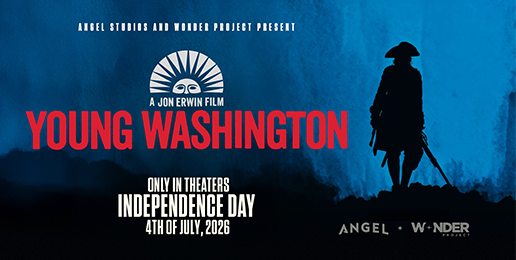
In the new historic film “Young Washington,” released July 3 to celebrate America’s 250th birthday, “pawns taking kings” is the underlying theme.
Take teens and older to see it – especially if you live in an area that has fallen into the hands of state and local officials that despise America and its Founding Fathers.

“Young Washington” will challenge and inspire all ages to high standards of loyalty, bravery, humility and tenacity – marks of an underrated pawn that eventually achieves greatness.
The film’s cinematography, script, story line and acting are exceptional. They focus upon George Washington’s earliest years – from the time he was a child until he began leading the Virginia Militia during the French and Indian War when he was 22 years old.
Breakthrough actor William Franklyn-Miller plays the part of Washington. He is compelling and believable in the role. Other respected veteran actors such as Ben Kingsley and Kelsey Grammer also play key parts in the film’s screenplay.
“Young Washington’s” writers portrayed a young George who was calmly passionate about his efforts but also stayed focused on the cause of liberty — despite numerous failures, setbacks and challenges. Indeed, he became a national hero and eventually, the first President of the United States.
Overall, the movie reminds us of so many things our current world ignores these days – the value of honorable leadership, sacrifice and commitment. While not perfect, George Washington is a role model badly needed in this world today, making the timing of the film’s release perfect.
There are different opinions about how historically accurate the film is – but history is often told through the eyes of the beholder. Was Washington the hero he is made out to be? What were the man’s core values? What was his motivation for the life paths he chose?
All we know for sure to answer those questions are the public statements made and preserved private correspondence penned by Washington. One of the most personal, heart-revealing letters is one Washington wrote to his wife Martha just after he was appointed as the Continental Army’s Commander-in-Chief.
Nicknamed the “My Dearest” letter, it is one of four surviving exchanges between George and Martha after Martha burned most of their private correspondence after George passed away in 1799.
The “My Dearest” letter starts with an apology:
You may believe me, my dear Patsy, when I assure you, in the most solemn manner that, so far from seeking this appointment, I have used every endeavor in my power to avoid it, not only from my unwillingness to part with you and the family, but from a consciousness of its being a trust too great for my capacity, and that I should enjoy more real happiness in one month with you at home, than I have the most distant prospect of finding abroad, if my stay were to be seven times seven years. But as it has been a kind of destiny, that has thrown me upon this service, I shall hope that my undertaking it is designed to answer some good purpose.
And as to the often-debated general’s view of God, Washington wrote in the same letter:
It was utterly out of my power to refuse this appointment, without exposing my character to such censures, as would have reflected dishonor upon myself, and given pain to my friends. This, I am sure, could not, and ought not, to be pleasing to you, and must have lessened me considerably in my own esteem. I shall rely, therefore, confidently on that Providence, which has heretofore preserved and been bountiful to me, not doubting but that I shall return safe to you in the fall. I shall feel no pain from the toil or the danger of the campaign; my unhappiness will flow from the uneasiness I know you will feel from being left alone.
Washington wrote that he would rely confidently on “that Providence.” In Colonial America, “Providence” meant the belief that an all-knowing, benevolent God actively guides the universe and human affairs.
There’s no doubt that the mistakes Washington made as a young, ambitious soldier and the lessons learned as a result were key in his eventual impact on Colonial America – an infant nation that would still miraculously be alive 250 years later.
The question now becomes who will be the next Washington? Will it be your son or daughter?
Who will be the next “pawn” to take the “powers that be”? Who will stir a nation to rely confidently on Providence and unashamedly be one that is righteous in God’s eyes as it is powerful in the world’s?
Let us commit to raising our own children to be such leaders in the way of the “Young Washington.”