
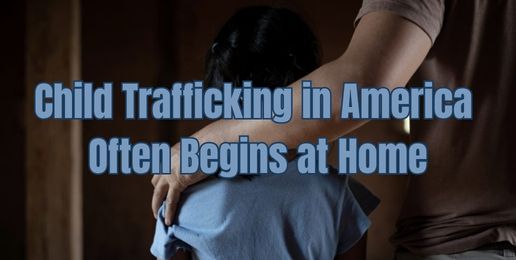
For years, I understood familial child trafficking mostly as a problem of the third world.
In countries without steady work or a safety net, parents sometimes sell a child because they can’t afford to raise one. The buyer usually wants labor for a field, a workshop, a household, or a market stall, and sometimes wants sex. The picture I had was that poverty forces the transaction, the family is the seller, and the buyer is mostly looking for an indentured servant or slave.
That picture is pretty accurate abroad, and the global data shows it.
In the Third World, when a family member is involved in a child’s trafficking, the exploitation is far less likely to be sexual than when no family member is involved — 36 percent versus 84 percent, according to international case records compiled by the Counter-Trafficking Data Collaborative (IOM).
Families abroad more often sell their children for labor, domestic servitude, begging, or early marriage. India’s bonded-labor households, Benin’s practice of sending children to wealthier families for work, Haiti’s restavèk children, and Nigeria’s informal placements and forced begging — these are labor pathways first.
While my understanding of trafficking in the Third World was accurate, I was wrong about my own country.
I knew that familial trafficking occurred in the United States. I have written about two such cases myself and know of many more. What I underestimated was its scale and its form.
Here, the family does not primarily sell a child into labor.
Here, the family most often sells sexual access to the child and frequently records it.
There is no national estimate of how many American children are trafficked by their own families. The Justice Department’s Bureau of Justice Statistics cannot provide a prevalence figure; there are no federal national estimates of the broader problem (DOJ 2023; BJS 2024; OJJDP). Any number you’ve seen published is a guess.
What we have instead is encounter data — the cases that reach an institution and are counted. In every system that records who the trafficker was, family members account for a large share. A national survey of justice professionals attributed 26 percent of child sex-trafficking cases to a family member (Allert 2022).
The National Human Trafficking Hotline found that a family member or caregiver was the recruiter for a third of victims with a known recruiter and for closer to 44 percent of sex-trafficking cases (Polaris 2021). A Kentucky child-welfare study identified family-controlled cases in nearly 60 percent of its child trafficking allegations (Edwards, Middleton & Cole 2022). A police-contact study put the family-and-acquaintance share at 12 percent — the low end.
There is a reason for the differences.
The figures disagree because each is viewed through a different lens. Child protective services investigates families, so the family share it sees is high. Arrest data captures street activity, so the family share it sees is low. The spread from 12 to 60 percent is not five measurements of one quantity. It is a photograph of the lens each agency uses.
The spread establishes a floor: even the systems least suited to finding family cases still find them in numbers no one can honestly call rare.
There is another reason the encounter numbers understate the problem. Families who traffic their own children are harder to detect than pimps who traffic strangers. Victims run away far less — 69 percent, compared with 92 percent for children exploited by non-family (COPS 2024).
They stay in school. They are disproportionately rural and homeschooled.
When a case does surface, it is often classified as neglect rather than trafficking, and the child is returned home. Nearly 60 percent of identified familial victims remain in contact with the trafficker after identification because the system most often relies on family reunification (COPS 2024; Sprang and Cole 2018).
A crime that stays within the household, committed against a victim who does not run and does not tell, will always be undercounted. What we can see is toward the lower end of the true figure.
These cases contradict almost every image the word “trafficking” typically evokes.
The most common family perpetrator is not the father. It is the mother — 60 to 65 percent across independent studies that have examined it (Allert 2022; Sprang and Cole 2018). The most commonly reported medium of exchange is not cash but drugs; caregiver addiction is prevalent in the case files, and the child’s body becomes the currency that buys the next supply (Allert 2022; Sprang and Cole 2018).
The victims are younger.
Familial control often begins years before adolescence, when street trafficking concentrates, with a documented tail extending into early childhood (DOJ 2023; Sprang and Cole 2018). The product is frequently not a live transaction at all but a recording — abuse filmed in the home and sold or traded, which is at once the production of child sexual abuse material and trafficking under federal law (Sprang and Cole 2018; UNC bulletin).
We don’t see this because our detection system is built around a different model: a stranger or a pimp, a runaway, a teenager, a motel, or a city street.
Awareness campaigns teach that model.
Screening tools are written for it, but the familial victim matches none of it.
She or he lives at home, attends school, has never been arrested, and depends on the person selling the child for food and shelter. A State Department fact sheet identifies the belief that does the damage — the assumption that familial trafficking occurs only in poor neighborhoods, poor communities, or poor countries — and ties it directly to failures in prosecution, prevention, and protection (State Department 2021).
In a 2024 fact sheet, the Department quantified the U.S. share, reporting that family members facilitate 44 to 60 percent of identified child trafficking cases in the United States, across labor and sex (State Department 2024).
Nobody can say that familial trafficking is increasing. Reported numbers are rising, but recognition is rising too, and the available data cannot distinguish between the two; the Justice Department says as much (DOJ 2023). No prevalence rate exists.
Here is what the evidence does support. A crime that accounts for a quarter to half of every counted caseload is common.
To reiterate, while in the U.S. familial child trafficking is common, the nature and prevalence of the crime here are not the same as in the Third World. It is different here.
- Abroad, the family that traffics a child is usually selling labor to survive.
- Here, the family that traffics a child is usually selling sex — often to feed an addiction, often to a camera, and usually involving a child too young and too dependent to understand that she is being sold.
For years, I understood the poverty-and-labor model to describe the world I thought existed. It does not describe the world we all live in.
We can’t continue to hold so many stunted views of the problem of child trafficking. I’ve known for years, decades, that no problem can be solved unless you can see it clearly. When we try to solve problems based on false stereotypes, they won’t be solved. Usually, it makes them worse.
One problem that is immediately evident and must be corrected is the failure of our national data systems to provide a place to record that a trafficker was a family member.
- First, we need to include the trafficker’s relationship to the victim in the forms.
- Second, we must create screening tools for the victim who does not run, attends school, is eight or ten years old, and names a parent as the abuser.
- Third, treat reunification as a question rather than a reflex when the home is where the trafficking took place.
- Fourth, train the people positioned to see it.
In one national survey, nearly half of the professionals working these cases had received only five hours of training over four years, and only a quarter had ever received any training specific to familial trafficking (Allert 2022).
A workforce never taught to recognize this crime will continue to see it as something else.
The final task belongs to the general public, especially our churches. A trafficking victim I’ve known for years was actively involved in the church while she was being trafficked. It’s not only her. The church encounters these children in a variety of ways—Sunday schools, food pantries, financial aid, pastoral home visits and counseling, hospitals, and schools.
We have to focus on the crime of child trafficking where it actually happens — not in another country, another income bracket, another kind of family, but inside ordinary homes on ordinary streets, worked by the adults a child is told to trust. The children hardest to reach are those being sold by the very people the system counts on to protect them.
Seeing them clearly is the first thing anyone who wants to help them must do.
There are many resources available to educate yourself.
All it takes is a will to do it.
Are you willing?
Sources
Allert, Jeanne L. (2022). Familial Trafficking Study. Institute for Shelter Care (BCFS). https://bcfstrafficking.org/wp-content/uploads/2024/02/Familial-Trafficking-Study.pdf. Peer-reviewed companion: Allert, Jeanne L. (2022). “Justice Professionals’ Lens on Familial Trafficking Cases.” Criminal Justice Review. https://journals.sagepub.com/doi/10.1177/07340168211024719
Bureau of Justice Statistics (BJS 2024). Human Trafficking Data Collection Activities, 2024. U.S. Department of Justice. https://bjs.ojp.gov/document/htdca24.pdf
COPS Office (2024). Familial human trafficking feature, Community Policing Dispatch (January 2024). U.S. Department of Justice, Office of Community Oriented Policing Services. https://cops.usdoj.gov/html/dispatch/01-2024/familial_trafficking.html
Department of Justice (DOJ 2023). Child Sex Trafficking in the United States (June 2023). https://www.justice.gov/d9/2023-06/child_sex_trafficking_in_the_united_states_2.pdf
Edwards, Emily E., Middleton, Jennifer S., & Cole, Jennifer (2022). “Family-Controlled Trafficking in the United States: Victim Characteristics, System Response, and Case Outcomes.” Journal of Human Trafficking, 10(3), 411–429. https://doi.org/10.1080/23322705.2022.2039866
Henderson, Margaret F. (2022). Human Trafficking by Families. Public Management Bulletin No. 24 (September 2022). UNC School of Government, University of North Carolina at Chapel Hill. https://www.sog.unc.edu/sites/default/files/reports/PMB%2024_Henderson.pdf
International Organization for Migration (IOM) / Counter-Trafficking Data Collaborative (2017). Data Brief: Child Trafficking. https://www.iom.int/resources/data-brief-child-trafficking
Office of Juvenile Justice and Delinquency Prevention (OJJDP). Commercial Sexual Exploitation of Children and Sex Trafficking (literature review). https://ojjdp.ojp.gov/model-programs-guide/literature-reviews/commercial_sexual_exploitation_of_children_and_sex_trafficking.pdf
Polaris Project (2021). Analysis of 2021 Data from the National Human Trafficking Hotline. https://polarisproject.org/wp-content/uploads/2020/07/Polaris-Analysis-of-2021-Data-from-the-National-Human-Trafficking-Hotline.pdf
Sprang, G., & Cole, J. (2018). “Familial Sex Trafficking of Minors: Trafficking Conditions, Clinical Presentation, and System Involvement.” Journal of Family Violence, 33(3), 185–195. https://doi.org/10.1007/s10896-018-9950-y
U.S. Department of State (2021), Office to Monitor and Combat Trafficking in Persons. Navigating the Unique Complexities in Familial Trafficking (June 2021). https://www.state.gov/wp-content/uploads/2021/06/Navigating-the-Unique-Complexities-in-Familial-Trafficking_LOW.pdf
U.S. Department of State (2024), Office to Monitor and Combat Trafficking in Persons. The Misconceptions of Child Trafficking (November 2024). Written by consultants for the Human Trafficking Expert Consultant Network. https://2021-2025.state.gov/wp-content/uploads/2024/11/The-Misconceptions-of-Human-Trafficking_-508-Accessible-11.13.2024.pdf