
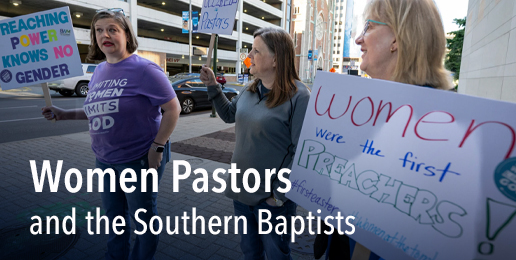
There is quite a ruckus in the Southern Baptist Convention and the media over the issue of whether women should hold the position of pastor in a local church. The fact that such even needs discussion reveals a lack of biblical understanding on the part of many. It appears that the spirit of the age, “no one is going to tell me what to do,” has infected the church.
There was a time when Christians simply said, “God said it, I believe it, that settles it.” Such is apparently no longer the case.
Any student of traditional Baptist teachings understands that Baptists historically reject outside controls on a local church. But, setting that issue aside for the moment, we understand that there is an important principle being addressed here that merits discussion. Critics of the SBC’s position point out the numerous examples of women being used by God in both the Old and the New Testaments to deliver the truth.
Their conclusion is that because God has used women in those instances, He intends that they also pastor churches. I would suggest not so fast. I trust that you will hear me out.
It is apparent that, while SBC leadership has made the case for male pastors only quite well, they may not be providing a sufficient argument for why these women, who desire to be pastors and are able and even gifted, should be satisfied with what appears to be a second-tier participation in the church.
God does nothing without a reason, and He is abundantly reasonable in all that He does. I would like to provide what I believe are salient reasons for Bible believing women to accept the roles Paul has prescribed for them in the church, as coming from God Himself, intentionally.
First, Scripture is the final authority, and it is unwise for those who disagree with a passage which has stood for nearly two thousand years to think themselves now able to determine that this text is not canonical or that it should be applied in only a limited fashion. Believers should beware of aiding skeptics in their objective of undermining the Word.
The current culture does not accept biblical authority and should hold no sway with a Christian. Why would we be influenced by, or even be interested in the opinions of those who hate God, the Bible, the church, marriage, the family, and children? Why would we think they have anything of merit to contribute to our lives?
There is no reason inherent to the text to believe that Paul’s words, which forbid women to be pastors, (I Timothy 2:12 NKJV, “I do not permit a woman to teach or to have authority over a man”) do not belong in the Word or that it can be interpreted for a merely localized application.
Without very good reason we should resist such a careless handling of God’s word. Once it is accepted that a text which irritates cultural sensibilities cannot mean what it clearly says, the Bible becomes malleable and meaningless, and we repeat the errors of early 20th Century liberalism. We have become the authority rather than God’s Word.
Consider this first principle of biblical interpretation: A text should be accepted as it presents itself except where it clearly has a figurative or symbolic meaning. Another principle is that one’s inability to understand a text or disagreement with the clear intent of the text does not allow for altering its meaning. God is its Author, and it is our responsibility to accept His word as truth, whether we understand it or agree with it.
There are two primary reasons why a woman might desire the position of pastor: First, she manifests some of the abilities that are generally associated with the position. The difficulty arises in that giftedness is, to those observing, virtually indistinguishable from natural ability. However, they are not the same. But it is quite normal to want to use one’s abilities for good, yet it is also a fact that many Christians are never afforded the chance to put their gifts or talents to use. Most people must choose between their various strengths or gifts. It is my expectation that our talents, abilities, and gifts will shine forth in their greatest expression in the future Kingdom of Christ.
Second, every one of us has a desire to be known, to be recognized as being important. The Scriptures call it the “pride of life.” We do not all covet fame, per-se, but we all want to stand out in some way. The sweetest music to the ears of each one of us is our own name! Yet the Word is clear that the only recognition that lasts and means anything is that of Christ’s; and regardless of how obscure our lives and service may be in this life, if we are faithful, we will hear those words from Christ Himself, “Well done, good and faithful servant.”
His approval will bring ultimate and eternal joy and fulfillment.
Now, there are very good reasons to accept the text in question as meaning precisely what it says: that Paul does not allow women to preach, or to hold authority over men in the church. This is not a categorical denial of her usefulness to Christ. Paul simply notes that she is not to be the pastor of a church, and she is not to be in authority over the men in the church. Otherwise, she has a great many opportunities to teach and disciple others.
Paul refers to Creation order as the basis for this. Man was created as the head of the home and the woman as his helper. Paul, in this passage, declares that this order is to be maintained in the church as well. It would foster confusion and conflict if the economic structure God ordained for the family was contradicted in the local church.
This order has nothing to do with intelligence, value, or personhood. Each of us has equal, infinite value to God. But He is a God of order; and can you imagine the chaos in homes if every couple had to self-determine who the leader was? Actually, this is largely what is seen across the nation today. Homes are often chaotic, at times violent, and tragically detrimental to children, leading to an epidemic of divorce.
Ultimately, every organization and organism of any significance can only function with a single leader. Not surprisingly, equal partnerships in the business world generally fail due to conflict.
An important element in God’s design for marriage is that it represents the greater “Groom and Bride.” Christ, as the Bridegroom, is the Head of His Bride, the church. He is represented by the husband, who is declared to be the “head of the wife,” (Ephesians 5:23). For the sake of that representation and to preserve peace in the home, God directs the wife to live in submission to her husband, as the church is to Christ, (Eph. 5:22-33). And this order is to be maintained also in the church.
Sadly, of course, there are men who take advantage of this arrangement to be abusive. Shame on them! They will not only answer to God for the abuse of their wives and children, they will also be held accountable for painting an evil picture of Christ. How wicked the man who treats his wife as a door mat!
Just as pastors are forbidden to lord it over their churches, husbands are forbidden to lord it over their wives. Christ commands them to sacrificially love and serve them just as He does the church!
I cannot help but contrast the spirit of this movement with that of Christ, “who, being in the form of God, thought it not robbery to be equal with God: But made Himself of no reputation, and took upon Himself the form of a servant, and was made in the likeness of man: and being found in fashion as a man, He humbled Himself, and became obedient unto death, even the death of the cross,” (Phil. 2:6ff).
If Christ, the Creator God, was joyfully willing to humble Himself as a servant, how much more should we all?
In the Gospels, Christ referenced the Pharisees and others who loved recognition and prominence saying that they “love the uppermost rooms at feasts, and the chief seats in the synagogues, and greetings in the markets, and to be called of men Rabbi, Rabbi. . . .But he that is greatest among you shall be your servant. And whosoever shall exalt himself shall be abased; and he that shall humble himself shall be exalted, “ (Matt 23:6-12).
It may be that the most exalted ones in Heaven, other than Christ of course, may be women who, while having ability and giftedness, (possibly greater ability and giftedness than their husbands), humbled themselves to serve as Christ did.
The Lord pointed out that those who seek glory here receive their reward here. The praise they hear from men is their reward, while those who humbly serve wherever God places them will receive a far greater reward for eternity. I believe that it is possible that the individual who for all eternity may receive reward and praise above most others is a person overlooked by virtually all but Christ. I refer to the widow in Luke 21 who gave her two mites. In pointing her out Christ noted that while she gave a mere pittance in human terms, it was greater than all that the others had given.
I would rather receive her reward than that of the many who were recognized and applauded!
These women who demand to be pastors and leaders, if they knew the Scriptures as they suggest they do, should recall Israel’s experiences in the desert. From those texts we see that God hates complaining. Israel was repeatedly judged by God for their discontent. Yet, many of these would be “pastors” appear quite bitter.
If Paul’s words were ambiguous, these women might be justified in their interpretation, but no honest reader can take any other meaning from the text. The only way they can arrive at their conclusion is by twisting the text or simply declaring it to be spurious, a later addition to the Bible penned by fraudsters. Such assertions are dangerous and unwarranted.
Recall that when Paul actually made a suggestion that had local, limited application, that it would be good for some believers to remain single, he stated that it was “for the present distress,” (I Corinthians 7:26) and therefore it is not to be applied for all time.
Is it not possible that men and women were created for the purpose of, among other things, representing different attributes of their Creator and Savior? I think we clearly were. Of course, a woman may be more intelligent, knowledgeable, and wise than many men.
In my own experience as a student, many girls and young women were academically ahead of the male students. Is that the primary criteria for determining one’s role in the church? I think not.
Christ was infinite in all things, yet He submitted Himself for a while to his human parents, and to the Father to live as a servant and die for others. What a beautiful portrait of Christ children would see if women and mothers, though being capable and gifted, would willingly and joyfully submit themselves to the “head” of the home and in the church, trusting that their eternal reward would be well worth it.
Paul noted that, “Our light affliction, which is but for a moment, works for us a far more exceeding and eternal weight of glory,” (II Cor. 4:17). Living in the shadow of others or taking a “behind the scenes” role is not really an affliction, though it may be annoying and disappointing for the moment. Considering our brief time here in comparison to eternity, it may not be such a sacrifice to take a lessor role temporarily in order to be richly rewarded forever!
How quickly we forget that “godliness with contentment is great gain.” Every believer at some point comes to accept the reality that they will fall far short of their ambitions and plans for this life. So many things we desire to do here will have to wait for eternity, and that is just fine.
Another issue they need to address is that a true servant makes no demands. It is simply too obvious a contradiction. Christ in the garden the evening before His death yielded to His Father saying, “not My will but Thine be done.” That sums up well the spirit that God seeks in every one of us.
Most of us are probably aware of the great saints of history beginning with Paul, Chrysostom, Augustine, Calvin, Luther and so on. I would suggest that there are likely to be many, many others unknown to us but well known to God who served more faithfully, yet invisibly, and whose rewards may well eclipse all these who are considered great. And many of them will, I suspect, be women.
Only God knows, and only His perspective matters.
Another serious error exhibited in their demands is that they apparently see themselves as essential to God’s plans, and that His church will malfunction without their input. How foolish of anyone not to understand that God needs none of us but graciously chooses in His wisdom and grace to use us where it best suits His purposes.
Now, I believe that every Christian ought to enter discussions of this nature with the caveat, “I could be wrong,” because we all may be wrong! But I do believe this particular text is clear. However, a larger question presents itself: Suppose God would allow women to pastor churches, but the church you desire to serve in does not. What is the correct response?
While it is not a precise parallel, Paul addresses the saints at Corinth who had been taken advantage of by other members. His solution was not that they complain, or worse, take the problem to outside arbitration; but rather, to protect the testimony of the church, he suggested that they absorb the hurt, and continue to serve, (I Cor. 6:7). He writes,
“Now therefore there is utterly a fault among you, because you go to law one with another (thus making the church issue public). Why do you not rather take wrong? Why do you not rather allow yourselves to be defrauded?”
Strong words, but a clear remonstrance to the church that God is sovereign, and that He will set things straight in His time. The manifest grace in the life of a gifted person humbly taking a “back seat” to others, even to lessor gifted individuals, brings glory to Christ, and is that not an important ministry as well?
Sadly, there are situations on occasion that require intervention from outside the local church, but the failure of a church to recognize one’s giftedness is not one of them. Issues relating to ministry within the church, gender roles, individual responsibilities, and recognition of gifts are the purview of the church family and leadership, acting under the direction of the Word and the Spirit.
Because the Word is the final authority, and God is a God of order, we do well to face the world with a unified, orderly, and biblical message. To air our personal grievances, which too often manifest worldliness, carnality and pride, before a watching world is a marked failure on our part and undermines the great mission entrusted to us, which is to reach the world with the Gospel and to make disciples of Jesus Christ.