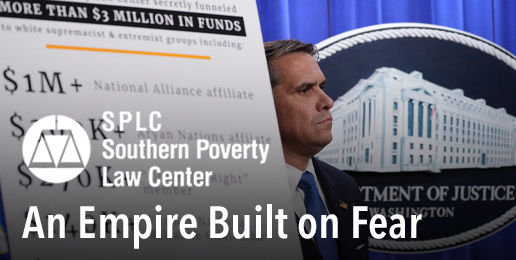
The Southern Poverty Law Center (SPLC) — the Montgomery, Alabama, organization that for decades has marketed itself as the nation’s preeminent watchdog against hate — was indicted this week by the government it once advised.
On April 21, 2026, a federal grand jury returned an indictment charging the SPLC with 11 counts of wire fraud, false statements to a federally insured bank, and conspiracy to commit concealment money laundering. According to the indictment, between 2014 and 2023, the SPLC funneled more than three million dollars in donor funds to paid informants embedded within the extremist organizations it simultaneously publicized as existential threats. Shell accounts and prepaid cards were used to conceal the transfers.
Prosecutors allege that the informants used some of those funds to commit additional crimes.
The Acting Attorney General offered a characterization that would have surprised no one who had been paying close attention:
“The SPLC is manufacturing racism to justify its existence.”
This revelation is not surprising to me. What surprises me is that they have been exposed and are being held accountable.
Morris Dees was a millionaire before he became a civil rights lawyer — and that sequence matters for understanding what the Southern Poverty Law Center became. While still in law school at the University of Alabama, Dees and his partner, Millard Fuller — who would later found Habitat for Humanity — built a direct-mail publishing business, Fuller & Dees Marketing Group, that grew into a substantial commercial enterprise.
By the mid-1960s, Dees had bought Fuller out for $1 million. In 1969, he sold the entire operation to the Times Mirror Company, a deal that left him, at 32, permanently wealthy and professionally unencumbered. The law firm he shared with Joseph Levin Jr. in Montgomery had, until then, been something of a side project.
The two men were already taking on pro bono civil rights cases that no other local attorney would touch, including a 1969 case that successfully integrated the Montgomery YMCA. But a snowed-in layover at a Cincinnati airport in 1967 became, as Dees later described it, his turning point: stranded overnight, he read the autobiography of Clarence Darrow and, by his own account, decided to walk away from business entirely and use his marketing genius and personal fortune to build a permanent civil rights legal center.
When Dees, Levin, and civil rights activist and Georgia State Senator Julian Bond formally incorporated the Southern Poverty Law Center in 1971 — Dees was 34, Levin just 28, Bond 31 — they opened in what amounted to a Montgomery storefront, sustained by a line of credit, modest furnishings, and Dees’s personal funds.
Early revenue came from direct-mail appeals for individual cases. But Dees had brought to the enterprise something that would eventually overwhelm its stated mission. Before he was a civil rights lawyer, he was one of the most effective direct-mail marketers in the country, and he understood better than anyone how fear and urgency generate money from donors.
According to Dees, the SPLC recognized as early as 1974 that fundraising costs would rise and took the unusual step for a young civil rights firm of setting aside funds for an endowment.
In retrospect, the decision revealed where the organization’s deeper ambitions lay. Through the late 1970s and into the 1980s, revenues climbed steadily into the millions as Dees applied those instincts to the cause of racial justice. What the organization needed, to fully activate that machinery, was a case dramatic enough to open checkbooks across the country.
The murder of Michael Donald and the lawsuit that followed provided exactly that.
On March 21, 1981, Donald, a 19-year-old Black man in Mobile, Alabama, was abducted, beaten, strangled, and lynched by two members of the United Klans of America (UKA). Henry Hays and James “Tiger” Knowles chose him at random to send a racial message. It was a brutal and senseless act.
Dees, together with Donald’s family attorney, Michael Figures, filed a wrongful death suit in 1984 against the UKA and its leadership. The legal theory was that the UKA, as a corporate organization with a functioning command structure, bore institutional liability for violent acts carried out under its own policies. On February 12, 1987, an all-white jury returned a $7 million verdict.
The plaintiff in that case was Beulah Mae Donald, Michael’s mother. What she collected from the $7 million verdict was the UKA’s only significant asset: a 7,000-square-foot headquarters building in Tuscaloosa. When she sold it, the building fetched approximately $51,875. She used the proceeds to buy her first home.
She died the following year.
What the SPLC collected was something quite different. The Donald case made Morris Dees nationally famous and triggered a flood of donations that funded the organization’s dramatic expansion through the late 1980s and 1990s. Dees acknowledged from the outset that the goal was to dismantle the UKA’s financial structure, not to secure a recovery for the plaintiff.
Beulah Mae Donald stated publicly that money meant nothing to her — nothing would bring her son back. Whether the SPLC’s institutional windfall was proportionate to the service it rendered is a question that answers itself when the numbers are placed side by side: $51,875 for the mother whose son was murdered; tens of millions in donations for the organization that brought the suit.
“Every great cause begins as a movement, becomes a business, and degenerates into a racket.” — Eric Hoffer
Hoffer, the blue-collar philosopher and San Francisco longshoreman who became one of the 20th century’s most penetrating social observers, described the natural arc of decay. The SPLC did not degenerate. It appears to have come out of the gate as a racket.
On the strength of the Donald verdict — a single lawsuit — the SPLC positioned itself as the authoritative national clearinghouse for domestic extremism. The organization began providing research, training materials, and intelligence to the FBI, eventually becoming sufficiently embedded in federal law enforcement that its hate-group designations functioned as a de facto government index of domestic threats.
There was no statutory authority for this arrangement and no congressional oversight. And there was no review of the designation process.
A privately funded Alabama nonprofit, accountable to no electorate and subject to no inspector general, had become the outsourced intelligence arm of the United States government for domestic extremism — and it had earned that position primarily by winning a single civil judgment against an organization that owned a single building worth $52,000.
Over the years, SPLC’s relationship with the FBI grew, deepening further under the Biden administration. During that administration, the FBI’s Richmond Field Office circulated an internal memo — reportedly to more than 1,000 agents — that used SPLC data to flag traditional Latin Mass Catholics as potential extremist threats.
According to an analysis of White House visitor logs by The Heritage Foundation’s Oversight Project, SPLC staff appeared in visitor records 11 times, including 6 instances in which President Biden was listed as host or present — a level of access that underscores how closely the organization was received at the highest levels of government.
FBI Director Kash Patel severed all ties with the SPLC on October 3, 2025, publicly stating that the organization had “long ago abandoned civil rights work and turned into a partisan smear machine” whose hate map had “been used to defame mainstream Americans and even inspired violence.”
He severed ties with the Anti-Defamation League the same week, for the same reasons.
I have a unique vantage point on this history. In the mid-1970s, I spent nearly two years working undercover inside the United Klans of America — the same organization that murdered Michael Donald and that the SPLC sued. I became the second-highest officer in the Illinois Klan and personally knew Robert Shelton, the UKA’s Imperial Wizard.
I knew every significant leader of every major Klan organization operating in the United States at the time, as well as the leadership of several other right-wing extremist groups.
When I learned of the SPLC’s suit against the UKA, shortly after I started my own investigation business and long before the Donald case went to trial, I contacted Morris Dees and offered my assistance. He spoke with me for less than two minutes. I had barely enough time to tell him that I had firsthand knowledge of these extremist organizations, including knowing the men who led them. He was not interested.
I found that curious at the time.
I cannot, from that brief exchange alone, prove what Dees’ motives were. But in retrospect, the dismissal looks to me like an early clue to what the SPLC was becoming: an organization that benefited more from the persistence of extremism than from its extinction.
If your stated goal is to dismantle extremist organizations — the Klan, the Nazis, the Posse Comitatus, the full spectrum — why would you decline the assistance of someone who had infiltrated them and personally knew their leadership?
In retrospect, my conclusion is that genuine expertise would have shortened the fight. For an organization whose influence and fundraising depended on keeping that fight vivid in the public imagination, shortening it may have been contrary to its institutional interests.
The fight appears to have been the product, not the path to a solution.
An undercover operative who might have helped neutralize these organizations had little place in a model that, as I now see it, depended on keeping the threat visible, alarming, and lucrative. My call came before the SPLC became an FBI advisor, but the rejection struck me then as curious and strikes me now as revealing.
The federal indictment of April 21, 2026, now gives that instinct a far more damning context.
Among the paid informants the SPLC allegedly maintained inside extremist organizations was an individual who held the title of Imperial Wizard of the United Klans of America — the same organization whose moral bankruptcy the SPLC had built its entire public identity on exposing.
Another informant sat on the planning committee for the 2017 Unite the Right rally in Charlottesville, attended the event at the SPLC’s direction, and helped coordinate transportation for participants. One person died that day. Dozens were injured.
The bureau was receiving intelligence about organizations that the SPLC was simultaneously funding from the inside. Donor money, raised from people who believed they were supporting civil rights litigation, was allegedly flowing through concealed accounts to informants inside hate groups that appeared on the SPLC’s own hate map.
The money tells the story more plainly than any indictment. The SPLC’s Form 990 filings with the IRS — publicly available through ProPublica — reveal an organization whose financial posture has nothing in common with a civil rights litigation shop and everything in common with a political fundraising operation that has found an inexhaustible fear-based product.
Over the five fiscal years from 2020 through 2024, the SPLC collected approximately $705 million in total revenue while maintaining net assets ranging from $588 million to $787 million. Its assets now exceed $700 million, including a very large endowment — far beyond the ordinary operating needs of a domestic civil rights litigation organization.
Tens of millions of dollars of those assets reportedly sit in offshore accounts — an arrangement that even some of the SPLC’s former employees found difficult to explain in a way consistent with the organization’s stated purpose of fighting American hate groups.
The SPLC’s hate-group designation process has never been subject to external review, legal challenge within the organization, or any form of due process for the designated entities. The consequences of designation are substantial.
Organizations labeled as hate groups by the SPLC have been cut off by payment processors, deplatformed by technology companies, and treated as national security concerns by federal law enforcement — all based on a private organization’s unilateral decision, made under criteria it controlled.
The organizations on that list include the Family Research Council, the Illinois Family Institute — the publication for which I write — and a wide range of other Christian organizations whose offense, in the SPLC’s framing, is holding traditional positions on marriage, sexuality, and religious liberty.
These positions have been held by the majority of Christians across all denominations for two thousand years.
The SPLC’s decision to classify them as hatred is not a civil rights judgment. It is a political one.
The Family Research Council responded to its designation by noting that a deranged gunman used the SPLC hate map to identify its Washington office as a target before attempting a mass shooting in August 2012. The SPLC maintained the designation. The question of whether the SPLC’s designation process has any relationship to actual public safety — or whether it serves to inflame rather than reduce the risk of political violence — is one the organization has never been compelled to answer.
The SPLC needed the Klan and a host of other organizations to be dangerous and growing, permanently and indefinitely, because defeated hate groups no longer generate donations. The organization’s financial model required that the problem it claimed to solve never be solved — and the indictment now suggests that the SPLC may have taken active steps to ensure that the threat it sold to donors continued unchanged.
Morris Dees was fired in March 2019 — not from a disagreement about the mission, but for workplace misconduct: reporting at the time connected the crisis to internal complaints about mistreatment, racism, and sexual harassment that staff said had been known internally for decades.
Two waves of employee letters followed, with the second accusing the SPLC’s entire leadership of being “complicit in decades of racial discrimination, gender discrimination, and sexual harassment and/or assault.” President Richard Cohen resigned days later.
The irony was almost too stark to believe: the organization that had built its identity on fighting discrimination was described by its own employees as a workplace defined by discrimination. But the problem was never primarily about Morris Dees or his successors. It was about what kind of institution the SPLC had always been.
The scandal was embarrassing. The indictment is something else entirely.
Eric Hoffer saw it clearly in the middle of the twentieth century: when a cause degenerates, it becomes a racket. What Hoffer didn’t mention is that sometimes the racket is the cause from the start.
The SPLC did not start as a genuine civil rights organization, nor did it slowly lose its way. It started as a vehicle for Morris Dees’s fundraising ambitions, discovered that the civil rights branding was extraordinarily effective at loosening donor checkbooks, and built an institution designed to perpetuate that arrangement indefinitely.
Beulah Mae Donald’s son is still dead. The $7 million verdict that made the SPLC famous produced $51,875 for her. The organization that won that verdict has collected hundreds of millions of dollars since and now stands indicted for allegedly using some of that money to fund activities of some of the groups it told donors it was fighting.
The indictment now suggests why Dees may have rejected my assistance decades earlier. The lesson here is that whenever some group solicits money or help “for a good cause,” your first question should be, “good for whom?”