
On June 11, 2026, three federal officials stood before a room full of journalists in Washington, described a crime scene the size of a city, and revealed that the government itself was responsible for it.
Acting Attorney General Todd Blanche, Homeland Security Secretary Markwayne Mullin, and Acting Office of Refugee Resettlement Director Angie Salazar told the country what their investigators had found. More than 475,000 unaccompanied children were referred to the federal government during the Biden administration. By the end of 2024, more than 300,000 of them could not be accounted for. In the eighteen months since, a federal task force has located roughly 146,000.
Some were found safe. Many were not.
Salazar’s investigators found children who had been sexually assaulted, children forced into labor-trafficking rings, children sold for sex, and children who were already dead. Mullin said some of them reported being raped six to seven hundred times. He said the vast majority of the 146,000 located so far had been obtained illegally.
I have written about these children before. In October 2024, after the Homeland Security Inspector General confirmed that the government had lost track of more than 300,000 of them, I asked a simple question: if a parent had four children and three disappeared, wouldn’t you suspect that parent of negligence? Our government — and every contractor it paid — stood in the place of those children’s parents.
We now have an answer to that question, and it is worse than negligence.
The most important admission on June 11 came from the government’s Acting Attorney General, who described what the previous administration’s leadership understood as events unfolded.
Blanche told reporters that it could not be disputed that the last administration knew. His department, he noted, had not needed forensic accountants or elite agents to compile the findings — the data already existed, and the government already had it. There were people in leadership positions, he said, who knew this was happening and “either didn’t care, encouraged it, or a little bit of both.”
When a reporter pressed him, was “encouraged” really fair? — Blanche did not retreat. If you know there is a problem, he answered, and you are in a position of leadership to stop it, and you do not stop it, what word should I use?
Secretary Mullin was even blunter. Neglect, at best, he said. Criminal, at worst.
This is the documented record, available to anyone willing to read it.
In 2021, ORR issued field guidance that removed the protections standing between a trafficker and a child. It eliminated third-party review of the sponsor-vetting process. It removed the requirement that caseworkers assess the quality of the relationship between a child and the adult claiming to be his guardian. It dropped proof-of-address requirements and fingerprinting for most sponsors. The HHS Inspector General later documented each of these changes.
The officials who made these changes were not confused about what they were doing. As early as July 2021, ORR’s own staff warned superiors — in writing — that leadership had dismantled the vetting policies and that the changes had weakened the agency’s ability to protect children from trafficking. That warning is recorded in the Congressional Record. Leadership left the policies in place for years anyway.
When the cost of that choice began to surface, the officials responsible resorted to the excuse of bureaucratic process. ORR Director Robin Dunn Marcos told Congress in 2023 that “ORR does not monitor or track the whereabouts of children” once they leave its care. Secretary Xavier Becerra said the same thing in his own way: our authorities, he testified, end when we have found a suitable sponsor.
Found a suitable sponsor.
When the New York Times reported that the department had lost contact with 85,000 children, Becerra called the figure “not at all realistic.” He did not offer a better estimate. He disputed the embarrassing number rather than disproving it the one way that would have mattered — by producing the children he insisted weren’t missing.
Because they were missing. They still are missing. And Becerra knew it, or should have.
That instinct — manage the story, not the catastrophe — is the scandal in miniature.
Those who saw it up close tried to warn us.
In 2021, federal employee Tara Lee Rodas volunteered to help with the surge. She was deployed to an emergency intake site at the Pomona Fairplex in California, expecting to help reunite children with their families. What she found there changed her life. “I thought I was going to help place children in loving homes,” she told Congress. Instead, she testified, she discovered a trafficking pipeline that began with recruitment in the children’s home countries and ended when ORR handed a child to a “sponsor” who was, too often, a criminal or a member of a transnational criminal organization.
Her conclusion was the one the government least wanted to hear: the United States had become the middleman in a multi-billion-dollar child-trafficking operation.
When Rodas and a fellow whistleblower, Deborah White, raised the alarm about specific children — including a sixteen-year-old girl released to a man who claimed to be her brother and who later posted photographs of himself touching her — they were told not to investigate the sponsors.
A Homeland Security Investigations agent put it as plainly as possible. As a government, he said, “we’ve turned a blind eye to their trafficking.” It is happening everywhere.
They were not believed. They were sidelined. The machine kept moving the children.
This should not only end careers, but also send government officials to prison.
The children did not transport themselves. ORR does not, in fact, operate most shelters or arrange most placements. It writes checks. The work — housing, transport, and “reunification” — is performed by a network of non-governmental organizations that present themselves to the public as charities animated by compassion.
They are not charities in any meaningful sense.
They are federal contractors, and their dependence on Washington is nearly total. Among the five largest, federal funding accounts for 97.9 to 99.9 percent of revenue. Strip out the government, and there is essentially nothing left.
I know how hard these organizations work to stay unexamined because I tried to examine them. In late 2025, with a professor at the University of Illinois Chicago, I took part in a peer-reviewed study of how this system actually served the children in its care.
The federal agencies stonewalled us. And not a single NGO would answer our questions.
We built the study on the public record, because that was all anyone would let us have — and in May 2026, an academic journal rejected it, faulting us, in part, for the very non-cooperation the subjects of the study had imposed. The refusal to answer was treated as our methodological failure rather than as what it plainly was: a finding, and an important one.
I told that story in a companion piece, “See No Evil.” That is why the figures that follow come not from the organizations but from their own tax filings, federal audits, and the public record — the only doors that do not lock from the inside.
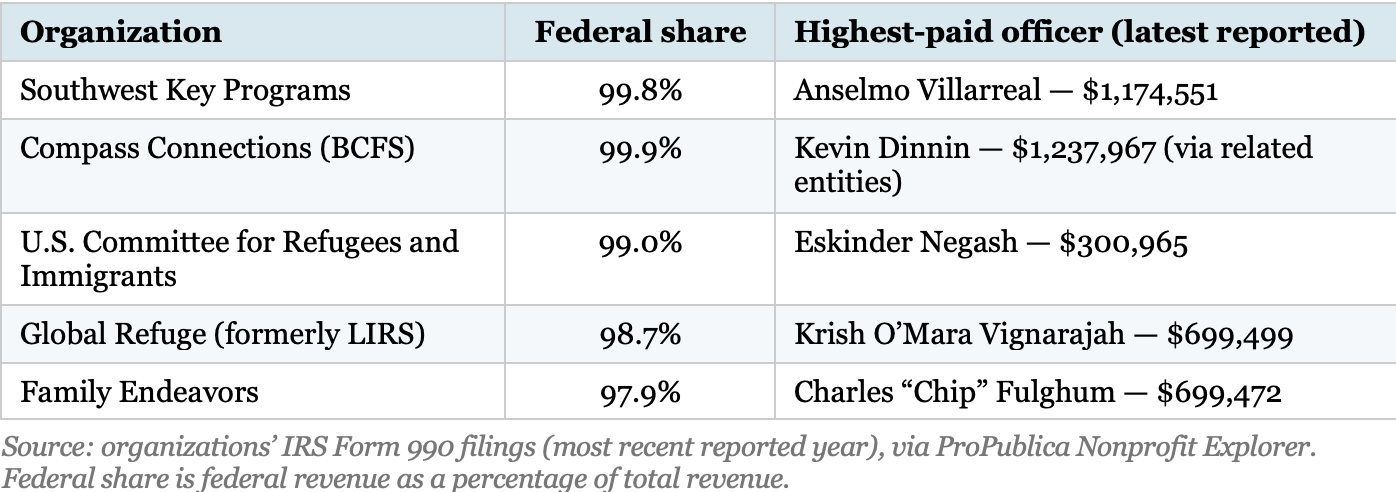
Together, those five organizations took in an estimated $15 to $17 billion to house, transport, and place unaccompanied children during the Biden years. The government paid roughly $43,000 per child. Three out of every four children were lost. Now watch what happened to the people paid per child.
Southwest Key Programs was the largest operator, drawing 99.8 percent of its $921 million in revenue from Washington and taking in roughly $3 billion during the Biden years — close to $6 billion over its lifetime. Its executives prospered as children arrived. Anselmo Villarreal, who became chief executive in February 2021, was paid about $491,000 in his first year; by 2023, his compensation had climbed 139 percent to more than $1.17 million.
He was not alone. Roughly a dozen Southwest Key executives saw their pay rise by 10 to 112 percent in the first two years of the administration; the chief of staff’s pay rose from $86,000 to $326,000. Total executive compensation at this one “charity” reached $9.4 million in a single year. None of it was a surprise: the HHS Inspector General had already found Southwest Key inflating executive salaries and bonuses using taxpayer grants in 2020.
Four years and three billion dollars later, the Justice Department sued the organization over a pattern of sexual abuse of children in its shelters dating back to 2015. The Trump administration emptied all twenty-seven shelters in March 2025, and the case was dismissed — because there was no longer a company to sue.
While Villarreal ran the country’s largest child-sheltering contractor and Washington shipped it some three billion dollars, he had a side pursuit: high-stakes tournament poker. According to the New York Post — and verifiable through public poker records — he won roughly $800,000 at the tables over his career, nearly $400,000 of it between 2021 and 2024, the very years his organization was losing track of the children it was paid to protect. He won his first event in Las Vegas in May 2021.
Global Refuge — the rebranded Lutheran Immigration and Refugee Service — drew 98.7 percent of its revenue from the government and took in roughly $881 million during the Biden years. Its chief executive, a former Obama White House and State Department official, was paid roughly $699,000 in 2024. Global Refuge is, in practice, less a service provider than a pass-through: it collects federal grants and routes them to a downstream network of subgrantees, sending one of them — Bethany Christian Services — some $246 million in a single year.
It also lobbied.
Between 2019 and 2023, the organization disclosed $480,000 in federal lobbying — an investment that, when set against the grants that followed, amounted to thousands of dollars in federal money for every dollar spent persuading Washington.
Endeavors offers the purest illustration of the racket. In March 2021, the San Antonio nonprofit — which had never done this work — received a $529 million no-bid contract from HHS to operate a 2,000-bed “emergency intake site” in Pecos, Texas, along with a separate $87 million no-bid contract from ICE. A 2026 HHS Inspector General review found that the agency had bypassed federal competition rules; the award came in at more than double the government’s own cost estimate and was amended fifteen times.
The organization’s cash and investments swelled from $8.3 million in 2020 to more than $520 million by 2023. And the Pecos facility itself? Federal cost-cutters found that it had sat essentially empty for roughly a year while the government paid some $18 million a month to keep it standing — a quarter of a billion dollars a year for a building with almost no children.
Along the way, congressional investigators cataloged how the money was spent: $533,000 to a single music therapist, hundreds of “pet therapy” and “horticulture therapy” sessions, $8 million to a hotel management company, and $700,000 to lobbyists.
A fifth operator, Compass Connections — spun off from the BCFS network in 2020 to handle these contracts — took in roughly $1.5 billion and ran 99.9 percent on federal money. Its board chairman, Kevin Dinnin, draws nothing directly from Compass Connections; his $1.24 million in compensation is instead routed through a web of related BCFS and FirstDay Foundation entities — the kind of arrangement that makes the money harder to follow, which is rather the point.
BCFS is a useful illustration of a quiet transformation that has overtaken much of the charitable world. It began in 1944 as a Baptist orphanage for Mexican-American children, an institution of the Baptist General Convention of Texas, sustained by congregations’ offerings, which they believed were caring for the least of these.
It never formally renounced that heritage; it simply outgrew it. As federal contracts replaced voluntary giving, the convention’s support dwindled to less than one percent of the budget. The Baptist name was reduced to an acronym and then abandoned altogether for the bland, faith-neutral “FirstDay Foundation.” The organization answered less and less to the churches that founded it.
What remained constant throughout was the tax status. The group kept its 501(c)(3) charitable exemption — the legal and moral credential of a charity — even as the substance beneath it changed entirely, from a ministry funded by believers to a government contractor funded almost entirely by the taxpayer.
And BCFS is not unusual. Global Refuge spent more than eighty years as the Lutheran Immigration and Refugee Service before dropping the word “Lutheran” for a faith-neutral name in 2024 — the same instinct, the same drift.
Across this field, organizations founded by churches, denominations, and private benefactors have retained the charitable label and the public goodwill that comes with it, while distancing themselves from the charitable origins — the faith, the founders, the donors, the underlying purpose — that once defined and disciplined them. The name over the door still says charity. The money and the master it now answers to say otherwise.
If the money tells you these are contractors rather than charities, the people tell you something worse: in some places, the line between the government that hands out the contracts and the organizations that receive them is no line at all.
Consider the U.S. Committee for Refugees and Immigrants (USCRI), the last of the five major operators, which drew 99 percent of its revenue from Washington. Its president, Eskinder Negash, followed a familiar path. He was a USCRI executive before 2009. From 2009 to 2015, he served as the federal Director of the Office of Refugee Resettlement — the very agency that funds USCRI. In 2015, he returned to USCRI as its chief executive. The man who, as a government official, helped decide how the resettlement money was spent now runs one of the organizations that received it. Investigators who have traced his career describe it bluntly: he returned to run the contracts he had steered there.
He did not invent the pattern. His predecessor at USCRI, Lavinia Limon, had walked the same path a generation earlier — ORR Director under President Clinton, then a USCRI executive — and it was Limon’s circle that helped bring Negash into ORR in the first place. The chair passes back and forth between the agency and the contractor like a baton.
The most brazen example is one we have already met. Andrew Lorenzen-Strait was a federal immigration official who, after a stint at one of these same NGOs, joined the Biden transition team in 2020 to help vet the appointees who would soon run DHS and HHS. On Inauguration Day, January 20, 2021, he began working for Endeavors.
The organization emailed the government an unsolicited offer on March 13; three days later, on March 16, the government awarded Endeavors a half-billion-dollar no-bid contract. His former boss at ICE had become the acting head of the agency that issued the separate $87 million check. Project Veritas later captured Lorenzen-Strait on undercover video describing the arrangement — a deal he himself reportedly called a ‘corrupt bargain,’ a phrase House investigators then cited in their oversight letter. For once, an honest description.
These are not isolated résumés.
The head of Global Refuge came to the role from the Obama White House and the State Department. The president of Endeavors is a former senior Homeland Security executive who once oversaw the department’s management and procurement — the very function that produces no-bid awards. Across this network, the people negotiating with the government on behalf of the “charities” are, in many cases, the same people who, not long before, sat on the government’s side of the table. They know which doors to knock on because, until recently, those doors were theirs.
For them, unlike the average person, a friendly face opened the door when they knocked. For the rest of us, the knocks go unanswered.
This is what institutional capture looks like. It is not a conspiracy hatched in a back room. It is a revolving door installed in plain sight, turning steadily through Democratic and Republican administrations alike — carrying officials out to contractors and bringing contractors’ allies back into the agencies. Every revolution of that door costs taxpayers more and protects children less.
Eighteen months ago, I wrote that this was a gold mine for everyone involved except the children. I was being too kind.
The cartels were paid to bring the children to the border — between $6,000 and $15,000 per child. The contractors were then paid far more by our own government to take them the rest of the way. The cartel and the “charity” were, functionally, two halves of the same supply chain, with the children the product moving through it. Salazar said as much on June 11, in words no one could misread: the children, she said, were shuffled by contractors through airports and delivered to unvetted sponsors.
Shuffled. Delivered. They were handled as freight.
Every adult in this chain will tell you, if you ask, that they care about the children. They will say children are our future. They said it as they dismantled the safeguards, as they disputed the body count instead of searching for the bodies, as their salaries doubled. Their cash reserves multiplied, and the children they were paid to protect disappeared.
Then the phones rang — 65,605 unaddressed reports of children in danger, including more than 7,000 suspected trafficking cases, sat in a queue for years. Nobody answered, and the children stayed wherever they were.
These are children who could be our own. Scripture tells us plainly what is owed to them, and what is owed to those who cause them to stumble. A wealthy and sophisticated government, spending some $17 billion, managed to lose them by the hundreds of thousands — and made a great many comfortable people very rich in the process.
Mercenaries all.
The current administration is finding some of them. That is good and overdue. But locating 146,000 children after the fact is not the same as protecting 475,000 in the first place, and nearly 300,000 are still out there.
Three things have to happen.
First, the officials who dismantled the vetting process and ignored their own staff’s written warnings must be named and held to account — not in a press release, but under oath, with subpoena power. Blanche says it is not his place to decide whether their conduct crossed from negligence into a crime.
Someone’s job is to decide exactly that.
Second, the contractor network has to be opened to daylight, which means following both the people and the money. Organizations that took tens of thousands of dollars per child and cannot account for what happened to those children should not receive another federal dollar until they do. Their books, their executive compensation, the related-party arrangements that route a million dollars through a maze of affiliated entities, the downstream grants to subgrantees, and the revolving-door hires who carried inside knowledge from the agency to the contractor — all of it belongs before an inspector general and a grand jury. The no-bid contract awarded three days after an unsolicited proposal is the place to start asking who knew what and when.
Third, contact the HHS Office of Inspector General and demand a full investigation into the 65,605 unaddressed reports and into every NGO that was paid by the head. File a complaint at oig.hhs.gov or call 1-800-HHS-TIPS. Then contact your member of Congress and your senators and demand oversight hearings focused squarely on the executives who took $43,000 per child and cannot say what became of three out of every four of them.
The children cannot speak for themselves. Most of them never could. We accepted responsibility for them — as a nation, in our name, with our money — and then we lost three out of every four. In the process, we paid a great many comfortable people very well to do it.
The least we can do is refuse to look away.