According to this century’s greatest philosopher,

“One often meets his destiny on the road he takes to avoid it.”
In the 2008 film Kung Fu Panda, Master Oogway delineates how the path taken to avoid truth often leads to truth itself. Similarly, when physicists try to disprove the existence of God, they tend to prove his existence instead.
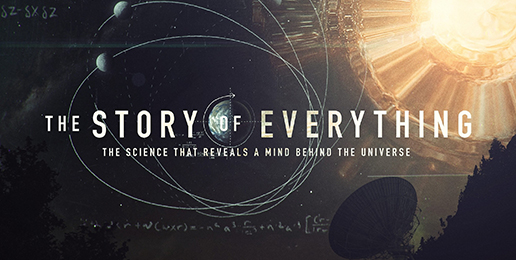
My family and I recently experienced the absolute masterpiece of film: The Story of Everything, directed by Eric Esau, featuring renowned scientists Dr. Stephen C. Meyer and Luke A. Barnes. Much to my personal enjoyment, the documentary was not only truthful and logical, but inspiring and cinematically aesthetic. Years of hard work and dedication is evident with every second.
Starting off, the movie gains credibility to the common viewer as Albert Einstein and his theory of general relativity is introduced in the first chapter of the film. To preface this analysis, the primary goal of most physicists mentioned hereafter is to disprove God’s existence by disproving the expansion of the universe.
This would support the argument that the universe had a beginning. If the universe had a start, the universe would need a starter. A big bang needs a big banger – Gregory Koukl. Prior to the point where these physicists were brought to their knees by divine revelation via astronomical evidence of a growing universe, every argument, equation, and formula was constructed to prove a static universe.
If a static universe was proven, in other words, if space was the same throughout time, we could all sit back and relax knowing proof of a creator stands superfluous.
Back to Einstein, where he designed an equation specifically to support universal stasis – the cosmological constant. In other words, he concocted a number backed by no evidence only to support claims of an unchanging universe. As truth sits with God as the proven Creator, this formula was unsolvable.
Einstein was invited to view the cosmos through the 100-inch Hooker Telescope. Expecting to witness proof of his own genius formula, Einstein was taken aback by what he saw. The universe was indeed growing. Shortly following this pivotal event, Einstein labeled the cosmological constant as his greatest blunder.
Einstein was not the first and certainly not the last physicist who took an attempt at disproving our creator’s existence. The equally notable physicist Stephen Hawking picked up where Einstein left off and expanded on his discovery. Met with ALS, Hawking was discouraged to continue his PhD and research of black holes at Cambridge University. However, he was struck with encouragement from his friends and family to continue.
Pressing forward, Hawking developed the idea of a singularity. The cosmos is a chaotic force. At this point we had already established the consistent growth of our universe. With expansion comes chaos and entropy. In other words, as we move forward in time, the universe expands, and gets more messy. But this means that inversely, if we go back in time, the universe shrinks and becomes more orderly. What this also means, is that if we go so far back in time, we get to a point where space can no longer shrink. Here, space is so miniscule, so infinitely dense, that rewinding one generous second back is impossible. They call this one tiny ball of dense matter a singularity. In essence, at one point, time and space had a beginning.
At this point, atheist physicists are left with questions like:
“How can the universe have a beginning without a creator?”
“Why can’t I disprove God’s existence?”
Meanwhile, Christians sit back confused, asking:
“Why don’t you consider an intelligent Creator?”
“Wouldn’t it make sense that all this order is existent via thoughtful design rather than sheer chance?”
This takes us to the next chapter – the idea that the universe exists by chance. We won the cosmological lottery.
Let’s forget for a second the fact that time itself had a beginning and wasn’t always existent (proven by the singularity theory) no circumstance of sheer chance can prove a big bang, shown by simple cause and effect. In the film, Stephen Meyer illustrates this point.
Let’s say you have an infinite number of monkeys mindlessly typing on a keyboard at random. Chances are, over the course of millions of years, one monkey would at random type out Hamlet. Let’s also ignore for a fact that Hamlet was written with intention. The circumstances for this scenario would have also had to have been thoughtful to commence in the first place. If the letter H was removed from those keyboards, this would suddenly become impossible.
In practicality, the big bang theory without God falls apart quite easily.
First, a big bang needs a big banger. But even without a big banger, the necessary conditions for intricate creation become more exponentially impossible the more variables you add. Up to this point in the film, we’ve only taken a look at outer space. We haven’t even explored intelligent life, conditions for life, or anything of the sort.
Let’s examine a few of the limitless variables.
If a random chaotic explosion caused the earth to form itself as it is currently, when did life begin to exist? And how did it come to be in its current form? Which organ would have appeared first? The brain? The heart? The lungs? How long did it take for a mouth, or an eye, or legs and arms to appear? Let’s also consider that when life “happened,” the earth just happened to be close enough to the sun for warmth, but far away enough to avoid being burnt to a crisp.
Additionally, the earth just happened to possess a magnetic field that protects us from the sun’s radiation. Too much radiation destroys life while just enough is essential to life.
But also, amidst all that randomized order, we just happened to be perfectly placed within the solar system with gas giants to shield us from being destroyed by comets and asteroids.
What now are the odds of all this occurring simultaneously?
Let’s step back and not rack our minds on pointless theory and take a look at a few simple words.
“In the beginning God created the heavens and the earth” – Genesis 1:1.
Based on Stephen Meyers book: The Return of the God Hypothesis, The Story of Everything illustrates the time squandered in disproving the existence of God to proving His existence.

Noah is a 17-year-old high school junior passionate about defending Christian and conservative values in today’s culture. Saved by Christ, he strives to live out his faith through leadership, service, and conviction. He enjoys debating important issues, cooking, woodworking, and gardening, all of which have taught him discipline, creativity, and patience. He is especially passionate about the pro-life movement, strengthening marriage and family, and promoting biblical values in society. He hopes to use his voice and hard work to make a positive impact for both his community and his faith.