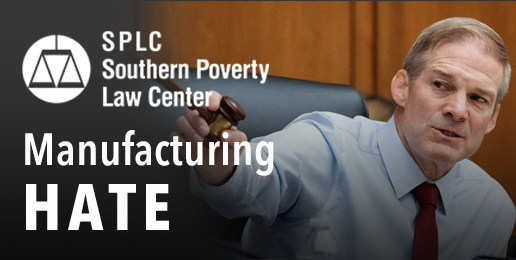
For decades, the Southern Poverty Law Center (SPLC) has portrayed itself as a “watchdog” against racism, but then in 2008 expanded into designating cherry-picked conservative organizations as anti-LGBTQ “hate groups.” However, a recent U.S. House Judiciary Committee hearing titled “The Southern Poverty Law Center: Manufacturing Hate, Part II” raised serious questions about how the organization strayed far from its original mission.
According to allegations discussed during the hearing, the SPLC is accused of using donor funds to make payments to sources connected with extremist organizations it claimed to oppose. Members of Congress questioned whether the organization had become more interested in sustaining a narrative of widespread “hate” than honestly identifying actual threats.
In his opening statement of the hearing, U.S. House Judiciary Committee Chairman Jim Jordan (R-OH) argued that the SPLC has not simply documented extremism but has helped create a system where the organization serves as an ideological gatekeeper. The committee examined concerns over how SPLC labels are used by corporations, technology platforms, financial institutions, and charitable organizations to determine who deserves access to services and who should be marginalized.

Redefining “Hate”
The Illinois Family Institute was added to the SPLC’s politically motivated “anti-gay hate group” list in 2009, alongside truly hateful and racist organizations. Why? Because we uphold the biblical standard of human sexuality and what Christians have believed for 2,000 years: marriage is an institution created by God as a covenantal union between one man and one woman.
These convictions are rooted in Scripture and have been affirmed throughout history by the Roman Catholic Church, Orthodox Christians, many Protestant denominations, Orthodox Judaism, as well as traditional Islamic teaching. In other words, billions of people across different faith traditions, cultures, and centuries have adhered to traditional beliefs about marriage and sexual morality.
To label these deeply held convictions as “hate” is not tolerance or inclusion. It is a strategic attempt to stigmatize and silence beliefs embraced by much of humanity throughout recorded history.
The Word of God calls Christians to love our neighbors (Matthew 22:37-40) because every person is created in the image of God (Genesis 1:27). But biblical love does not require us to ignore or affirm what Scripture identifies as sin. Followers of Christ are called to speak “the truth in love” (Ephesians 4:15) and “have no fellowship with the unfruitful works of darkness, but rather expose them” (Ephesians 5:11).
This is why the SPLC’s attempt to redefine “hate” is so dangerous. Historically, hatred has been understood as hostility, contempt, or the desire to harm others. Scripture treats hatred as a serious matter because it begins in the heart. Jesus identified the inward attitude of hatred toward another person as the same sinful root that gives rise to the outward act of murder (Matthew 5:21-22; 1 John 3:15). Hatred is the root spirit that leads to murder.
The SPLC has expanded the definition to include disagreement with its preferred political and cultural positions. This distortion poisons civil discourse by suggesting that anyone who holds traditional biblical beliefs about marriage, sexuality, and the sanctity of human life should be treated like a genuine extremist.
It is appalling and deeply dishonest for the SPLC to place peaceful Christian organizations alongside groups like the KKK, Nazis, and white supremacists. Disagreement is not hatred. Biblical conviction is not bigotry.
Yet the SPLC has repeatedly maligned organizations like Family Research Council (FRC), Alliance Defending Freedom (ADF), Liberty Counsel (LC), American Family Association (AFA), and Illinois Family Institute (IFI) with inflammatory labels designed to stigmatize, silence, and marginalize those who refuse to surrender their convictions.
Real-World Consequences
During the hearing, Ryan Bangert of ADF warned lawmakers that SPLC designations have been used far beyond political commentary.
According to Bangert, these labels have influenced decisions by corporations, technology companies, financial institutions, and charitable platforms—resulting in organizations losing access to services simply because they hold traditional Christian beliefs about marriage, sexuality, parental rights, and the sanctity of human life.
This is not how a healthy society handles disagreement.
Americans should debate ideas openly—not destroy reputations, pressure companies into blacklisting opponents, or portray people of faith as dangerous because they refuse to abandon biblical truth. Watch his full testimony here:

We Are One Human Race
One of the most powerful moments of the hearing came from Dr. Alveda King, niece of Dr. Martin Luther King Jr., who reminded lawmakers that the answer to hatred is not more division.
Dr. King rejected the idea that Americans should be divided into competing groups of oppressors and victims. Instead, she pointed to the biblical truth found in Acts 17:26—that God “has made from one blood every nation of men.” Watch her powerful testimony here:

During the questioning time of U.S. Representative Brandon Gill (R-TX), Dr. King also did an amazing job defending the pro-life movement, explaining that protecting unborn children is rooted in the belief that every person has dignity and value from the womb to the tomb. Watch that full segment here:

It is also noteworthy that during this portion of the hearing, U.S. Representative Chip Roy (R-TX) pressed SPLC Interim President Bryan Fair about the organization’s decision to label Charlie Kirk’s Turning Point USA (TPUSA) a “hate” group. Fair defended the designation, claiming TPUSA “expresses views and vilifies other people based on immutable characteristics,” which the SPLC says justifies its inclusion.
Fair’s explanation raises an important question: How can the SPLC base its “hate” designations on claims involving “immutable characteristics” while many LGBTQ activists and scholars argue that sexual orientation and gender identity can be fluid? If identity is not fixed in the same way as race, why does the SPLC treat moral disagreement over sexuality as equivalent to racial hatred? That line of questioning is in the video segment here:

Questions That Demand Answers
If Congress holds additional hearings examining the work and alleged misconduct of the SPLC, lawmakers should ask some fundamental questions about the organization’s standards and definitions:
- How does the SPLC define “hate”?
- What objective criteria does the SPLC use to distinguish actual hatred from disagreement over moral, religious, political, or scientific questions?
- What evidence does the SPLC rely on to suggest that beliefs about sexual behavior and identity should be treated the same as beliefs about race or ethnicity?
- Many people believe sexual identity and behavior involve complex questions of identity, biology, belief, and personal choice, while race is an immutable characteristic. How does the SPLC account for these differences when making “hate group” designations?
- What is the difference between hatred toward a person and moral disagreement with a behavior?
- Does the SPLC believe all moral opposition to certain behaviors constitutes hatred?
- Does the SPLC believe publicly expressing moral or religious disagreement is inherently harmful or defamatory?
- How does the SPLC account for individuals who once identified as LGBTQ or transgender but now publicly disagree with aspects of those movements? Are their views considered hateful as well?
- Why does the SPLC selectively target certain Christian and conservative organizations while many other religious traditions and groups hold similar teachings regarding marriage and sexuality?
Christians Should Not Be Surprised
Standing for biblical truth is not popular in our culture. According to a recent Gallup poll, public support for same-sex “marriage” has declined from its high-watermark, but a strong majority of Americans (65 percent) still support it. Yet Christians understand that truth is not determined by polls, cultural trends, or public opinion. Our calling is not to follow the world, but to faithfully follow Christ.
Jesus warned His disciples in John 15:18-19:
If the world hates you, you know that it hated Me before it hated you. If you were of the world, the world would love its own. Yet because you are not of the world, but I chose you out of the world, therefore the world hates you.
But Christians are not called to respond with bitterness or hatred. We are called to speak the truth in love, defend what is good, protect the vulnerable, and remain faithful regardless of cultural pressure. Moreover, Jesus intructs us to:
…make dsciples of all the nations, baptizing them in the name of the Father and the Son and the Holy Spirit, teaching them to observe all that I commanded you; and lo, I am with you always, even to the end of the age.
The SPLC may label biblical convictions as “hate,” but Christians must continue proclaiming the truth that every person is created in the image of God, every life has value, and God’s design for marriage and family is good.
The real threat to America is not people who peacefully live out their faith and point others to a loving, forgiving God who calls all people to repentance and truth. The real danger comes when powerful institutions decide that historic, orthodox biblical teachings should be maligned, marginalized, and silenced.
This content was composed and finalized by the author.
IFI staff and AI tools were used for proofing and clarity.