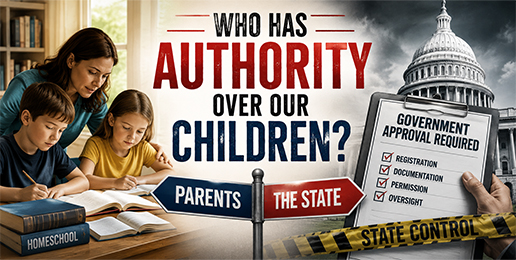
Are you a parent who homeschools? Then you must be abnormal, a danger to your own children. Or so says the Connecticut legislature. They’ve passed a bill, which became law, regulating who can homeschool.
These rules are designed to close what proponents say are blind spots in the systems Connecticut relies on to protect children from abuse.
…
Many homeschool advocates, however, bristle at the idea of any kind of government involvement and contend the DCF check amounts to an accusation that the homeschool community is rife with abuse.
If you want to “withdraw from school” then you’ll need prior permission from their Department of Children and Families. To them, you’re guilty unless proven otherwise.
However, you’re actually the normal one. Those advancing “child rights,” both in and out of Connecticut, are the abnormal ones. They’re the people working to overturn our society’s norms, and ignoring parents so they can directly affect children. Read on and you’ll see how they’re literally revolutionaries, working to break society.
Treating homeschoolers as morally suspect
The bill’s sponsors acted because the state was embarrassed by a child abuse incident. Homeschooling wasn’t involved, but they think that regulating homeschooling will help reduce child abuse. The text of the bill, which the governor signed into law, is at this link.
The bill says that the local school board can prevent homeschooling for a parent for which there is a complaint at its Department of Children and Families. Not that the parent is convicted of abuse, but that someone has entered a complaint.
According to the advocacy group Choose Education Independence, this is a gross violation of constitutional rights:
Homeschooling in Connecticut is privately funded and parent directed. It belongs to the family, not to the state.
HB 5468 asserts government authority over that private sphere by requiring homeschool families to register with school districts, submit ongoing documentation, and demonstrate educational compliance to public authorities.
So, while the education remains privately financed, the bill attempts to place it under public supervision. In that sense, the legislation treats private family education as though it were subject to collective ownership and control, rather than recognizing it as private property beyond the state’s rightful jurisdiction.
And Leslie Wolfgang, of the Family Institute of Connecticut Action, said this about the bill:
“This bill creates a system where exercising a constitutional right triggers government surveillance,” Wolfgang said. “That is not good policy—and it is not constitutional.”
Here’s how easy it would be to ruin a parent, and deny homeschooling persmission.
When most people hear “child abuse and neglect registry,” they picture a list of people convicted in court of brutalizing their children. That is not what Connecticut’s registry is.
A parent can be placed on the DCF registry if a caseworker checks a box declaring that he or she has “reasonable cause to believe” an allegation is true. There is no court hearing. There is no requirement to consider evidence in the parents’ favor. And most cases involve “neglect” — a term so broad and subjective in Connecticut law that it routinely captures families whose only offense is poverty — or a parenting choice a caseworker didn’t recognize or approve of.
The result is a registry that is “easy to get on to but difficult to get off”—increasing the likelihood that families remain listed even when the underlying finding is weak or disputed. The families least likely to be able to navigate a DCF appeal are the same families most likely to be caught in this bill’s net.
Under H.B. 5468, registry placement means no homeschooling.
Through its action the Connecticut legislature smears homeschooling as abnormal, such that its children are presumed endangered by their parents, and requires state permission.
Parents are the legitimate stewards of their children
By tradition parents have stewardship of their children. In every culture around the world, and from ancient times, the task of raising children is left to the parents.
The Bible tells parents to “train the child up in the way he should go” (Proverbs 22:6). This excellent article at Got Questions has a great summary about the Bible’s view of child raising. It’s a better article than I can write, so just go and read it.
From its very beginning our American Christian-based culture presumes that parental oversight of the family is normal, and expects that parents will guide and raise their own children. Even so, the government has, at times, vied with parents for control of child raising. But time and again the courts have affirmed the supremacy of the parents’ rights and responsibilities. For example, the 1972 U.S. Supreme Court decision Wisconsin v Yoder:
The history and culture of Western civilization reflect a strong tradition of parental concern for the nurture and upbringing of their children. This primary role of the parents in the upbringing of their children is now established beyond debate as an enduring American tradition. – Wisconsin v. Yoder, 406 U.S. 205 (1972)
These affirmed responsibilities explicitly include the parents’ right to influence their children’s thinking and values, both at home and through schooling. While some parents are satisfied with public school offerings, there is nothing wrong with parents who seek school alternatives for their children – private school or homeschool – that are more compatible with their own worldviews.
Parents must be jealous to defend their rights, for we see many schemes to overrule them. Without these stewardship rights you are merely a state-owned baby machine.
The rise of Child Rights
In the aftermath of World War I many people noted the ruined national economies and the numbers of orphaned children. This led people, notably Eglantyne Jebb, to publish the 1924 Declaration of the Rights of the Child. This document declared these principles:
- The child must be given the means requisite for its normal development, both materially and spiritually;
- The child that is hungry must be fed; the child that is sick must be nursed; the child that is backward must be helped; the delinquent child must be reclaimed; and the orphan and the waif must be sheltered and succored;
- The child must be the first to receive relief in times of distress;
- The child must be put in a position to earn a livelihood, and must be protected against every form of exploitation;
- The child must be brought up in the consciousness that its talents must be devoted to the service of fellow men.
In 1959 the United Nations adopted this language as its own proclamation Declaration of the Rights of the Child. And in 1989 the UN adopted the Convention on the Rights of the Child. The Convention covers the same ground as the 1959 Declaration, but expands its verbiage in ways that only a bureaucrat could love.
It’s good to care about children’s needs, and we can forgive the authors if their principles seem to be rather obvious to everybody. But note the focus of these declarations. The do-gooders mean to act directly with children, and not through their parents. This introduces a dynamic, an excuse, to reach past the parents and work directly with children.
Besides encouraging the government to nose its way into a child’s upbringing, child rights are also used to advocate for generally overturning how society works. Try this missive from the researcher Anna Holzscheiter:
Global child rights governance—also in its narrower focus on social issues and policies such as health, housing, food security, social benefits or education—has been evolving toward a field of global governance marked by a growing visibility of children and stronger claims for social justice made on their behalf, or sometimes even directly made by children themselves.
…
The idea that children are bearers of human rights has thus dislocated childhood from a narrow, traditional social policy agency focusing on health, social security, education, housing, childcare, labor and food security toward more fundamental social questions such as discrimination (i.e. gender, age), social exclusion, inequality and (distributive) justice, including intergenerational justice.
Decoding these sentences, we find:
- Global governance: A demand for international laws, superseding national soverignty.
- Social justice on behalf of children: The justification for becoming unwanted intermediaries.
- Crusade of children: Social demands supposedly “directly made by children themselves.”
- Distributive justice: What else but socialist property redistribution?
- Intergenerational justice: Trying to set the children against their parents.
These are a lot of requests for change, and all supposedly occasioned by a simple declaration of child rights. Or maybe the people with “overturn society” agendas find the declarations to be convenient levers for implementing change.
Child Rights vs Parenting
The concept that “children should be cared for” has quickly morphed into society-changing child rights, guaranteed by government edicts. James Dwyer is a prominent advocate of these expanded child rights. He wrote an article “debunking” the doctrine of parents’ rights. He’s not shy about shaking up society.
As a starting point, I closely examine judicial treatment of parental child-rearing rights and contrast this with judicial treatment of other legal rights. Through this analysis, it becomes apparent that the claim that parents should have child-rearing rights-rather than simply being permitted to perform parental duties and to make certain decisions on a child’s behalf in accordance with the child’s rights-is inconsistent with principles deeply embedded in our law and morality.
…
Concluding from this analysis that all of the proffered justifications for parents’ rights are in fact unsound, I recommend a substantial revision of the law pertaining to child-rearing. I propose that children’s rights, rather than parents’ rights, be the legal basis for protecting the interests of children. I propose further that the law confer on parents simply a child-rearing privilege, limited in its scope to actions and decisions not inconsistent with the child’s temporal interests.
…
It is important to recognize that this alternative approach would not entail doing away with the institution of the family in favor of collectivized child-rearing. Nor would it transfer to the State vastly greater control over child-rearing or enable the State to intervene whenever social workers think a parent is performing less than optimally.
Despite Dwyer’s assurances that his proposals aren’t “doing away with the institution of the family,” they would do just that. True, he’s not asking for socialist-style collective homes. But he is pushing for parents to essentially become unpaid employees of state social agencies. In his advice, America is supposed to overthrow everything we know about parenting, and make parents become caretakers for the government’s property interest in their own children.
Another child rights advocate is Elizabeth Bartholet. She labels homeschoolers as tyrants:
The legal claim made in defense of the current homeschooling regime is based on a dangerous idea about parent rights—that those with enormous physical and other power over infants and children should be subject to virtually no check on that power. That parents should have monopoly control over children’s lives, development, and experience. That parents who are committed to beliefs and values counter to those of the larger society are entitled to bring their children up in isolation, so as to help ensure that they will replicate the parents’ views and lifestyle choices.
This legal claim is inconsistent with the child’s right to what has been called an “open future”—the right to exposure to alternative views and experiences essential for children to grow up to exercise meaningful choices about their own future views, religion, lifestyles, and work.
It is inconsistent with state laws and constitutional provisions guaranteeing child rights to education. It is inconsistent with state and federal laws guaranteeing children protection against abuse and neglect.
Bartholet’s hate of homeschooling is a mere lead-in to her hate for parenting. Don’t you dare interfere with children’s exposure to libertine worldviews, or they won’t have an “open future.”
It isn’t just academics who believe in this expanded version of child rights. The Washington Post published an article asserting that parents must not interfere with the public schools.
[E]ducation should prepare young people to think for themselves, even if that runs counter to the wishes of parents.…
When do the interests of parents and children diverge? Generally, it occurs when a parent’s desire to inculcate a particular worldview denies the child exposure to other ideas and values that an independent young person might wish to embrace or at least entertain.
That is, parents have no right to shield their children from society-changing concepts. Neither may they interfere with a school predator or groomer having evil intent.
Are child rights advocates really interested in helping children? Perhaps not, or we wouldn’t get advice that parents who love their children are giving them an unfair advantage.
What we realised we needed was a way of thinking about what it was we wanted to allow parents to do for their children, and what it was that we didn’t need to allow parents to do for their children, if allowing those activities would create unfairnesses for other people’s children.
The concept of child rights is actually a struggle for power. Who ultimately gets to guide and educate the children – the parents or civil government? If government, then all children become wards of the state. With one sweep of the hand, these child rights advocates would set aside an entire culture of parenting and families. This is called “revolution.”
Socialism vs Parenting
The child rights agenda wants the government to have direct access to children, bypassing the protection and oversight of their parents. This also delights socialists, because they’ve always advocated for the abolition of families. Child rights and socialist designs on the family cooperate so well that I wonder how much the similarities are intentional.
Socialist views of the family come out of the writings of Karl Marx and Friedrich Engels. That is, modern socialism is so influenced by Marxism that there is really no separation between them. Marxism is relevant today because it is pervades the culture of American colleges. All students get exposed to it, and far to many of them become convinced that America has a socialist future.
Marxism has a problem with the institution of the family because its members are loyal to each other, and not to the socialist community. According to Engels, this is the fate Marxism has for the family.
With the transfer of the means of production into common ownership, the single family ceases to be the economic unit of society. Private housekeeping is transformed into a social industry. The care and education of the children becomes a public affair; society looks after all children alike, whether they are legitimate or not.
This isn’t mere theory, words without substance. The Bolsheviks in the early Soviet Union implemented it right away. They worked to put children in communal homes, that mothers may return to factory work. Here are their words of “encouragement” to mothers and wives.
The woman who takes up the struggle for the liberation of the working class must learn to understand that there is no more room for the old proprietary attitude which says: “These are my children, I owe them all my maternal solicitude and affection; those are your children, they are no concern of mine and I don’t care if they go hungry and cold – I have no time for other children.” The worker-mother must learn not to differentiate between yours and mine; she must remember that there are only our children, the children of Russia’s communist workers.
Under socialism your offspring belong to everybody. You have no personal rights to them, and no personal responsibility towards them. In the Soviet Union, the result of this policy was abject failure.
- Children were abandoned everywhere.
- Teen gangs ran rampant.
- There was an alarming drop in the birthrate.
The Soviet government reverted to encouraging traditional families as soon as possible.
But if implementing the Soviet anti-family policy was a failure, why should the child rights agenda still delight socialists? Because they never learn. Their mantra is always “that wasn’t real socialism.” We still hear the anti-family claims today.
Today, the main backwards role the family plays is the oppression of children, who are subjected to a tyranny of the parents and denied the basic rights which should belong to every human, most importantly the right of free development of the personality.
Hmmm, sounds like the Bartholet quote above, wanting for children an “open future – the right to exposure to alternative views.” See how easy it is to go from child rights to socialism?
Families, and the homeschools, depend on the parents. But both child rights advocates and socialists want to essentially do away with parenting.
Promote the revolution by shaming what is normal
Suppose that you’re a parent who would homeschool your children. Does this make you:
1.) Abnormal, a likely child abuser.
2.) A tyrant, denying your children an “open future.”
3.) Unfair to society, giving your children an unfair advantage.
4.) Completely normal.
The answer is 4. The other answers are slander. Being called a tyrant, etc., by child rights advocates doesn’t make you one. The other labels are meant to shame us, to discourage us from practicing our rights.
Illinois Governor JB Pritzker claims that his opponents are enemies of America, saying:
I think over the last year, much of what I said has been proven to be true, that the institutions of this democracy are being attacked by the Republicans and by Donald Trump.
Our institutions are indeed being attacked, but not by us. We’re trying to preserve our cultural inheritance, our practices that work. Rather, Pritzker’s friends – the socialists, the child rights activists, those trying to overthrow how we practice parenting – are the people attacking our institutions. They’re are the ones trying to overthrow our society.
Child rights advocates want reach into families to work directly with the children. This demand is pure invention, for there is no historical precedent for ignoring the parents. This is a cultural revolution implemented through bureaucracy.
If you can’t raise your own children without restrictive state oversight then both you and your children have become state property. You’re no longer citizens but subjects. We fought a war with Great Britain to cease being subjects. Is another war on the horizon, this time over attempts to enslave us?
If you love your children, and seek to teach them what is right and wrong, then relax because you’re normal. You’re striving to give them every advantage, and keep them from missteps. You’re reasonable. But the people in government, and in the schools, they have become unreasonable.