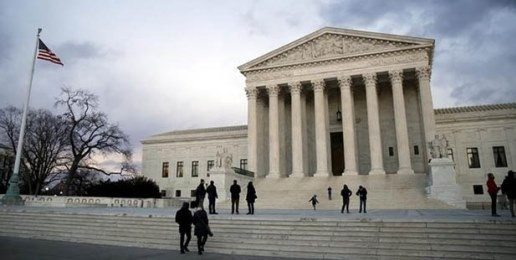
In a landmark decision in Mirabelli v. Bonta, the Supreme Court of the United States (SCOTUS) ruled Tuesday in favor of parental rights, delivering an important rebuke to government policies that attempt to sideline parents in decisions involving their own children.
In a 6–3 decision, the Court affirmed that a lower court was correct in restricting school officials from withholding information from parents when their child is experiencing “gender confusion” or requesting a social gender transition at school.
At the heart of the case was a policy that allowed school officials to facilitate a child’s gender transition while deliberately keeping parents in the dark. The Court rejected that premise outright, emphasizing that parents — not government bureaucrats — are the primary protectors of their children’s well-being.
This ruling reflects an obvious principle recognized throughout American jurisprudence and affirmed repeatedly by the courts: parents possess a fundamental right to direct the upbringing, care, and education of their children. As the Court stated, California’s policy effectively “cut out the primary protectors of children’s best interests: their parents.”
The Thomas More Society, one of the leading legal advocates for parental rights in the case, welcomed the ruling. Peter Breen, Executive Vice President and Head of Litigation, stated:
“No more can bureaucrats secretly facilitate a child’s gender transition while shutting out parents. California built a wall of secrecy between parents and their own children, and the Supreme Court just tore it down. This groundbreaking ruling will protect parents’ rights to raise their children as they see fit for years to come.”
While this decision represents an important victory for families across the nation, it also shines a light on how far some states — including Illinois — have moved in the opposite direction.
Over the past several years, Illinois lawmakers have repeatedly enacted policies that weaken parental authority and expand the power of the state over children.
Perhaps the most glaring example occurred in 2021, when the Illinois General Assembly repealed the Parental Notice of Abortion Act (PNA) — a commonsense law that required a parent, grandparent, stepparent living in the household, or legal guardian to be notified at least 48 hours before an abortion could be performed on a minor. Keep in mind, the bill only required notification of abortion, not consent.
Governor JB Pritzker signed the repeal into law in December 2021, and the requirement officially disappeared on June 1, 2022.
The result is astonishing: in Illinois today, a minor cannot receive an aspirin from a school nurse without parental consent — but she can obtain an abortion, one of the most serious medical procedures imaginable, without her parents ever being informed.
The repeal of this commonsense bill also provides cover for sex traffickers and pedophiles to continue their crimes. Think about that.
According to the Illinois Department of Public Health’s abortion statistics, 2,224 abortions were performed on minors in Illinois in 2023.
This shift reflects a troubling trend in Illinois policy. Increasingly, the state assumes that government officials, educators, and activists know better than parents when it comes to the physical, emotional, and moral welfare of children.
In the realm of gender ideology, the danger is particularly acute. Illinois law now classifies gender-transition procedures and medications as protected “health care,” and the state has positioned itself as a refuge for minors seeking such interventions — even when those actions may conflict with the wishes of their parents.
Such policies place government authority above parental responsibility and undermine the family structure long recognized as the foundational institution of society.
The U.S. Supreme Court’s ruling in Mirabelli v. Bonta affirms a truth the government should never deny: parents—not the state—are the primary stewards of their children, bearing the God-given duty to protect, guide, and raise them in the instruction and admonition of the Lord. In a concurring opinion, Chief Justice John Roberts, joined by Justices Amy Coney Barrett and Brett Kavanaugh, warned of the profound harm that occurs when government policies deliberately exclude parents:
“Under California’s policy, parents will be excluded—perhaps for years—from participating in consequential decisions about their child’s mental health and wellbeing. Thus, the parents are likely to suffer irreparable harm if California enforces its policy while this litigation winds its way through the courts.”
This warning highlights something fundamental that both Scripture and common sense affirm: parents bear the primary responsibility to guard the hearts, minds, and well-being of their children. Mothers and fathers are uniquely positioned to recognize emotional struggles, provide wise counsel, and help their children navigate confusing and difficult seasons of life. When schools or government officials deliberately conceal information from parents, they do more than violate parental rights—they deprive children of the wisdom, protection, and love that only parents can faithfully provide.
Children facing emotional or identity struggles need support, patience, and truth from those who love them most. Public policies that cut parents out of these deeply personal matters do not protect children—they isolate them from their most important advocates.
Scripture recognizes this responsibility. In Deuteronomy 6, parents are instructed to diligently teach and guide their children in the truth of God’s Word, shaping their understanding of life and identity. The state oversteps its authority when it encroaches upon the family and the God-given role of parents. When government inserts itself between parents and their children, it undermines the very order God established for the flourishing of families and society.
The U.S. Supreme Court’s decision in Mirabelli v. Bonta is a welcome reminder that parental rights are not a political invention—they are a fundamental liberty rooted in both natural law and long-standing legal tradition. Yet Illinois continues to move in the opposite direction, adopting policies that sideline parents and elevate government authority over the family. Christians and concerned citizens should recognize what is at stake.
Parents and grandparents must remain vigilant in guarding the spiritual, emotional, and mental well-being of their children, and our state lawmakers must be reminded that the family—not the government—is the primary authority in the lives of our children.
(IFI staff & AI tools assisted with proofreading, additions & clarity;
the human author made all final content decisions.)