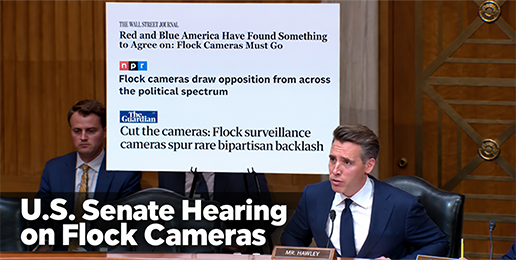
Last week, the U.S. Senate Judiciary Subcommittee on Crime and Counterterrorism held a bipartisan hearing titled “Always Watching: Flock’s Nationwide AI Surveillance Network.” Chaired by Senator Josh Hawley (R-MO) with Senator Richard Durbin (D-IL), the hearing examined the privacy risks, data collection practices, and potential Fourth Amendment violations associated with automated license plate reader (ALPR) systems and corporate AI surveillance networks.
The major hurdle remains: do we trust the government to surveil us constantly? Knowing the corrosive nature of power and the inherently tyrannical bent of the human heart, it is clear these tools can be weaponized to advance an agenda. We need only look at Communist China, which has deployed over 600 million CCTV cameras nationwide—utilizing extensive license plate and facial recognition systems to enforce “social credit scores“—to see the dangerous path this technology can facilitate.
Beyond the sheer scale of the network, there are significant concerns regarding misuse, user error, misidentification, database breaches, and indefinite data retention. Moreover, the practice of warrantless collection—conducted without informed consent or transparency—is a direct affront to our privacy and Fourth Amendment right to unreasonable searches. The vast majority of citizens remain unaware that they are being scanned and tracked in their daily movements.
For a better understanding of the bipartisan concerns at play, watch the subcommittee’s Q&A session HERE or at the end of this article. You will hear U.S. Senator Cory Booker (D-NJ) decry the use of these surveillance cameras to track those visiting abortion clinics, while Senator Hawley quickly raises parallel concerns regarding the surveillance of pregnancy resource centers and gun shops.
Watch the following opening statements by U.S. Senators Hawley and Durbin, and then the five witnesses who were invited to the subcommittee to testify.

The first witness, Lindsey Isaacs, was wrongly arrested for a fatal crash she had nothing to do with. A license plate camera had captured her vehicle a few miles from the scene; she spent 13 days in jail before prosecutors declined to pursue the case. Isaacs urges lawmakers to consider the human consequences when surveillance data shapes an investigation.

Alasdair Whitney also testified on behalf of the Institute for Justice (IJ). Mr. Whitney warned that automated license plate readers can create searchable records of Americans’ movements. He describes cases of misuse and mistaken identification, and calls for stronger safeguards, including warrants to access historical location data.

Sheriff Ross Teeple explained to the committee why he ended his department’s contract with Flock despite supporting license plate readers for finding stolen vehicles, missing people, and criminal suspects. In his testimony before this subcommittee, he warned that AI camera networks can track innocent Americans’ movements and urges Congress to set clear limits that protect Fourth Amendment rights.

Shocking testimony was given by Ben Jordan who told the subcommittee how he and other researchers found vulnerabilities in Flock’s cameras and surveillance systems, including exposed footage and sensitive license plate data. He urges Congress to require independent security testing of surveillance vendors and establish stronger federal privacy protections.

Even the testimony from the ACLU’s Chad Marlow consistently warned that automated license plate readers can track Americans’ movements and reveal private details about their lives. He questioned the public safety benefits of Flock’s camera network and urges Congress to prohibit law enforcement agencies that receive federal funding from using the technology.
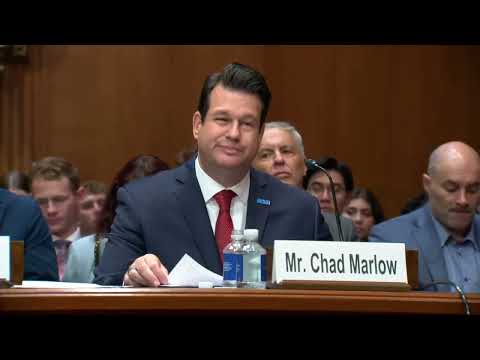
During the Q & A portion of this hearing, Senators examined how AI-powered license plate cameras can track drivers across the country and reveal visits to churches, gun ranges, and pregnancy resource centers. Witnesses raised concerns about weak data security and wrongful arrests, including Lindsey Isaacs’ 13 days in jail after investigators wrongly focused on her vehicle. The hearing centered on protecting public safety without sacrificing Fourth Amendment rights.

Conclusion
Public opinion is shifting sharply against the use of surveillance cameras that track our every movement. The majority of Americans are becoming intolerant of vast, AI-enhanced networks that monitor our daily commutes without our consent and provide no way to opt out. At its core, this is a constitutional crisis: does the Fourth Amendment not require the government to obtain a warrant supported by probable cause before tracking the movements of free citizens?
Take ACTION: Click HERE to send a message to your state and federal officials. Demand that they curtail or even eliminate warrantless surveillance and the mass collection of our private travel data. Urge them to mandate a warrant for searching historical travel records and to strictly limit how long such data can be stored or shared.
Pray that elected officials and the courts recognize their duty to protect our constitutional rights, our privacy, and our liberty, all of which deserve clear, ironclad protections.