
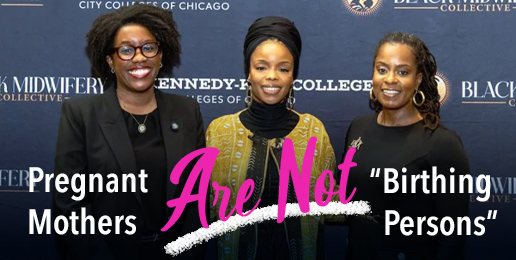
Recently, the Black Midwifery Collective (BMC) announced the start of a new program at Kennedy-King College in Chicago called, “Licensed Certified Professional Midwifery.”
Its express purpose purpose is to train students how to help “birthing individuals” and educate them on “institutional racism” and how to give “culturally responsive care.”
Unfortunately, the culture of “institutional racism” is alive and well in urban Chicago. This program is proof of that.
Critics of this program have rightly pointed out the dangers of supporting the idea that Black women require Black medical providers to combat racism, when in reality, quality medical care should be blind to DEI practices.
Dr. Kurt Miceli, the chief medical officer for Do No Harm, commented to The Fix,
“According to the Illinois Maternal Mortality Data Report from November 2025, the top five causes of pregnancy-related deaths in Illinois for 2021-2022 were substance use disorder, blood clots, COVID-19, postpartum bleeding, and heart conditions…
A midwife is not qualified to address these underlying problems…
Focusing on ideological slogans like ‘obstetric racism,’ as well as perpetuating the myth of racial concordance – that black patients need black providers – completely misdirects the conversation, prioritizes the wrong solutions, and does nothing to truly improve the lives of patients.”
To be clear, I am a big proponent of midwifery. I used midwives throughout my pregnancy with my daughter and am currently seeing midwives as my husband and I anticipate the arrival of our new baby in March.
I have nothing against the practice of midwifery – in fact, I personally find the practice to be superior to OB/GYNs in the case of pregnancy.
However, as Kristi Hamrick of Students for Life America notes,
“…if your program is unclear that it’s women having babies, it’s already off to a rocky start.”
Pregnant mothers are not birthing individuals.
Black women do not need to be seen by black medical providers in order to be considered to have received quality medical care. The same principle applies the other way. I do not need to be seen by a white medical provider in order for me to feel as though I have received quality medical care.
In fact, when I first went to the hospital when I was in labor with my daughter, the midwife on call in labor and delivery was a black midwife (who I was hoping would be there because she was my favorite).
The quality of medical care that one receives has nothing to do and should have nothing to do with the color of someone’s skin.
In an effort to “reverse racism,” programs like BMC are engineering racism where it does not exist.