
One of Victor Davis Hanson’s recent podcasts triggered a concern I have had for years.
He and his co-host spent a few minutes discussing two men. One was Charles Littlejohn, the IRS contractor who gave President Trump’s tax return and other return information to The New York Times and tax data for approximately 7,600 wealthy Americans and about 600 entities to ProPublica.
The other was Kevin Clinesmith, the FBI lawyer who altered a CIA email by adding the words “not a source,” thereby reversing its meaning. The altered email was then relied on when submitting the fourth and final FISA application concerning former Trump campaign adviser Carter Page, who had previously provided information to that same agency.
For more than fifty years, I have studied how institutions and the people in them work — how they describe themselves and what they actually do when nobody is watching. Something in the Littlejohn and Clinesmith cases reminded me of an image I had seen before. Repeatedly. In government. In corporations. In charities. In churches.
The events themselves are documented. What I cannot yet prove is that they are all expressions of a single mechanism. But the pattern is strong enough to name and examine.
You should know that Littlejohn did not get off easy on the single felony count to which he pleaded guilty. After an upward departure, the court calculated a guideline range of twelve to eighteen months. Judge Ana Reyes sentenced him to five years — the statutory maximum, more than three times the top of that range — and the D.C. Circuit upheld the sentence.
How do you explain the gap between the scale of the conduct and the case that was brought? The disparity begins with the charging decision.

Federal law permits consecutive sentences. No judge was going to stack 7,600 five-year sentences and send Charles Littlejohn to prison for thirty-eight thousand years. That is not the point. The number underscores the scale of what the charging decision erased. If prosecutors had charged and proved one violation for each taxpayer, the theoretical maximum would have been 38,000 years. The Justice Department charged one count.
The criminal case identified about 7,600 individuals and about 600 entities. The IRS later said it mailed notices to 405,427 affected taxpayers, 89 percent of whom were business entities. These are different measures, not 405,427 individual people or criminal counts.
Either way, the breach’s reach was enormous.
Judge Reyes said that the fact that Littlejohn faced a single count left her without words. She pressed the government on why it had not brought multiple charges that carried a much higher possible sentence. The D.C. Circuit later noted that the judge repeatedly asked because far more charges were possible. The government never publicly explained the full charging decision.
Prosecutorial discretion.
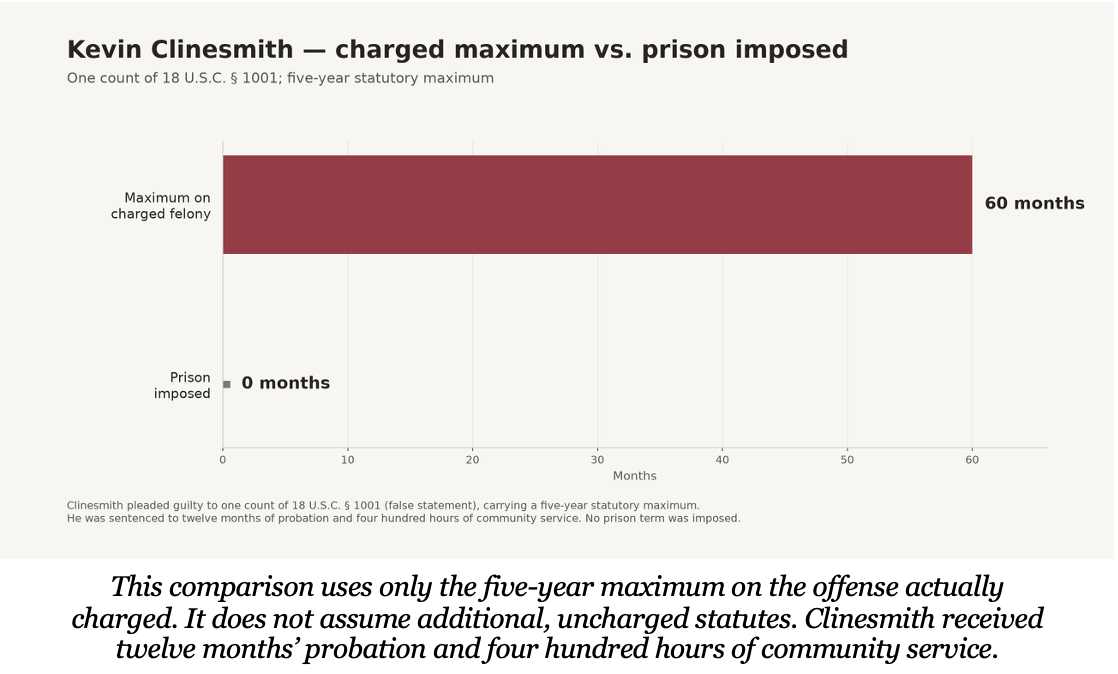
Now compare Clinesmith. The Justice Department’s Inspector General documented seventeen significant inaccuracies and omissions across the four surveillance applications involving Carter Page. Clinesmith was prosecuted for altering a single document. He added “not a source” to a CIA email and then sent the altered email to the agent preparing the fourth and final application. He pleaded guilty to one false statement and received twelve months of probation and four hundred hours of community service. He never went to prison.
According to reporting at the time, the D.C. disciplinary proceeding did not begin until five months after his guilty plea — four days after a reporter called attention to the inaction. The D.C. Court of Appeals ultimately approved a one-year suspension, retroactive to the date he reported his conviction, concluding that the offense did not involve moral turpitude.
Michigan, looking at the same underlying conduct, automatically suspended him and later imposed a two-year suspension and assessed costs.
Same lawyer. Same act. Two bars. Two answers.
Michigan matters because it shows that professional self-regulation does not make a weak judgment inevitable. A professional body can reach a tougher conclusion. But both outcomes expose the structural problem. When an institution judges one of its own, it often judges two things at once: the member’s conduct and the adequacy of the institution that admitted, supervised, and trusted him—the incentive shifts toward containment.
Littlejohn and Clinesmith did not commit the same offense. Their motives may not have been the same. I am not trying to make them morally interchangeable. What connected them in my mind was their position. Each had been entrusted with access and authority the public did not have. Each used that position to substitute his own judgment over the law and regulation.
Call it insider substitution.
It does not require a conspiracy. It requires an insider with entrusted power, an expansive view of his own authority, and an institution eventually left to judge both the insider and itself.
I have seen this many times even inside the denomination to which I once belonged.
In the early nineteen-seventies, I was a member of the American Lutheran Church. One year, my congregation formally designated me a delegate to a convention in Chicago — a district gathering, as best I can now remember.
The ALC was a conservative body, more conservative than I was at the time, and I was no liberal. Its constitution officially affirmed the inerrancy of Scripture. It maintained pulpit and altar fellowship with the even more conservative Missouri Synod until widening doctrinal differences — including the ALC’s move toward a merger with the more liberal Lutheran Church in America — ended that relationship.
So, when I first read that a national officer of the American Lutheran Church had spent church funds to bring sexually explicit film seminars from a San Francisco organization into the denomination, had funded a homosexual caucus, had sat for years on the board of the Sex Information and Education Council of the United States, and had helped establish a university sex program, my first thought was that the archive had made a mistake. It must have meant the LCA. That would have been believable.
It was not a mistake.
The man was the Reverend Doctor James A. Siefkes. He helped establish the ALC’s Department of Congregational Social Concerns in 1969 and served as its director. He served on the national staff until 1991 and died in 2016. Most of what follows is from his own words, recorded in 2011 by an oral history interviewer from the University of Minnesota, with his own files in front of him.
An enemy was not describing him. He was explaining his work.
The Agenda
Before looking at the method, it is worth asking what the agenda was.
Siefkes believed the church’s position on homosexuality was wrong — not merely its pastoral tone but its discipline. He convened the first gathering of Lutheran homosexual men and women, paid their travel expenses, housed them for three days, and funded the caucus that grew out of it. By his account, the American Lutheran Church became the only denomination in the country to bankroll such an organization with church funds. He worked with a woman he described as one of the first lesbians irregularly ordained in the ALC — that is, ordained outside the church’s own order. When the successor denomination finally voted to ordain partnered homosexual clergy, he called it the important thing that had eventually happened.
He served on the board of the Sex Information and Education Council of the United States for seven years. When he described what he had come to believe, he moved beyond the confessions of his own church to Paul Tillich, who described God as the ground of being. Siefkes then made his own leap: he declared sexuality to be the ground of our being as well. Clearly, that was Siefkes reading his own desires into Tillich, not reporting Tillich’s theology.
This is another example of substitution, one he stated plainly.
Near the end of his life, Siefkes described himself as “not a very religious person” and said he was no great admirer of the Apostle Paul.
The agenda was not hidden from the interviewer in 2011. It was not disclosed to the congregations that had paid for it four decades earlier.
The Method
Siefkes had learned to work around the stated rules before he ever arrived in Minneapolis.
Through the 1960s, he served as a regional stewardship director for the ALC — first from Dallas, then from Palo Alto, covering nine western states. Visiting congregations in financial trouble, he concluded they were out of sync with what was really happening in society. So he built a program he called Matrix, from the Latin for womb, a space where new life is conceived, and began taking pastors and their wives to San Francisco.
The Tenderloin YMCA. The campus riots at San Francisco State, where he walked them through the picket line — his phrase — to hear a few heads being hit with clubs. Meetings with the Black Panthers. Draft counselors. And half a day at Ted McIlvenna’s National Sex Forum.
Then he built the methodology. Each time he ran a Matrix in one city, he paid for a carload of people from another city to attend. If they wanted to run their own when they got home, he funded that as well. Phoenix came to Denver, went back, and set one up. He described the result as lines spreading across the church, infusing the ecclesial system with information.
That is his own phrase. He was not describing a program. He was describing a delivery system, and he had proven that it worked before anyone in Minneapolis knew his name.
Word got back to the national office. In 1969 he was invited to Minneapolis to start a new department: Congregational Social Concerns.
And here is where it turns.
The board’s one expectation was that he write a manual on how to do congregational social concerns. He refused — “You’ve got the wrong guy” — telling them the issues were too many and too large, and that only the people experiencing them really knew what was going on.
So the board asked what to do instead.
Keep going with Matrix, he said. When asked what else, he proposed taking one issue at a time and exploring it to see what could be done with it. He suggested the issue of human sexuality to start and offered to bring his friends from Glide to Minneapolis for a two-day seminar.
His mandate was genuinely broad — race, hunger, criminal justice, the environment, Vietnam, Latin America. Eventually, forty people reported to him across all of it. But the board had approved a method before it approved a subject, and the man who supplied the method also supplied the subject. Nobody voted to make human sexuality the operating center of the new department. A board asked one man what to do, and he told them.
The License
Before he carried out any of it, he did one more thing.
Siefkes said he arranged to include “action research” in the church’s constitution and bylaws before doing anything else, “so I had a license.”
He defined action research as learning by doing — act, reflect, act again. It sounds like nothing. It is a procedure, not a doctrine. Nothing in the phrase announces a program to restructure sexual attitudes. But Siefkes regarded it as a basis of authority for an open-ended activity in the church’s governing documents.
The other half was already in place. The constitution permitted direct programs to promote human welfare. Many people, Siefkes acknowledged, understood that to mean charities. He understood welfare to mean the whole human scene.
Whether or not that interpretation was ever formally tested, it gave him the language to defend what he built.
Siefkes never amended the confession, nor did he even try. The ALC constitution officially taught the inerrancy of Scripture throughout his tenure there. He did not touch a word of it.
He never had to.
This is not uncommon. In The Subversion of Compassion, I documented the same administrative approach in federal food programs: statutory restrictions remained on the books while verification and enforcement were progressively weakened. The purpose was not changed by legislation. It was hollowed out by administration.
Siefkes did not repeal the doctrine of the American Lutheran Church. He created wiggle room to operate around it — with a department, a budget, and a job description he largely defined himself.
The Program
The first Minnesota seminar took place in June 1970. Siefkes brought the National Sex Forum program to Minneapolis and ran it in a downtown condominium tower with drapes over the windows.
The guest list was the church’s: one of the bishops and his wife, members of the national church staff, Catholic Social Service, the YWCA, and the Lutheran Social Service agencies of Minnesota, South Dakota, and Wisconsin. He also invited the University of Minnesota Medical School. A doctor named Ted Cole came in place of a colleague, returned to the medical school, and within two months the university had run its own pilot.
The program’s core was a module called the SAR. Its original name was Sexual Attitude Restructuring. It was developed at the National Sex Forum, then an arm of the Glide Foundation in San Francisco, by two Methodist ministers, Ted McIlvenna and filmmaker Laird Sutton.
In Minnesota, it was renamed Sexual Attitude Reassessment. Mary Briggs, one of the Minnesota program’s founders, later explained why with unusual candor: they did not want to be seen as restructuring anyone. They wanted it to sound as though people were merely looking at and studying things. The change was cosmetic, and she said so.
The first name serves as the mission statement.
The program grew into what Siefkes called a Week of Enrichment — roughly five days, about sixty hours, designed for pastors, seminary students, seminary faculty, and the social workers of Lutheran Social Service agencies. Most of those sixty hours were worthwhile. Siefkes lectured on the church and sexuality. Ted Cole spoke on sexuality and disability. Wilson Yates, dean and later president of United Theological Seminary, lectured on ethical systems. He taught a room of clergy that the view he called deontological — in which right and wrong are settled once and for all — was one option among several, alongside the ethics of ends and the ethics of the loving act in the moment.
Two of those sixty hours were something different.
The SAR
The best description I have found comes not from Minneapolis but from a man who attended the National Sex Forum’s course in San Francisco. George Leonard was a magazine writer and author who enrolled in Human Sexuality #101 while researching a book.
Leonard did not attend the Minnesota seminar, and I cannot establish that every film or sequence was identical. He attended the San Francisco source program, created by the same people, from which Siefkes imported the SAR model. His account therefore reflects the philosophy and methods of the originating program, not necessarily the exact content of every Minnesota presentation.
Briggs later said the Minnesota group adapted the entire process. They changed what surrounded the central presentation — the lectures, the reassessment label, the trained facilitators, and the small-group processing. They did not remove the explicit sexual content from the center.
Leonard was not a critic. He admired the men who ran it and thought the course worked very well indeed.
He summarized its purpose this way: to provide information about sex; to break down stereotypes about homosexuals, bisexuals, the elderly, and the disabled; to desensitize members of the audience so they would not be shocked by a wide variety of sexual behavior; and to present sex as a rich and enjoyable experience.
Leonard described multiple explicit films projected at once:
“Sensory overload reached its climax on Saturday night with a multimedia event . . . As we lounged on cushions in the darkness, the whole wall lit up with images of human beings and sometimes animals engaging in every conceivable sexual act, accompanied by wails, squeals, moans, shouts, and the first movement of the Tchaikovsky violin concerto. It was a technical triumph: up to seventeen simultaneous moving pictures, mostly excerpted from commercial pornography, projected over a period of forty minutes. How did we react? There was shock, laughter, sporadic arousal, and, finally, boredom. By the end . . . nothing seemed shocking. The physical act of sexual joining seemed commonplace. I considered myself thoroughly desensitized.”
Again, that was not a side effect. Desensitization was one of the stated purposes.
The Minnesota program added small-group discussions afterward. Participants were placed in groups of eight or ten with trained facilitators to discuss what they had just seen and felt. Mary Briggs also said people were stationed to intercept anyone who walked out during what could only be described as an extreme porn show, crudely dubbed and widely known as the F***-O-Rama, because the organizers did not want anyone going back onto the street with that as the last thing on their minds.
The sequence is intentional: shock, sensory overload, and then guided interpretation. The program did not merely expose people to explicit material they had never seen before or would ever see again. It provided the setting in which they were to interpret what the exposure meant.
It was an indoctrination.
According to Siefkes, several thousand people eventually went through the program, including a couple of bishops. One bishop and his wife later publicly defended it. At United Theological Seminary in the Twin Cities, Siefkes said the films were projected onto the chapel walls.
Four pages after describing the course, Leonard — who liked it, defended it against academic critics, and considered the shock tactics justified — arrived at this:
“Nothing about sex was shocking. But nothing was sacred either.”
That is a man sympathetic to the entire enterprise, reporting what the program had taken from him.
The men who built it were candid about the instrument. “Pornographic films,” McIlvenna told Leonard, “have done more to help people see their options than all the sex therapists in town.” The woman who led Leonard’s course was equally direct about what was missing. Human Sexuality #101, she explained, focused on sex, not on love, romance, or intimacy.
One other detail belongs here. Among the early funders of the University of Minnesota program was the Playboy Foundation. Siefkes acknowledged and defended the foundation. The foundation had no real input into the product, he said; it simply liked what was being done. The church was accused of being in bed with Playboy, and in a narrow accounting sense, it was.
The comparison is more than an accusation. Playboy sold a centerfold wrapped in serious writing by serious writers, and that writing was not a pretense. That was precisely why the arrangement worked. A man could buy the magazine and discuss the interview. The Week of Enrichment had a similar structure. Ted Cole’s work on the sexual lives of people with disabilities was real, humane, and needed. Wilson Yates believed in his lectures on ethics. Fifty-eight of the sixty hours could be defended, and a pastor who attended could describe them to his elders with a clear conscience.
The other two hours, the SAR, were the centerfold.
The Build-Out
Then Siefkes built the network.
By his own count, he eventually had as many as forty people working under him across the country — on race, health, criminal justice, hunger, men’s issues, the environment, Latin America, and transnational corporations. Each reported to him every six months and received a subsidy or stipend from his office. He kept a file drawer with every name and program. These were people, he said, you did not have to motivate.
About ten thousand dollars a year in church funds went to bring social workers, pastors, and seminarians to the seminars. He gave the University of Minnesota Medical School its first ten thousand dollars, and the total grew to sixty thousand. He paid for travel and lodging for the founding meeting of the Lutheran homosexual caucus and continued funding it afterward. When participants returned home, they were expected to do what the Matrix participants had done: reproduce the program in their own communities.
Siefkes knew what formal authorization looked like because his division had used it elsewhere. When the ALC gave the American Indian Movement its first eighteen thousand dollars — a story in itself — he carefully noted that he had full board approval and that Paul Boe had initiated the funding.
The point is not the grant. The point is the process. He knew the difference between a controversial action expressly approved by the board and one defended afterward with broad language about human welfare.
How They Found Out
The congregations paying for the program were never asked to approve its direction before the first seminars. Some church officials knew a sexuality program existed and participated in it. That is not the same as informing the presiding bishop, the congregations, and convention delegates what lurked at the program’s explicit center.
I know that firsthand. I belonged to one of the congregations that paid for it, and my congregation later sent me as a delegate to a regional convention. Neither the congregation nor the delegates were informed about the SAR.
The initiating board accepted human sexuality as the department’s subject; a bishop and members of the national staff were invited to the first seminar; and Siefkes later said his board authorized part of his work with the University of Minnesota. However, according to Siefkes’s account, the presiding bishop learned the program’s explicit details only after receiving the Commonweal article, the national Catholic journal.
Siefkes called the article a pretty accurate, highly detailed description. It circulated across the country. A pastor in California obtained a copy, flew to Minneapolis, and hand-carried it to the presiding bishop. No one had provided the explicit videos to the presiding bishop, let alone explained them. Commonweal did.
“The search was on,” Siefkes said, to find out who had done this.
His office responded: We did it. We believe it is within our purview because we did our homework and had constitutional authority to direct programs promoting human welfare.
The defense had been built years earlier and was waiting.
Siefkes made one other statement about his own activities that matters. He always tried to be truthful about what was going on, he said, but he did not always explain everything. People get confused by too much information at once.
Truthful, but not fully explanatory. That distinction will protect almost anything.
They Objected
The people of the American Lutheran Church were not asleep.
Siefkes counted and sorted his own mail: 176 letters. Thirty-six were thanks from people who had been through the program. He said eighty-two were protests — seventy against the involvement generally and eleven against a single episode in southern Minnesota. Those two subcategories add up to eighty-one, not eighty-two; the inconsistency is in his own account. Fifty-eight came from pastors who needed something, anything, to tell their congregations because their people were asking.
A conservative newsletter, Lutherans Alert, was sent to all five thousand ALC pastors nearly every month, opposing what he was doing. Christianity Today published an article titled “Dollars for Disobedience,” accusing him of spending God’s money to disobey God’s word. The denomination’s presiding officer did not favor the program and, according to Siefkes’s own account, would have liked to end the relationship with the medical school altogether.
Two national conventions took it up. At Detroit in 1974, the convention called for an open hearing. At Washington in 1976, people came, Siefkes said, ready to lower the boom, arriving with their arms full of material. A delegate’s wife raised the issue from the floor. The convention scheduled an open forum that evening, and the room was packed.
They objected. Through every channel the church gave them.
The Unspeakable Center
Yet in the record I have reviewed, the debate appears to have focused on the money, the propriety, the association with San Francisco, the medical school, and the use of church authority. Those were all legitimate issues. But the program’s explicit core was much harder to articulate in ordinary church speech.
I cannot prove that no participant ever described the films or that no opponent ever named them. The record is too extensive for that absolute claim. But the barrier is easy to see.
No one was sworn to secrecy. Nothing had to be concealed by formal agreement. The content itself imposed silence. To describe it publicly, a pastor first had to identify himself as a participant. Then he had to bring into his own sanctuary or council meeting the details of what he had witnessed. He could instead talk about the disability lecture, the seminary faculty, the ethics discussion, and the professional value of the training — all of it true, and none of it the part that had produced the shock and desensitization.
Siefkes’s distinction between truthfulness and a full explanation mattered. A participant could give a truthful account while omitting the center.
That, I believe, is why the objections never landed with their full force. The people on the outside knew something was wrong. The people on the inside had the most direct knowledge but also bore the greatest cost for describing it.
An unspeakable center protects itself. Nobody needs to arrange it.
The Investigation That Judged Itself
The convention passed a resolution. The head bishop appointed a committee of ten — five from Siefkes’s board and five from the church council. According to Siefkes, none had completed the program.
The committee was formed to study the church’s involvement in the program. At its first meeting, Siefkes offered to prepare the report himself. The committee ultimately accepted the arrangement and directed him to report the project’s findings.
Whatever the committee intended, it was not an independent fact-finding process. The person most responsible for the program became the principal author of the account used to evaluate the program.
He wrote them: sixteen findings in sixty-three pages. He delivered ten copies to the committee, and more than ten thousand were eventually distributed throughout the church.
But there was no decisive verdict. The broad authorization had done its work. The Constitution permitted programs promoting human welfare. Siefkes said he had arranged to include action research before he began. The men who approved the language may have understood welfare to mean charity; he understood it to mean the whole human scene.
The church was investigating a man for violating rules he had helped put in place, according to a meaning he supplied, and it relied on the central findings he provided. That was not an independent investigation. It was an institutional process built around the subject’s own account.
The American Lutheran Church ceased to exist in 1988 without ever rendering a final judgment on Siefkes’s program or methods. The objectors never received a ruling, and the case disappeared into the merger.
In August 2009, the ELCA revised its ministry policy to permit people in publicly accountable, lifelong, monogamous same-sex relationships to serve as rostered leaders.
That vote did not approve the program or the sexually explicit film. It did something else. It adopted the direction Siefkes had been pushing the church toward for thirty-nine years.
The following year, the American Association of Sexuality Educators, Counselors and Therapists presented Siefkes with its Humanitarian Award. The ELCA’s presiding bishop then thanked him for leading by example, called him a voice for justice, and praised his passion and perseverance.
Siefkes framed the letter and hung it on his wall. He said it was the institutional church telling him that what he had done was okay.
At the beginning, the top national leadership and the people in the pews were bypassed. Once the presiding bishop was alerted, leadership looked, objected in places, investigated, and failed to reverse what had already been built.
The objectors never got a ruling. Siefkes got a commendation.
The methods were never judged. The direction was adopted. The man was honored.
What the Machinery Is
In my article For a Bowl of Stew, I wrote that when a church hands a ministry to a third party, the third party’s rules become the church’s. It is not that anyone in the church necessarily sets out to strip away the gospel content. Rather, the container into which the ministry is poured has no room for it and cannot hold it.
In that article I described only half of the machinery.
Siefkes described the other half himself. If the church came under fire, he could argue that the program could not be all bad because the University of Minnesota Medical School was doing it. If the medical school came under fire, it could claim that it had the support and participation of a mainline Protestant denomination.
Each institution treated the other’s participation as validation. Neither had to return to first principles. The arrangement was structurally incapable of producing a real audit, not because anyone suppressed one, but because each party’s involvement served as the other’s permission slip.
That brings us back to the bar associations. The District of Columbia judged Clinesmith one way, while Michigan judged the same underlying conduct another. Self-regulation does not mandate leniency, but it creates a conflict that cannot be wished away. The institution must judge a member while also confronting what the member’s conduct reveals about the institution’s supervision, standards and reputation.
The same mechanism can operate without the same offense occurring.
Littlejohn violated a clear legal prohibition. Clinesmith altered a record used to obtain judicial authority. Siefkes worked primarily through expansive administrative authority. They are not equivalent men, and these are not equivalent acts.
The connection is substitution.
Each man held a position of trust. Each decided, in one form or another, that his own judgment should control the use of authority placed in his hands. The insider supplied the action. The institution supplied the position and access. The reviewing body supplied the containment.
No conductor required.
By Their Fruit
Jesus warned about wolves in sheep’s clothing, and I turned to that verse first as a reminder of what we need to guard against. But the next verse matters even more.
By their fruit you will recognize them. Not by their intentions. Not by their sincerity. By what grew.
I cannot tell you everything James Siefkes intended. I do not need to. I can tell you what he did because he described it himself. He arranged for authorizing language to be included in the governing documents before acting. He relied on a phrase about human welfare that he acknowledged many others understood more narrowly. He said he tried to be truthful but did not always explain everything. And when the presiding officer’s opposition became clear, the work continued.
That was not the theatrical version of subversion — no secret cabal, no common orders, no conductor. It was administrative subversion: an insider converting elastic authority into operational power and then defending the outcome in the language that made it possible.
Littlejohn told the court a desire for transparency drove him, and the judge said his actions were guided, however mistakenly, by a genuine belief that he was doing right. The trove he handed to ProPublica included George Soros, Michael Bloomberg, Warren Buffett, Bill Gates, and Mark Zuckerberg, alongside Ken Griffin and Rupert Murdoch.
He selected by wealth, not simply by party.
He decided that 7,600 people had forfeited the protection the law gave them, and he seized an authority nobody had granted him. Trump was a separate and targeted matter; the government’s own filings say Littlejohn sought the contractor position in 2017 to obtain the sitting president’s returns.
Clinesmith’s motives are more opaque, and I cannot speculate. He said he believed the information he inserted was accurate. Nothing in these records requires a predatory motive to explain the conduct.
That is exactly the difficulty.
A wolf is rare. We know to screen for one. We see a wolf as a vicious beast. But a man who is certain he is right can create his own job description, control information others do not have, and who the successor institution may eventually thank does not look like a wolf. He looks committed. Innovative. Courageous. Persevering.
None of these men seemed predatory or vicious. Yet the fruit they all produced was rotten throughout. Appearance is irrelevant. It’s in the outcome that the wolves become visible.
Perseverance is not enough. Siefkes had perseverance in abundance. Honesty is not enough if the speaker reserves the right to decide which part of the truth others need. Institutional loyalty is not enough when it means protecting the institution from the meaning of its own record.
The safeguards are not mysterious. Authority must be stated narrowly enough to be understood. Controversial programs must receive explicit approval, not retroactive justification using elastic language. Outside funders and institutional partners must be disclosed. The person whose conduct is being examined cannot write the findings. Dissent must be recorded and addressed. And when an institution is required to judge both one of its own and the adequacy of its own controls, an independent party must be involved.
I have documented pieces of this system before — in No Conductor Required, Equality Illinois and the Network Behind It, The State Is Not a Parent, and For a Bowl of Stew. What I had not done before was to say plainly that they are manifestations of one thing.
Insider substitution.
The motto of the unit where I served during my years in the Air Force applies here: “The Price of Freedom is Eternal Vigilance.” So it is with every institution worth saving, with every good thing worth keeping.
Someone outside has to be watching.