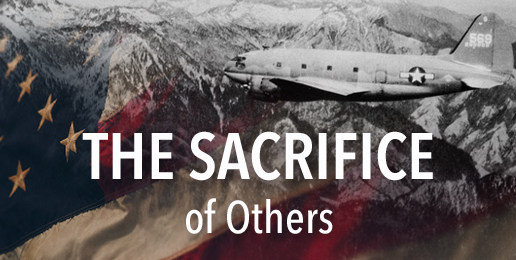
On a bright day over the eastern Himalayas, my dad sat at the controls of a C-47 Skytrain as it climbed out of Assam, India, with nothing but mountains and clouds in every direction. The men who flew that route called it “the Hump.”
The world below his windshield was a maze of rock and jungle stretching toward China, with peaks high enough to rip the bottom out of a fully loaded transport and valleys just wide enough to slip through. Every mile between the Assam Valley and Kunming was a gamble with death. Still, those flights were the only way to keep China supplied and to deliver ammunition, rations, and fuel to American units fighting deep in Burma’s jungle.
My dad didn’t see himself as a hero. He was just a young American from Pennsylvania who was a pilot at a time when the country needed pilots to do the impossible. By the end of his 18-month tour, he would say you could follow the Hump routes just by following the crashed planes.
The C-47 Skytrain, affectionately called a Gooney Bird by the men who flew them, was a big, rugged airplane, but it lacked the power to fly above the tallest Himalayan peaks. That meant he and his fellow pilots couldn’t simply fly over the mountains; they had to wind their way through them. On many missions, they flew in the valleys, weaving between ridgelines rather than soaring above them.
The weather over the Hump could change in minutes. A pilot might leave Assam under blue skies, only to see solid clouds roll in as he neared the mountains. When that happened, the world outside disappeared. The mountains, the ridges, the passes—all of it vanished into a heavy gray mist. Inside that gray covering, you were blind, but you kept flying by instruments and sheer faith that your dead reckoning was accurate enough to keep your wings from brushing the rock you couldn’t see.
There was no GPS. No modern terrain-warning systems. No satellite weather. Just a compass, a map, a watch, and the best estimate of where you thought you were. A small navigation error could mean a wingtip scraping a ridge or an entire crew being erased in a blink.
One of the three routes out of Assam held a special kind of terror. The Japanese had carved the top off a mountain to build an airfield, turning the summit into a launch pad for fighters. They had no radar on that mountaintop field, just their eyes. My dad’s and the other pilots’ only hope was to stay low in the valley below that mountain, so low that if the Japanese looked out from the airfield, his C-47 would be hidden beneath the ridge’s rim.
Dad told me how they would fly at treetop level through the valley, then look up to see Japanese fighters taking off from the carved-off summit above them, enemy aircraft climbing into the same sky his unarmed transport had to occupy unseen, while he and his crew slipped through the shadowed valley below with nothing but their wits, their courage, and a compass to guide them. The fighters were up in the light; my dad’s crew was down in the dark, praying the clouds and terrain would cloak them long enough to get past.
Losses mounted with grim regularity. My dad’s squadron went to India with fifteen C-47 crews. By the time the war ended, only two of those original planes and crews had survived. The others had disappeared into mountainsides, been blown apart in storms, or gone down over the jungle and never been found. Replacement planes and crews arrived, and all too often they vanished the same way, into clouds, ice, and silence. When we talk about the Hump as an “airlift,” we ought to remember that it was an airlift built on aluminum wreckage and empty bunks.
These were horrifying losses.
In that forgotten corner of the war, he was awarded the Distinguished Flying Cross and the Air Medal twice for his Hump missions. Those decorations were often pinned on posthumously. Many crews never lived long enough to fly the missions and log the hours those medals required, and when they did, the awards were mailed home to grieving families instead of hung on uniforms at victory parades.
In his squadron, thirteen of the original fifteen crews never got that chance.
The Hump wasn’t the only place my dad’s courage showed. On one mission, his squadron was sent to resupply Merrill’s Marauders, the long-range jungle unit fighting deep behind Japanese lines in Burma. The Marauders were encircled, down to the bare minimum of food, water, and ammunition, and they desperately needed artillery to hold their position. The only way to keep them alive was by air.
The drop zone was little more than a small clearing in the dense jungle. If the pilots missed that opening by even a hair, the water, food, cannon, and shells would disappear into the thick canopy, hung up in the trees where no one could reach them. To make matters worse, Japanese troops had slipped through the American lines and set up machine-gun nests along one side of the clearing, waiting to cut down anyone who ventured out to collect the supplies.
My dad’s C‑47 was the first airplane in. As the bundles came down, he watched men from Merrill’s Marauders get hit as they ran into the clearing, trying to drag the supplies back to cover. So he did what he could with what he had. He shoved the nose down and brought that big transport in just above the treetops. With the aircraft skimming the jungle, he had his six‑man crew hang out of the double‑wide cargo door with their Thompson submachine guns, raking the Japanese positions to suppress their fire as they circled.
There were no mounted guns, no armor plates, no manual for turning a cargo plane into a gunship. Just six men hanging out an open door over Burma, trusting their pilot and throwing as much counter-fire as they could to protect the soldiers below. They kept that pattern, circling and strafing from an “unarmed” transport, until every magazine was empty, long enough for Merrill’s Marauders to bring in the supplies and retake control of the clearing they needed to survive.
Years later, when I was in the Air Force, I watched a demonstration of the AC-47 “Spooky” gunships used in Vietnam. They were old C-47s converted into “dragon ships,” bristling with side-firing Gatling guns aimed out the cargo door and flown in circles over enemy positions. I couldn’t help but think of my dad and his crew. I credited them with creating the idea, which they put into practice in a makeshift version of that same tactic over Burma, using their Thompsons in their C-47.
All of this, my dad did as a single man in a single squadron, in a single theater of a very big war. He came home with medals and stories he rarely shared. The men who didn’t come home left only stories others told about them. Their names are scattered across unit rosters and after-action reports, buried in archives most Americans will never read.
And yet, the freedom we celebrate on July 4th rests as much on their shoulders as on those of Washington’s army.
Over the past 250 years, the cost of American freedom has been paid, again and again, by people whose names most of us will never know. We rightly honor the founders who pledged their lives, fortunes, and sacred honor in 1776. But we must also honor the pilots whose planes never made it over the Hump, the infantrymen who never made it out of the jungles of Burma, the sailors resting on the ocean floor, and countless others in every war since.
My dad’s sacrifice, and that of the men who did not return from those Hump flights, is no less than that of the soldiers who marched barefoot with Washington’s army. The uniforms and weapons changed, as did the geography and the enemy. The price did not.
We owe it to them all to remember. We owe it to the men who froze at Valley Forge, the boys who fell at Gettysburg, the Marines on Iwo Jima, and the Hump pilots and Merrill’s Marauders in the Burmese jungle. Like my dad, most never had their stories told in classrooms or on television. Yet the liberty we take for granted rests on their unseen courage and unmarked graves.
Every generation is called to make the same commitment: to be willing, if necessary, to spend and be spent so that others can live free. Freedom is never free for any of us. It always has a cost, and that cost is paid in real lives and real blood and the grief of the people left behind.
On this Fourth of July, as the fireworks crackle and flags wave, I will be thinking of a young pilot from Pennsylvania flying through a valley under a Japanese mountaintop airfield, watching enemy fighters take off above him, and pressing on anyway. I will be thinking of a C‑47 circling a jungle clearing, six men hanging out the cargo door with Thompsons, holding off machine‑gun fire so that exhausted soldiers on the ground could live to fight another day.
And I will be thanking God for the legacy they all gave us—a country still free, still flawed, and worth defending.
May we honor those who paid the price before us, be grateful for what they secured at such terrible cost, and resolve that we will not squander the freedom they placed in our hands.