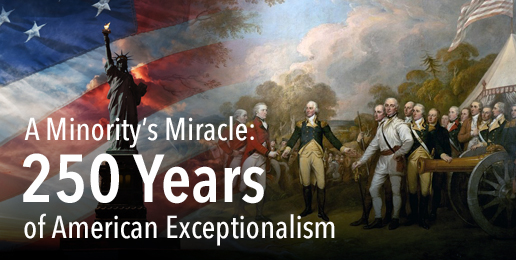
Two hundred and fifty years ago, on July 4, 1776, a small group of men — educated, propertied, and fully aware of what they risked — pledged their lives, their fortunes, and their sacred honor to take the first step toward founding something the world had never seen: a nation grounded in the conviction that rights come from God, not from government.
They did not claim to create those rights. They recognized them and built a republic whose sole legitimate purpose was to protect them.
What makes this anniversary worth examining is not simply that the American republic, set in motion 250 years ago, continues to survive.
What’s remarkable is that it survived at all.
That founding principle — that rights are endowed by the Creator and cannot be legitimately revoked by any government — is the most consequential political claim in human history. It means that freedom of speech, freedom of assembly, freedom of religion, and the right to keep and bear arms do not belong to Americans because Congress passed a bill.
They belong to every human being because that’s what God ordained.
No legislature can grant them. No legislature can take them away. A government that tries has not merely enacted bad policy. It has stepped outside its legitimate authority.
Except for ours, history has not been kind to revolutions.
They begin with genuine grievances, produce capable leaders, ignite the masses — and then they devour everyone in reach. Liberators become oppressors. Purges follow victories. New tyrannies replace old ones.
This pattern holds across cultures, centuries, and continents.
The American Revolution is the exception. Understanding why is the most important political question of our time.
Start with a fact that surprises most people: successful revolutions are almost never spontaneous uprisings by an oppressed majority. They are triggered, organized, and sustained by a disciplined, motivated minority.
The American Revolution was no different. Historians estimate that active Patriot supporters made up 40 to 45 percent of the white colonial population. About 15 to 20 percent remained loyal to the Crown. The rest — 35 to 45 percent — waited to see which way the wind blew. The fighting force was a fraction of a fraction. Between 10 and 25 percent of colonists served in some military capacity throughout the war.
The leadership core was even smaller. Samuel Adams organized the Sons of Liberty in Boston taverns. John Hancock financed the cause from his personal fortune. Patrick Henry thundered in the Virginia House of Burgesses. Jefferson drafted the Declaration. Hamilton ran Washington’s war from behind the general’s desk. Madison worked out the constitutional mechanics that would allow a free republic to endure across generations.
John Adams put it plainly.
“The Revolution was effected before the War commenced,” he wrote late in life.
“The Revolution was in the minds of the people.”
A small intellectual and political vanguard changed enough minds to sustain a war against the most powerful military on earth — and then designed a government capable of outlasting the revolution itself.
France: The Guillotine and the Emperor
When the French Revolution began in 1789, educated observers watched with cautious hope. Here was a great nation casting off absolute monarchy. The Declaration of the Rights of Man proclaimed that liberty and equality were the birthright of every citizen. The Bastille fell, and the people rejoiced.
Then the guillotine came out.
The French Revolution was driven by the educated bourgeoisie — lawyers, merchants, and intellectuals — who were right about the injustice of the ancien régime but wrong about what followed. They lacked constitutional architecture, separation of powers, and any principle to limit what the new revolutionary authority could do to its own citizens.
Without those constraints, they had not dismantled tyranny. They had only replaced it.
The deeper failure was philosophical. The Declaration of the Rights of Man used the language of natural rights and even invoked the Supreme Being. But the revolution failed to build a constitutional and moral structure capable of restraining revolutionary power once the revolution claimed necessity as its law. Rights became whatever the Committee of Public Safety said they were.
When the Committee decided that your rights had expired, there was no effective authority left to appeal to. The guillotine was not an accident of the French Revolution. It exposed the danger of a revolution whose stated rights could not restrain its own revolutionary power.
The Reign of Terror lasted from September 1793 to July 1794. Robespierre and the Committee of Public Safety officially executed roughly 17,000 people. Thousands more died in prisons, without trial, or in mass violence across the provinces. The revolution kept inventing new enemies because revolutionary purity, once established as the standard, is never satisfied. Robespierre himself was arrested and guillotined in July 1794 — consumed by the machine he had built.
What followed was not liberty. It was Napoleon Bonaparte. The revolution that began by abolishing a king ended by crowning an emperor. France would pass through five republics, two empires, multiple monarchies, and Vichy before reaching the comparatively durable democratic settlement embodied by the modern Fifth Republic.
The lesson is written in blood: rights proclaimed on paper are not secure unless the rulers themselves are bound by an authority above the state. A revolution that places no authority above itself has not produced freedom. It has produced a new tyranny with better rhetoric.
Russia: The Vanguard and the Gulag
Few revolutions are as instructive — or as expensive in human life — as the Russian.
In October 1917, the Bolsheviks seized power with fewer than 400,000 party members in a country of 160 million people. In the Constituent Assembly elections that followed, the Bolsheviks won roughly a quarter of the vote, while the Socialist Revolutionaries won the largest share of the vote and a majority of seats. Lenin responded by dissolving the elected assembly after one day of sessions and ruling by decree.
Lenin had theorized this in advance. His concept of the “vanguard party” held that the masses were incapable of guiding their own liberation — they needed a disciplined revolutionary elite to lead them to freedom, whether they wanted to be led or not. As the Library of Congress has documented, the Bolsheviks:
“were inherently hostile to any form of popular participation in politics” and “employed ruthless methods to suppress real or perceived political enemies, ruled by decree, enforced with terror.”
Lenin was also explicit about what rights meant under his system. Rights existed to serve the proletariat as defined by the Party. They were instruments of the revolution, not endowments of the individual. There was no Creator in the Marxist framework — Marx had dismissed religion as the opium of the masses. With God removed from the equation, nothing stood above the state. Rights became whatever the Party required them to be on any given Tuesday. When the Party required them to disappear, they disappeared.
The terror grew. Under Stalin, the Great Purges of 1937–1938 consumed hundreds of thousands to more than a million people, depending on what is counted — including many of the original Bolshevik revolutionaries. More Communists died in Stalin’s purges than had died fighting the Tsar. The revolution’s vanguard became its executioners, then its victims.
The Soviet Union endured 74 years as one of the most totalitarian states in human history before collapsing under the weight of its own lies. The revolution that promised to liberate the working class produced the Gulag.
China: The Body Count of Utopia
Mao Zedong’s Chinese Communist Revolution followed the same template, with an even higher body count.
Mao dispensed with philosophical ambiguity.
“Political power grows from the barrel of a gun,” he said.
That sentence is a complete theory of rights: you have what the gun allows, and nothing more. With no authority above the state — no God, no natural law, no fixed floor of human dignity — the Party could define and redefine rights at will. When the Party decided that peasants had the right to denounce their landlords, peasants did. When it decided that professors had no right to teach, professors were dragged into the street. When it decided that 30 to 40 million people had no right to eat, they starved.
Mao acknowledged from the outset that industrial workers — Marx’s intended revolutionary base — were a small minority in China. Accordingly, his movement cultivated the peasantry as a substitute. After seizing power in 1949, the Communist Party launched a series of campaigns that, according to The Black Book of Communism, led to an estimated 65 million deaths. The Great Leap Forward — Mao’s forced collectivization program from 1958 to 1961 — produced the worst famine in human history, leaving 30 to 40 million people dead from starvation.
The Cultural Revolution, launched in 1966, sent gangs of young Red Guards into universities, hospitals, and government offices to purge anyone suspected of insufficient ideological commitment. Professors were publicly beaten and humiliated, and churches and temples were destroyed. Stanford sociologist Andrew Walder estimates that the Cultural Revolution killed at least 1.6 million people. Other scholars put the number higher.
The revolution that promised to liberate the Chinese people from feudal exploitation built a state that murdered its own citizens by the tens of millions and then spent decades suppressing any honest accounting of its actions.
Cuba and Iran: The Same Pattern, Different Flags
Fidel Castro came to power in 1959 with a guerrilla force numbering in the hundreds. He promised democracy. He denied being a communist. He spoke the language of liberation.
He then held no free elections, built a surveillance state, censored dissent, and executed or imprisoned political opponents. Millions of Cubans fled, and those who stayed were silenced. As Deutsche Welle put it:
“In 1959, Fidel Castro overthrew Fulgencio Batista, a brutal dictator — and became one himself.”
More than six decades after its revolution, Cuba remains unfree.
The Iranian Revolution of 1979 began as a broad coalition — liberals, leftists, secularists, religious moderates, and Islamists — united against the Shah. Ayatollah Khomeini was not interested in sharing power. He eliminated his revolutionary partners, one category at a time: arresting, executing, and exiling the liberals, Marxists, and democratic reformers who had helped bring down the Shah. The monarchy was replaced by a theocratic dictatorship.
Forty-five years later, Iran remains an authoritarian theocracy that suppresses women, executes dissidents, exports terrorism, and pursues nuclear weapons. The revolution that promised freedom from the Shah delivered submission to the Ayatollah.
In Cuba, rights exist at Castro’s pleasure. In Iran, they exist at the Ayatollah’s. Different flags, different uniforms, same answer to the same question: where do rights come from? From us. Which means they can be taken by us. The pattern is identical to that of France and Russia because the premise is identical. No authority above the rulers. No fixed point the rulers cannot reach. No Creator whose endowment no government may touch.
The Pattern and the Exception
Look at this history honestly, and the conclusion is unavoidable: revolutions are led by minorities, and those minorities consolidate into new tyrannies once the old order falls. The French gave us the guillotine and Napoleon. The Russians gave us the gulag. The Chinese gave us the Cultural Revolution. The Cubans gave us the Castro dynasty. The Iranians gave us the Ayatollah.
Historian Crane Brinton identified the mechanism decades ago. In their later stages, revolutions are seized by their most radical and disciplined faction — a minority even within the revolutionary coalition. That faction uses terror to consolidate power, invokes the revolution’s original ideals to justify its authority, and suppresses the very people it claimed to liberate. The cycle is consistent enough to seem inevitable.
Almost.
The American Revolution was also led by a minority. But it was a minority with a different purpose.
These men were not trying to seize power. They were trying to limit it — including their own. They had read Montesquieu, Locke, Cicero, and Blackstone. They had just fought a tyranny, and they knew the greatest future threat to American liberty would not come from foreign enemies. It would come from the temptations of concentrated power at home.
But constitutional architecture alone does not explain the difference. France had a Declaration of Rights. Russia had a constitution. What they lacked — what the American founders had — was a fixed point above the state.
“We hold these truths to be self-evident,” Jefferson wrote,
“that all men are created equal, that they are endowed by their Creator with certain unalienable Rights.”
Unalienable. The word means what it says: these rights cannot be transferred, surrendered, or stripped. Not by a king. Not by a parliament. Not by a Committee of Public Safety, a vanguard party, or a Revolutionary Guard. They come from God, and only God can revoke them. No government that has ever existed has that authority. The American founders built their republic on that premise — and that is why the republic stands.
They built a Constitution designed to frustrate ambition. Separation of powers. Checks and balances. Federalism. A Bill of Rights. They created not a government of men but a government of laws — and handed it off, peacefully, to their political opponents. George Washington was approached with the idea of monarchy and rejected it. After two terms as president, he voluntarily transferred power and went home to Mount Vernon. That example remains one of the most consequential political acts ever.
The Men We Owe
We should speak their names — not as historical abstractions, but as real human beings who risked everything on a bet that most of history said they would lose.
John Adams — stubborn, brilliant, and relentlessly honest. Adams made the legal and moral case for independence before anyone else was willing to. “Liberty must at all hazards be supported,” he wrote in 1765 — more than a decade before the Declaration. He defended British soldiers after the Boston Massacre because he believed that even enemies deserved a fair trial and that a republic that abandoned the rule of law when it was inconvenient was no republic at all. He lost the presidency to Jefferson and accepted the result.
He died on July 4, 1826 — the same day as Jefferson — fifty years to the day after the Declaration he had fought to create.
Alexander Hamilton — the Caribbean immigrant who became the intellectual architect of the American economy, co-author of The Federalist Papers, builder of the Treasury, and the most consequential American never to hold the presidency. Hamilton understood that a republic without sound finances and a constitutionally constrained central government would not survive. He lived by his principles and died for them on dueling ground in Weehawken, New Jersey, in 1804.
James Madison — the Father of the Constitution, who arrived in Philadelphia in 1787, having read more about failed republics than any man alive, and who used that knowledge to design a government engineered to prevent the concentration of power. “If men were angels, no government would be necessary,” he wrote in Federalist No. 51. They were not angels. He knew it. And he designed accordingly.
George Washington — who deserves to be remembered not only as the general who won the war but also as the statesman who won the peace. Washington was approached about the idea of monarchy and recoiled from it. He could have served a third term, but he declined. His Farewell Address — warning against partisan division, foreign entanglements, and the erosion of moral character in public life — reads like a diagnosis of our current condition. He loved his country more than he loved power.
Benjamin Franklin — the oldest, the wisest, and the most indispensable. Franklin’s diplomacy in Paris secured the French alliance that made victory possible. At 81, Franklin, the oldest delegate to the Constitutional Convention, urged his colleagues to sign a document none of them considered perfect: “I agree to this Constitution with all its faults… because I think a general Government necessary for us, and there is no form of Government but what may be a blessing to the people if well administered.” He understood that the perfect is the enemy of the good and that what they had built was good enough to become great.
Patrick Henry — who spoke the revolution into being. “Give me liberty, or give me death” was not rhetoric. It was a declaration of intent from a man who meant it, at a moment when meaning it was dangerous. Henry was the conscience of the revolution’s popular spirit — the voice that linked constitutional theory to human passion.
Roger Sherman — less celebrated today, essential then. Sherman was the only Founding Father to sign all four principal founding documents: the Articles of Association, the Declaration of Independence, the Articles of Confederation, and the Constitution. A farmer’s son from Connecticut with no formal education, he taught himself law, became a judge, and devised the Great Compromise — proportional representation in the House and equal representation in the Senate — that broke the deadlock at the Constitutional Convention and made ratification possible. Without Roger Sherman, there might not have been a Constitution.
Thomas Jefferson — who wrote the words that would convict every generation of Americans who fell short of them. “We hold these truths to be self-evident, that all men are created equal, that they are endowed by their Creator with certain unalienable Rights, that among these are Life, Liberty and the pursuit of Happiness.” Jefferson was imperfect. But he articulated the founding promise of this republic — a promise that would take generations to begin fulfilling and that we are still working to keep.
What It Actually Cost
The signers of the Declaration knew what they were doing. The closing line — “we mutually pledge to each other our Lives, our Fortunes and our sacred Honor” — was a legal death sentence if they lost. The British deemed them traitors.
Five signers were captured. Many had their homes burned and their property seized. Richard Stockton of New Jersey was captured, imprisoned, and so brutally mistreated that it destroyed his health. Francis Lewis of New York had his home destroyed and his wife imprisoned. Thomas Nelson, Jr. of Virginia ordered American artillery to fire on his own home when British forces occupied it.
None of them recanted.
These men — educated, propertied, comfortable — chose danger, poverty, exile, and death rather than submission. They were not the most oppressed in the colonies. They had the most to lose. And they fought anyway, because they understood something most people in most eras never grasp: liberty is not a gift the powerful grant to the powerless. It must be secured and then kept by people with both the courage and the wisdom to deserve it.
“[Y]ou will never know how much it has cost the present generation to preserve your freedom,” John Adams wrote. “I hope you will make good use of it. If you do not, I shall repent in Heaven that I ever took half the pains to preserve it.”
Two hundred and fifty years later, that bill remains unpaid. It comes due in every generation. This anniversary presses one question on every American: What are we willing to risk — what are we willing to sacrifice — to honor what they gave us?
They were a small minority. They changed the world. And unlike every revolutionary minority before or since, they built something designed to outlast themselves.
That is the miracle. That is what we are celebrating this July 4th.
Let us be worthy of it.