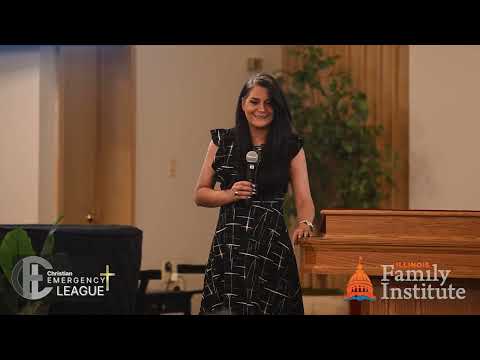
Equality Illinois held a news conference in Springfield on May 21, 2026, to kick off the public phase of its legislative advocacy day. Six speakers took the microphone for over twenty-four minutes, each delivering a piece of a coordinated policy package. (Watch it HERE.)
This is an account of what they said, who said it, and who authored the legislation they celebrated.
Jesus “Aces” Lira, Director of Public Policy at Equality Illinois, opened the briefing. He said the 2026 agenda is “about people,” that Illinois has “a responsibility to lead” against what he called coordinated national attacks on LGBTQ Americans, and that the bills are “practical and rooted in the lived experiences of our communities.”
He then outlined four pillars.
First: privacy protections for transgender Illinoisans, including two specific measures — confidentiality of gender-marker changes on state identification and shielding prescription data from what Lira called “politically motivated investigations.”
Second: expanded access to healthcare, with a focus on uninterrupted hormone therapy.
Third: an LGBTQ and HIV Long-Term Care Bill of Rights for older adults in care settings.
Fourth: a prohibition on state funding for conversion therapy.
Dr. Norma Seledon, Director of Leadership Development and Capacity Building at Equality Illinois, spoke next. She explained that nearly one in ten Americans identify as LGBTQ, yet only about a quarter of one percent of elected officials in the United States are openly LGBTQ. Closing that gap would require 47,000 additional LGBTQ-identified elected officials. She described the organization’s Boards and Commissions Initiative, which she said has moved Illinois from one openly gay state appointee in 2017 to 191 LGBTQ and 21 transgender-identified appointees today.
The organization’s job, she said, is to build that representation through training, candidate recruitment, and placement.
Lira returned to introduce HB 4554, sponsored by State Representative Laura Faver Dias (D-Grayslake). The bill cuts off state funding for organizations that provide what its sponsors call conversion therapy. Dias, a teacher and mother, framed the bill as Illinois’ response to the U.S. Supreme Court’s March 31, 2026 decision in Chiles v. Salazar, where the Court held that Colorado’s conversion-therapy law, as applied to a licensed counselor’s talk therapy, regulated speech based on viewpoint and could not be reviewed merely as professional conduct.
She called the decision “horrifying.”
Mike Ziri, Senior Director of Public Policy at Planned Parenthood Illinois Action, took the microphone next.
“LGBTQ plus rights are reproductive rights, and reproductive rights are LGBTQ plus rights,” he said.
He announced that the Illinois Senate had passed HB 4834 the previous evening by a 39-19-0 vote, sending it to Governor Pritzker’s desk. State Representative Kelly Cassidy (D-Chicago) sponsors the bill in the Illinois House, and State Senator Adriane Johnson (D-Waukegan) sponsored it in the Illinois Senate. Its provisions do not match what the speakers advertised, and I will return to them shortly.
Ziri also previewed HB 5492, which would require insurance coverage for the full prescribed quantity of hormone therapy when a provider’s clinical judgment supports it.
State Representative Cassidy spoke next. She is the legislative architect of HB 4834 and of the original Illinois ban on conversion therapy ten years ago. Since the Dobbs decision, she said, the coalition has been “very nimble and very creative,” moving preemptively to strip future hostile administrations of the regulatory tools they might use against transgender patients and abortion providers. Illinois has already barred continuing professional education credit for any practice the state bans — another preemptive move intended to anticipate future federal action on conversion therapy.
Carolyn Austin, Chief Executive Officer of AgeLinc, the Area Agency on Aging for Lincolnland, made the case for the Long-Term Care Bill of Rights. She cited internal advocacy figures: 70 percent of LGBTQ older adults fear returning to the closet to enter long-term care, and over 60 percent of those living with HIV fear a complete lack of confidentiality in such facilities.
State Representative Nicolle Grasse (D-Arlington Heights) sponsor of HB 4359, followed with personal testimony from her work as a hospice chaplain during the early 1990s AIDS crisis.
Channyn Lynne Parker, Chief Executive Officer of Equality Illinois and the first Black transgender woman (that is, a man) to lead the organization in its thirty-four-year history, closed the event. She (he) celebrated the passage of HB 4834 and called on supporters to push two more bills across the finish line by May 31: HB 5095, which would shield gender-marker data on state IDs as confidential medical information, and HB 5492, the hormone-therapy supply bill.
(Legislative status was changing rapidly in the final days of the session; this account reports what Parker said at the May 21 event.)
That was the public event. What’s not so public deserves a closer look.
Equality Illinois is not a single nonprofit. It comprises three entities operating under one brand. Equality Illinois itself is a 501(c)(4) advocacy organization with unlimited lobbying authority. The Equality Illinois Institute is a 501(c)(3) educational arm that is subject to lobbying limits but is eligible for tax-deductible donations and major foundation grants. Equality Illinois PAC is a state-registered political action committee that endorses and funds candidates.
Each entity has its own board. Executive leadership oversees all three as a single operation. Mature advocacy organizations operate this way because it allows them to shift resources and activities among charitable, lobbying, and electoral functions while preserving the legal firewalls required by each function.
Founded in 1991 as the Illinois Federation for Human Rights, the organization rebranded as Equality Illinois over the following decade. It claims credit for two of the largest statutory wins for Illinois LGBTQ advocacy: the 2005 amendment to the Illinois Human Rights Act that added sexual orientation and gender identity to the protected categories, and the 2013 legalization of same-sex marriage in Illinois — nearly two years ahead of Obergefell.
The combined operating budget across the three entities ranges from $1.45 to $1.7 million, depending on the year and the source. ProPublica’s Nonprofit Explorer reports 2024 revenue of roughly $447,000 for the 501(c)(4) and $1.17 million for the 501(c)(3) Institute. The charitable arm accounts for about two-thirds of the reported finances. It is the Institute that receives funding from foundations such as the MacArthur Foundation. The advocacy arm and the PAC are the smaller vehicles, though the advocacy arm is the more visible.
Equality Illinois hosted the May 21 event to showcase its partner network. Three categories of partners are listed in the public record.
The first is the legislative coalition within the General Assembly. Three Democratic state representatives appeared on the program: Kelly Cassidy of Chicago, the senior architect of Illinois LGBTQ policy, who originally sponsored the 2015 conversion therapy ban and now carries HB 4834; Laura Faver Dias of Grayslake, sponsor of HB 4554; and Nicolle Grasse of the 53rd District in the northwest suburbs, sponsor of HB 4359. Adriane Johnson sponsored HB 4834 in the Senate, but did not appear on the program. State Senator Lakesia Collins (D-Chicago) sponsored HB 5492 in the Senate, and State Representative Katie Stuart (D-Collinsville) sponsored it in the House.
The second is the institutional coalition outside the legislature. Planned Parenthood Illinois Action is the most prominent partner and secured a featured slot through Ziri. His formulation — “LGBTQ rights are reproductive rights and reproductive rights are LGBTQ rights” — signals a strategic decision to merge two policy fronts into a single coalition. AIDS Foundation of Chicago is the second major partner, present through Lira’s prior employment and through the Getting to Zero Illinois 2.0 framework that AFC anchors. AgeLinc served as the long-term care partner through Carolyn Austin. The ACLU of Illinois appears in the witness-slip record alongside Equality Illinois and AFC on the same bills, but did not have a speaking role.
The third is the national and philanthropic coalition that operates behind the scenes. AIDS United, which selected Lira for its Caminos Fellowship, is the national network into which the Illinois operation integrates. The MacArthur Foundation is the most prominent institutional funder of the Institute.
These are the partners the speakers chose to acknowledge.
There is another — and it may be the most important — that they did not.
While the speakers celebrated HB 4834 as a privacy bill protecting transgender Illinoisans from “politically motivated surveillance,” that characterization is incomplete.
HB 4834 amends the Illinois Controlled Substances Act to remove five drug categories from the state’s Prescription Monitoring Program: testosterone, mifepristone, misoprostol, GnRH analogs (puberty blockers), and estrogen. The Prescription Monitoring Program is the database doctors and pharmacists use to track high-risk drugs, detect dangerous prescribing patterns, and prevent multi-provider doctor shopping that fueled the opioid epidemic.
The bill also directs the Illinois Department of Human Services to purge all existing testosterone prescribing and dispensing records from the central database by January 1, 2027.
In one bill, Illinois blinds its public health surveillance system to an entire class of drugs prescribed to minors and adults alike. None of the five categories includes a parental notification requirement. The existing testosterone records are slated for deletion. State Representative Bill Hauter, MD (R-Morton) — one of the few physicians in the Illinois House — has called the bill dangerous because treating physicians will lose access to information that, in his words, can be a matter of life or death.
HB 4834 is the latest in a series of Illinois bills that began in 2015. Each bill, by itself, sounds reasonable. Together, they transfer authority over children from parents to the state.
In 2015, Illinois eliminated parental consent requirements for minors seeking certain mental health services. In 2017, the state extended gender-related counseling to minors without parental knowledge. In 2019, the General Assembly expanded comprehensive sex education mandates, with content set by the state rather than by families.
In 2021, Illinois repealed the Parental Notice of Abortion Act, ending even the notification requirement that had stood for more than two decades. In 2023, the juvenile provisions of the SAFE-T Act further insulated minors from parental oversight in interactions with the justice system. HB 4834, now awaiting the Governor’s signature after passing the Illinois Senate 39-19-0 on May 20, is the next step.
The common thread is jurisdiction.
Each bill expands the state’s authority over a child’s body, mind, and medical decisions while narrowing parents’ legal standing to know, object, or intervene.
For as long as we have records of human society, the family has been the basic unit of social order.
These laws replace the family with the state.
Substituting the state for parents inverts the constitutional ordering of the family and the state. Every totalitarian government in the twentieth century made this substitution. Illinois voters have been ratifying this substitution, election cycle after election cycle, by returning the architects of these laws to office.
Is this really what you want?
This tangle of legislation did not develop on its own. There was and is a plan. A document that lays it out has been distributed to legislators, advocacy organizations, and state health agencies across the country and serves as its operational manual. It is called Minor Consent and Confidentiality: A Compendium of State and Federal Laws, published by the National Center for Youth Law, a nonprofit law firm and policy advocacy organization headquartered in Oakland, California.
The Compendium catalogs the status of minor-consent laws in every state. It maps the gaps where parental authority remains legally intact. It models successful statutory language from states that have already enacted the relevant legislation. And it hands legislators in other states a ready-made roadmap to replicate those laws.
The National Center for Youth Law does more than publish the document. It publishes state-specific versions of the Compendium, including an Illinois edition, and maintains TeenHealthLaw.org as a training and resource hub for minor-consent, confidentiality, child-abuse reporting, and health-information-sharing law.
Its public materials and third-party profiles document training, technical assistance, coalition-building, and policy development. Its organizational descriptions state that it works through litigation, policy development, coalition building, research, and the drafting and advocacy of new laws and regulations. In other words, the Compendium is not merely a reference work. It is an operational tool.
That is the coordinating role. The National Center for Youth Law supplies the legal map and policy framework. State-level organizations take the playbook, adapt it to local conditions, and run it through the legislative process.
In Illinois, the organizations that have advanced this body of legislation over the past decade include the ACLU of Illinois (litigation support, testimony, and lobbying on the full spectrum of minor consent and parental notification repeal bills); the Illinois Caucus for Adolescent Health (the primary youth health advocacy organization, which drafted and championed the sex education mandate expansions); Planned Parenthood of Illinois (the lead advocate for the parental notification repeal, with legislative testimony at every relevant hearing since 2015); the Illinois Safe Schools Alliance (which drove the gender identity counseling and school accommodation legislation); the Lurie Children’s Hospital Center for Gender, Sexuality and HIV Prevention (which provided clinical testimony normalizing gender-affirming care without parental consent, which became key evidence in legislative hearings); Lambda Legal (national litigation support aligned with the National Center for Youth Law’s strategy); and Equip for Equality (the Illinois disability rights organization whose framing of adolescent autonomy has been incorporated into mental health consent legislation).
Equality Illinois is now joining that list, not as a peripheral signatory but as a primary legislative voice. The May 21 event announced that the organization is taking up bills that others have been advancing for a decade.
These organizations do not operate independently. They coordinate. They share legislative strategy. They align their testimony calendars so that each hearing produces a chorus rather than a single voice. The coordinating point — the organization whose research and legal analysis provides the intellectual framework that makes the chorus cohere — is the National Center for Youth Law.
The National Center for Youth Law files audited financial statements each year. Drawn directly from those certified audits, the picture from 2015 through 2024 looks like this.
Over ten years, the organization received $92.1 million in foundation grants and $29.7 million from the federal government through grants, contracts, and Paycheck Protection Program loans that were later forgiven. Of every dollar that flowed into the National Center for Youth Law over that period, nearly one in three came from federal taxpayers.
In 2015, federal grants and contracts to the organization totaled $209,728. By 2022, the figure had risen to $4,655,369 — a 2,120 percent increase over seven years, during which the organization published and distributed the national legislative playbook to expand minor consent law and actively lobbied for that legislation in states across the country.
The American taxpayer funded both the playbook and its distribution.
The largest year-over-year increase in federal funding hit in 2017 — the year Donald Trump was inaugurated. Federal grants to the organization nearly quadrupled, from $329,408 in 2016 to $1,476,928 in 2017.
This is a lesson in how the administrative state actually works.
The Trump Administration did not authorize those 2017 dollars. They were disbursements from multi-year grants the Obama Administration had legally obligated in 2015 and 2016 — grants tied to HHS Children’s Bureau Title IV-E Foster Care Demonstration Programs, the Office of Refugee Resettlement’s legal services contracts (which funded the organization’s immigration litigation under the Flores Settlement), and Department of Justice juvenile justice reform initiatives. Federal grant money, once legally committed, does not expire at the inauguration. It belongs to the grantee by contract. Canceling it requires a legal basis for termination and the ability to withstand the inevitable lawsuit.
The 2018, 2019, and 2020 figures — which held steady at $2.1 to $2.4 million throughout Trump’s first term — reflect the same mechanics. Funding continued because the grant machinery the Obama administration built was embedded in the career bureaucracy, maintained by program officers who were not political appointees, and protected by court orders in the Flores Settlement — a case in which the National Center for Youth Law was both the opposing party to the Trump administration in federal litigation and the recipient of federal funds tied to that very case.
The elected government did not control those dollars. It watched them spent.
This is the technique the architects of these laws have mastered. They do not merely pass legislation. They embed their agenda in multi-year federal grant programs, court settlements, demonstration projects within state agencies, and the career bureaucracy that administers it all.
Once embedded, the machinery runs regardless of election outcomes.
The Trump administration began terminating DEI-related child welfare grants in late 2025 — cutting $34.9 million across eleven organizations — but that came eight years after the machinery was built, required extraordinary political effort, and triggered immediate litigation.
One detail in the financial statements warrants close attention. The 2022 audit shows a donor-restricted fund labeled “Reproductive Health” with a balance of $3,037,065 — the third-largest restricted fund category in the organization. That fund had been building since at least 2018, when it stood at $181,250. It grew to $412,065 by 2021, and a major grant infusion pushed it to $3 million in 2022. By 2024, it had drawn down to $520,710 — not because the program ended, but because the money was being actively spent on program work.
An organization that holds a $3 million “Reproductive Health” restricted fund is not a child welfare organization that touches reproductive issues only at the margins. Access to reproductive health for minors — without parental knowledge — is a core institutional priority, backed by major foundation funding and coordinated with the legislative campaigns for which the Compendium serves as the manual.
The people who built this are not hiding their philosophy. They state it openly.
The National Center for Youth Law’s mission statements describe its purpose as working to “dismantle racism and other structural inequities” and to “fundamentally transform our nation’s approach to education, health, immigration, foster care, and youth justice.” The 2017 annual report lists among the organization’s current campaigns:
“Empowering youth in foster care to make decisions about their bodies and futures by ensuring access to reproductive health care.”
The 2018 audit’s organizational description states that the organization works by “drafting and advocating for new laws and regulations.”
The IRS classifies it as a charity. Its spending serves as a legislative engine. It researches the law, drafts legislation, trains advocates, coordinates the coalition, and uses federal and foundation funding to sustain the entire operation — election cycle after election cycle, administration after administration.
In this system, the family is the obstacle to be overcome. The parent is the gatekeeper whose authority must be legally constrained so the state and the network of organizations it funds can reach the child directly.
That is the project. HB 4834, and bills like it, are the visible surface of it.
One more thing about HB 4554 that the speakers did not address.
HB 4554 does more than restrict state funding. It adds a definition of legitimate counseling to the Illinois statute. Any practice that “seeks to change” a minor’s gender identity is, by statutory declaration, conversion therapy. Any practice that affirms the minor’s stated identity is, by the same statute, legitimate therapy. The carve-out runs in one direction. A counselor who begins with the premise that the minor’s self-declaration accurately describes the minor’s condition is funded.
A counselor who begins with the premise that the self-declaration is a clinical question to be explored — that the distress may have other sources, that the declaration may be revisable, that the therapist’s professional judgment has standing to disagree — is not.
That is not a clinical judgment. Clinical judgments are provisional, contingent on the individual patient, and subject to revision in light of evidence. A statutory definition is none of those things. When the legislature writes into law that one account of the human person is therapy and the competing account is harm, it has stopped legislating about counseling and started legislating reality itself.
The bill’s claim is that gender identity is a fixed and self-authenticating fact about a person — knowable by introspection, declared by assertion, and binding on every other person and institution in society.
The bill does not debate this claim. It is written into the statute and written out of clinical practice by force of law.
This is a religious claim about the nature of humanity.
It contradicts the historic Christian, Jewish, and Muslim claims, as well as those of every traditional moral framework. It is a new claim, and Illinois is enacting it into law through people who, if pressed, would insist that they are not making any religious claims at all.
They are.
A claim about what constitutes a human being, and about who has authority to define that, is the kind of claim the First Amendment was written to prevent the state from making.
HB 4554 uses the term “religious organization” in the bill’s text. The drafters could have written “any other entity” to reach every organization the bill needs to reach. Instead, they named religious organizations specifically. That is not a drafting accident. The bill’s text states that the legislature targeted religious counseling providers. Under Trinity Lutheran v. Comer, Espinoza v. Montana Department of Revenue, and Carson v. Makin, a state may not create a generally available public benefit and then deny access to religious organizations because their religious character or religious use conflicts with the state’s preferred viewpoint.
HB 4554 conditions public funding on one approved counseling account and excludes the competing account, even when that competing account is religious.
A state that funds only counseling consistent with its preferred account of the human person and refuses to fund any counseling that leaves the question open has taken sides on a contested ultimate question. The Founders deliberately denied the government that authority. They had seen what governments do when they assume it, and they had no intention of repeating the experience.
The architects of HB 4554 have claimed authority that is not theirs. They will not be the last to make this mistake. But Illinois residents are entitled to see it for what it is.
These are legislators. They are not God. They have neither the wisdom nor the authority to legislate the nature of humanity, and the Constitution they swore to uphold forbids them from trying.
The hosts of this press conference explained that their agenda is to ensure the following become law: HB 4834 (passed both houses, awaiting the Governor’s signature), HB 4554 (conversion therapy funding bill to be revisited in the near future), HB 4359 (long-term care to be revisited in the near future), HB 5095 (gender-marker confidentiality passed both houses, awaiting the Governor’s signature), HB 5492 (hormone therapy insurance coverage passed the House and could be voted on before May 31st), and related measures.
The machine behind these bills is a well-funded, multi-entity advocacy organization operating in close coordination with Planned Parenthood, the state’s largest HIV services organization; with named legislators in both chambers; with a national HIV policy network; and with one of the country’s largest private foundations.
HB 4834 did not originate in the conscience of a concerned legislator. It is one bill in a decade-long sequence, run by a coordinated state-level network operating from a playbook published in Oakland, California, by an organization that has taken nearly $30 million in federal taxpayer funding while creating and promoting that playbook.
The legislation does not come from the legislators. It’s not the true believers, generous donors, or individual supporters who reach into their wallets by the thousands or tens of thousands to finance their activities.
The government funds the organization — we fund it.
And the funding does not end when the administration changes.
The Illinois General Assembly accepts witness slips from any Illinois resident on any bill, but only when they are scheduled to be debated in a committee hearing. The process is free, takes less than two minutes per bill, and records the resident’s position in the formal legislative record. We have provided links to file witness slips for many bills. Unfortunately, the window to file witness slips has passed for HB 4554, HB 4359, HB 5095, HB 5492.
But you can call your state representative and state senator.
Take Action: Click HERE to obtain their office phone number. Then click Continue under View Your Officials.
Tell them you know what HB 4834 does, where the framework originated, and who funded it. The bills discussed at the May 21 conference face a May 31 legislative deadline. Until then, the record is open.
The full picture of this network — the foundation donors who fund it, the interlocking boards linking the National Center for Youth Law to the broader progressive legal system, the state-level organizations that serve as its legislative arms, and the personnel pipelines that move people between government agencies and the organizations those agencies fund — is the subject of a forthcoming article.
I end with this one question: Do you want the state raising your children?