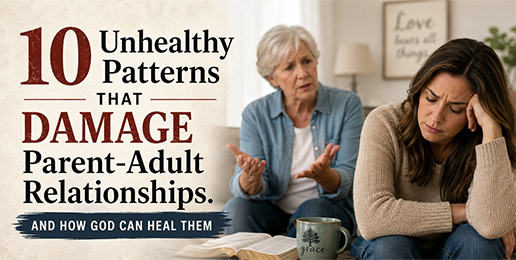
Nobody sets up a boundary with their parents because things are going well. Boundaries happen because patterns have developed — often quietly, over a long period of time — that have made the relationship feel too costly to maintain without some kind of protection. Here are ten we are seeing often in our work with families.
- They lecture instead of listen. When a parent’s idea of a conversation is talking at their child about everything going wrong in their life, the child eventually stops coming to the table. Your family members may increasingly push you away if communication feels to them like a one-way street.
- They override the rules in their child’s home. Grandparents who step into the role of primary disciplinarian, establish their own rules, and undercut the parents’ authority create a collision course. The adult child is eventually forced to choose between honoring their parent and protecting their own family. Unhealthy patterns that go unaddressed do not get better on their own. They get worse.
- They avoid direct conversation about real problems. Many parents stay silent, telling themselves they are keeping the peace. But choosing the path of avoidance — hoping things improve without an honest conversation — only allows the patterns to calcify. The resentment builds quietly on both sides, and by the time it surfaces it has been building for years.
- They fail to take responsibility for their anger. A parent can go a whole day at work without losing patience, then lose their cool with the kids within ten minutes of arriving home. Who we are at home is who we really are. Anger, if not dealt with biblically, will reap a harvest of hard hearts.
- They apologize without repenting. Repentance is more than an apology. Too often apologies are superficial exchanges of the right words with no genuine change following. When a parent confesses the same sin, asks for forgiveness, and then returns to the same behavior, each successive apology does more damage than the one before it. Adult children can tell the difference between words and real change.
- They are hyper-spiritual as a substitute for genuine relationship. Some parents quote Scripture at their children rather than connecting with them. They talk about God’s expectations without grace. Fake spirituality pushes kids away.
- They put career and ministry ahead of family. Even Billy Graham, looking back at the end of his life, acknowledged that he was too busy preaching all over the world and missed his children growing up. A parent who consistently prioritizes their work, career, or even their public ministry over their family is communicating a message their children hear clearly.
- They subtly communicate their expectation of perfection. A parent may tell their child they do not expect perfection, but then react with shock or frustration when the child falls short. Over time the unspoken message lands louder than the words — and the adult child who never feels fully accepted for who they are will eventually stop trying to earn approval they have concluded is out of reach.
- They triangulate instead of talking directly. Rather than having an honest conversation with the person they are in conflict with, some parents route their frustration through other family members — venting to siblings, texting other relatives, posting veiled comments on social media. This pattern, which counselors call triangulation, allows the real problem to fester while the whole family becomes aware of a conflict that was never addressed directly.
- They prioritized their children’s performance over genuine relationship. Parents who spend years focused on grades, achievement, and success at the expense of heart-connected relationship can look up one day and find that their adult child feels more managed than loved. When a child grows up concluding that their parent cared more about what they accomplished than who they are, that wound runs deep and does not heal quickly.
“See to it that no one fails to obtain the grace of God;
that no root of bitterness springs up and causes trouble,
and by it many become defiled.” (Hebrews 12:15)
God loves to take broken things and put them back together again. If you are ready to discover a biblical game plan for changing these patterns, I invite you to explore my book “Healing Family Relationships,” where we walk through what God’s Word says about taking real, practical steps toward healing the relationships that matter most.