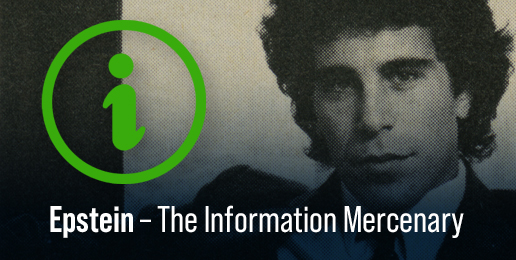
There is still confusion about the real Jeffrey Epstein.
Was he a gifted poseur — a college dropout and social climber whose crimes against minors and appetite for other people’s money were his primary motivations? Or was he a covert intelligence asset, a blackmailing architect of elite corruption, a Bond villain with a private island?
The record is clear if you can make sense of what you can see.
Michael Shellenberger and Alex Gutentag, in their article in “Public” on February 26, 2026, argue that Epstein’s sex trafficking operation was not directed by or run for intelligence agencies. That assessment is accurate.
There is no evidence of a formal contractual relationship, no case officer, no tasking orders, and no reporting structure of the kind that characterizes a directed intelligence operation.
Their portrayal of Epstein as an extraordinarily gifted manipulator — someone who cultivated relationships with exceptional patience and then deployed them for his own benefit — also aligns with the evidence.
Epstein was neither naïve nor lucky. He understood the nuances of various social networks and intentionally exploited them.
Specifically, they explain their
“view of Epstein has changed from that of a shadowy intelligence operative running a state-sponsored blackmail ring to something both more banal and, in some ways, more concerning: an extraordinarily gifted manipulator who exploited the vulnerabilities of a sexually permissive culture, the neediness of even the most powerful people for friendship and status, and the erosion of the moral frameworks that once helped societies identify sexual coercion and exploitation.”
But Shellenberger’s and Gutentag’s framework contains a gap that their analysis does not fill.
It asks the wrong question.
“Was Epstein controlled by intelligence?” is less relevant than:
“What did Epstein provide, to whom, and why would multiple foreign governments and intelligence services maintain active, ongoing financial relationships with a private American citizen who was also a convicted sex offender?”
Shellenberger’s account largely passes over Epstein’s activities between 1981 and 1987. Those are not missing years. They are the formative years. They are the years that explain everything that came after. And understanding them requires, first, understanding the legal framework in which they were built — a framework created by our United States Congress.
In 1975 and 1976, the Senate Select Committee to Study Governmental Operations with Respect to Intelligence Activities — known as the Church Committee after its chairman, Senator Frank Church of Idaho — conducted the most comprehensive investigation of American intelligence activities in the nation’s history.
Its findings were stunning: the CIA had plotted the assassinations of foreign leaders, conducted illegal domestic surveillance, infiltrated lawful political organizations, and operated programs of mind control and human experimentation.
The hearings transformed public understanding of what the intelligence community had been doing over the previous three decades.
The legislative response was swift. The Intelligence Oversight Act of 1980 imposed binding requirements on American intelligence agencies: “timely notification” of “significant intelligence activities” to the relevant congressional oversight committees.
The requirement was sweeping. It applied not only to CIA officers operating under official cover but also to anyone under a formal contract with the agency. The era of unaccountable covert operations — the world of Allen Dulles, of Operation Mongoose, of COINTELPRO — was officially over.
However, the consequences were not what Congress intended. The legislation created a powerful incentive that operated in precisely the opposite direction from its purpose. A formally contracted CIA asset — someone with a signed agreement, a case officer, and a reporting obligation — now requires Congressional notification. Every significant activity of every formal contractor was, in principle, subject to oversight. But an independent operator who provided information on a transactional basis — without a formal contractual relationship, without a case officer, without a defined reporting structure — did not trigger the same threshold. He was not a contractor. He was a commercial source.
It was the difference between Congressional oversight and no accountability.
The obvious, though unspoken, incentive was: don’t officially recruit the assets you need to protect most. Keep relationships informal. Pay only for transactions. Maintain deniability. Avoid leaving a paper trail that could alert authorities.
The precedent was set not through any arrangement with Epstein but by Executive Orders issued by Presidents Ford (1976) and Carter (1978), and later through the adoption of the Intelligence Oversight Act of 1980.
The CIA immediately implemented the revised policy of using deniability in its intelligence dealings with the Bank of Credit and Commerce International (BCCI). BCCI was not, in any way, a CIA front bank. However, it was an institution the CIA used for off-the-books financing, gathering financial intelligence on clients, and moving funds across jurisdictions without traceable documentation.
Years later, the Kerry Committee’s 1992 findings revealed that the CIA had maintained informal relationships with BCCI officers and used the bank to bypass the oversight system established by the Church Committee. No formal contracts. No reporting obligations. Perfect deniability.
This is the culture in which Jeffrey Epstein’s independent career began in 1981. He did not invent the post-Church-Committee information-mercenary model. He entered a world that had already developed it.
Over the next four decades, he became its most accomplished practitioner.
His entry point was a party in Texas — most likely a gathering at the Houston mansion of oil tycoon Oscar Wyatt — attended by Epstein and his girlfriend, Paula Heil, while Epstein was still working at Bear Stearns.
Heil, a former Miss Indianapolis who served as Associate Director of Corporate Executive Services at the firm — a role she held alongside her work as a published author on personal finance — already knew Nick Leese, the Oxford-educated son of British defense contractor Douglas Leese.
Nick had studied at Christ Church and was a member of the Bullingdon Club — the all-male private dining society whose alumni roster read like a directory of the British establishment. Heil and Nick were acquaintances. Introductions were made.
When Epstein left Bear Stearns in early 1981 — under circumstances, according to those who knew him, linked to concerns about trading practices involving high-value client accounts — the Texas connection provided an immediate next step. That year, Epstein and Heil traveled to England. Heil took him to the Leese family’s country estate in Wiltshire to visit Nick. There, they met Nick’s father, Douglas, for the first time.
Julian Leese later described his father’s reaction to the twenty-seven-year-old from Brooklyn:
“Dad understood, ‘Here was a very intelligent person who was very clever with the stock market.’ Dad was enamoured with Jeffrey and Jeffrey was enamoured with Dad as a sort of mentor. The whole family liked him and he would come down on many occasions to our family home in Wiltshire.”
The relationship that started that day in Wiltshire would continue until 1987 — six full years, covering the entire period discussed in this article.
Heil later married M. Anthony Fisher of the New York Fisher Brothers real estate family. They had two children and separated in the early 1990s. She became a Broadway producer, and Epstein and Paula remained friends until Epstein’s death.
Epstein’s relationship with Leese was the beginning of everything.
Sir Douglas Leese was not a typical businessman. He established and sold a steering equipment manufacturing firm—Cam Gears—which was acquired by TRW, a major American defense contractor—and then entered the realm of high-level arms brokerage, where the line between business and intelligence often blurs.
The parliamentary record clearly shows his importance in that world. During a 1995 debate in the House of Commons, MP George Galloway stated that
“secret commissions on the Al-Yamamah deal have been handled by British Aerospace through a British businessman, Douglas Leese, who has close connections with an offshore bank, the Bank of NT Butterfield in Bermuda.”
Even more revealing was the language Leese’s own attorneys used in a subsequent U.S. civil case. They stated that his activities involved
“highly sensitive and confidential information, some of which are believed to be classified by the Department of Defense and other agencies of the United States government.”
That is not language typically used to describe a retired manufacturer. It sounds more like someone involved in the commercial side of classified government programs.
Leese operated within the highest levels of the British defense and financial sectors, maintained connections with Saudi royal intermediaries, including arms dealer Adnan Khashoggi, and processed his commissions through the same Bermuda banking infrastructure — the Bank of NT Butterfield — that was later linked to Epstein’s offshore financial dealings.
What the Leese relationship provided Epstein wasn’t financial training, which he already had from Bear Stearns. Instead, it offered something rarer and more valuable in the world he was entering: social camouflage.
The New York Times, in later reporting, noted that Leese “mentored” Epstein and “let him tag along for meetings with British and international elites.” Julian Leese confirmed that the family taught Epstein “to shoot and to mix with aristocrats.”
This instruction taught how to carry oneself in rooms built for people whose ancestors have occupied them for generations — how to speak, how to dress, and how to project the quiet confidence of someone who belongs rather than someone who has been allowed in. Epstein absorbed these lessons with the same intelligence he applied to everything else.
Steven Hoffenberg — who met Epstein through Leese in 1987 and worked with him for several years afterward — later quoted Leese’s assessment of his protégé in terms that proved prophetic: “
The guy’s a genius. He’s great at selling securities. And he has no moral compass — morals would not impede profit.”
That combination — mathematical brilliance, social ease, complete ethical flexibility — was exactly what the world Leese was about to introduce him to demanded.
In August 1981, right after leaving Bear Stearns, Epstein founded Intercontinental Assets Group. IAG had no obvious institutional presence, no publicly listed clients, and no clear investment approach. Its listed clients were mainly people in the arms and finance circles that Leese had introduced him to.
Among them, the most notable was Adnan Khashoggi, the Saudi arms dealer who played a key role in the geopolitics of the early Reagan era as the main financial mastermind behind what became the Iran-Contra operation.
Starting in 1980, as part of a strategy to reduce Soviet influence in Tehran and prevent either side from outright winning the Iran-Iraq war, the CIA covertly backed Chinese arms sales to Iran. Beijing began supplying arms to both Iran and Iraq. In the spring of 1983, Iran signed a $1.3 billion arms deal with China.
The weapons were mainly supplied by Norinco — China’s state manufacturing conglomerate — with British Hong Kong serving as the transshipment point.
The commissions from a $1.3 billion arms deal, which moved through multiple jurisdictions and were obscured through offshore shell corporations, require advanced financial management. They do not go through standard banking channels. They involve people who understand how to structure cross-border transactions, reduce paper trails, and transfer funds from the arms industry into legitimate private banks, where they will ultimately be kept.
As the China-Iran deal was being finalized, Douglas Leese owned a Bermuda-based holding company called Lorad. Within months of signing the deal, a new Lorad entity—a shell company named Norinco Lorad—was registered in Bermuda. Shortly afterward, a Hong Kong trading company, Lorad Far East, was established.
The timing, naming, and Bermuda location—home of the Bank of NT Butterfield, through which Leese managed Al-Yamamah commissions—leave little doubt about the purpose of these structures.
In 1995, George Galloway alleged in Parliament that Leese had “clandestinely funded Middle East arms deals using a Bermuda bank.” The Norinco Lorad structure is the most plausible vehicle for that activity.
Steven Hoffenberg, who maintained a close working relationship with Epstein from 1987 until the collapse of Towers Financial, described Epstein’s activities in the early 1980s in extraordinary terms. However, the accuracy of those claims is unclear. According to Hoffenberg, Epstein received training in “arms trafficking and money laundering by Adnan Khashoggi and Douglas Leese jointly.”
By 1983, Hoffenberg stated, Epstein was “directly involved in the sale of Chinese weapons to Iran through the state-owned company Norinco, at the height of the Iran-Iraq war.” Hoffenberg characterized these activities as running “in parallel” with the Iran-Contra affair.
[Note: Hoffenberg was a convicted fraudster whose testimony requires corroboration. His account of Epstein’s operational role in the Norinco pipeline is based on a single source. However, the corporate structure — Norinco Lorad, Lorad Far East, Butterfield Bank Bermuda — is documented through records from the British Parliament and corporate filings. Together, these records provide corroboration for the broad outline of Hoffenberg’s account, if not every specific detail.]
At some point in the 1980s, Epstein obtained an Austrian passport under a false name, listing his address as Saudi Arabia. After his 2019 arrest, American federal agents found it in a safe in his Manhattan mansion. His attorneys explained: it was provided by a friend as protection against kidnapping while traveling in the Middle East, where his identity as a Jewish American might endanger him.
Whatever the merit of that explanation, it confirms the world Epstein was navigating. A New York investment advisor doesn’t need a Saudi-backed Austrian passport to protect him while visiting European clients. But someone routing money through arms-finance networks across jurisdictions where his American-Jewish identity could restrict access or pose physical risks does.
The document isn’t a curiosity. It’s operational — and it required the kind of official cooperation that doesn’t usually happen spontaneously at a foreign government’s passport office.
From the CIA’s viewpoint, the Norinco pipeline was not an illegal or rogue operation. It was policy-adjacent — part of a calculated American plan to support Chinese arms sales to Iran, maintain the war’s stalemate, and curb Soviet influence. The financial network set up to transfer commission money — Bermuda shell companies, Hong Kong trading entities, and Saudi-based middlemen — was exactly the kind of network that post-Church Committee rules made impossible for CIA officers to handle directly.
Any official contractor involvement would require congressional notification. An independent operator, trained by Leese and working through Khashoggi’s team, could operate without leaving a trail back to Langley.
Epstein entered this environment not as a CIA creation but as a commercially useful independent actor. He was not placed there. He grew into it with the guidance of someone who had operated within it for years.
It is important to be precise about the timeline. By the time Britain’s Al-Yamamah arms deal was officially signed on September 26, 1985 — Epstein’s twenty-second month working with Leese’s network — the personal working relationship between Epstein and Leese had already ended.
Julian Leese confirmed the falling out, attributing it to Epstein’s misuse of his father’s expense accounts — charging personal Concorde flights and stays at luxury hotels. The timeline, as Julian described it to journalist Tom Pattinson, places the break in 1987, after six years of collaboration. The “falling out” explanation raises, as one analyst noted, more questions than it answers. Still, the timeline is reasonably clear: Epstein’s direct mentorship under Leese ended before Al-Yamamah was finalized.
This matters for accuracy. Epstein neither brokered nor participated in Al-Yamamah. Instead, he spent four years immersed in the human networks — Leese, Khashoggi, Prince Bandar bin Sultan, and British defense and banking figures — whose relationships led to Al-Yamamah, and whose offshore commission system he had learned to navigate through his work with Norinco.
Al-Yamamah was the largest arms deal in British history: £43 billion over twenty years, structured not as a cash payment but as oil — up to 600,000 barrels per day delivered to a Ministry of Defense account managed by BP and Royal Dutch Shell. The commissions were enormous: police investigations later estimated that $8.5 billion in total commission payments had been made.
Prince Bandar received about $1.4 billion personally and a customized Airbus for his birthday. Mark Thatcher (son of Prime Minister Margaret Thatcher) received between £12 million and £18 million. Leese managed his commissions through the Bank of NT Butterfield in Bermuda — the same institution and offshore structure that Epstein had learned to work with.
For our purposes, the significance of Al-Yamamah is not Epstein’s role in it. It is what it reveals about the world he had been fully embedded in: the intersection of British defense contracting, Saudi royal money, CIA-adjacent supply networks, and European private banking.
By the time the deal was signed, Epstein had spent four years in this system, learning its protocols, gaining credibility with the people within it, and developing the specific skill set — financial structuring, cross-jurisdictional discretion, and access brokering — that the players needed and would pay for.
He had also, through those networks, been introduced to the family whose endorsement would increase his access by many orders of magnitude.
On January 2, 1982—six months after Epstein arrived in London—François Mitterrand’s Socialist government nationalized Banque Rothschild and 38 other French financial institutions. The Rothschild family had occupied 21 rue Laffitte since 1818.
They were expelled.
The government paid 150 million francs in compensation — less, observers noted, than the cost of building the new headquarters they would need. They were legally prohibited from using the Rothschild name in commerce.
Guy de Rothschild responded in Le Monde with an op-ed that became a reflection of its time: “A Jew Under Pétain, A Pariah Under Mitterrand.”
He moved to New York. His nephew, David de Rothschild, began the slow process of rebuilding in Paris with three employees and one million dollars in capital.
Baron Élie de Rothschild — vice-chairman of the original bank, keeper of the family’s institutional memory and its network of international relationships built over the past century — was left managing the family’s private wealth outside the nationalized system. But they suddenly found themselves without an organization backing them.
The nationalization did not eliminate the Rothschild family’s private wealth. The family’s personal assets — offshore holdings in Switzerland and Luxembourg, American trust structures, and U.S.-focused investment positions built over decades — were suddenly without institutional oversight. The state now owned the bank that managed them.
The Rothschilds needed discreet, technically skilled private operators who could serve as U.S.-side advisors for the family’s personal holdings. The specific requirement — expertise in American tax law, trust structuring, and offshore management — was demanding and rare.
It required someone who understood the American regulatory and tax environment and possessed the mathematical fluency to implement solutions rather than describe them.
Jeffrey Epstein had spent five years in Bear Stearns’ “special products” division — the department that handled tax mitigation and estate planning for ultra-high-net-worth clients. It was exacting, mathematically sophisticated work, and very few people in the world could do it well. Epstein was one of them. He could walk into the most aristocratic private banking context in Europe and explain American trust law and offshore tax structures with the technical competence required to execute, not merely advise.
He arrived at the Rothschilds’ doorstep with exactly the skills they desperately needed, right at the height of the crisis. This was no coincidence. Leese’s network had connected him with people who understood what the family required. His Bear Stearns background lent him the credibility that made him worth meeting. In the private banking scene of the early 1980s, this combination was highly unusual.
The most evidence-supported pathway to the French Rothschilds runs through Leese to Khashoggi to the family. Adnan Khashoggi operated at the exact intersection — Saudi money, European private banking, and French aristocratic social circles — where a connection could likely have been made. He had existing financial ties with the French Rothschild family. He knew, from his work with Leese, what Epstein was capable of. He had both the access and the motive to make the introduction: a trusted, discreet American operator, recently available, with exactly the skill set the family was looking for.
An alternative pathway runs more directly through the British defense establishment.
- M. Rothschild & Sons, led by Sir Evelyn de Rothschild, was deeply involved in Margaret Thatcher’s privatization initiatives during this period. Leese’s work in British defense commerce placed him within the same professional circles. Both paths went through the network that Leese had established, which Epstein was allowed to be part of.
The nature and extent of Epstein’s relationship with the Rothschild family are not just suspected; they are verified by sworn Congressional testimony.
On February 9, 2026, Leslie Wexner testified before the House Oversight Committee. Under oath, he stated that before hiring Epstein as his financial manager, he received a personal phone call from Baron Élie de Rothschild, vice-chairman of the original Banque Rothschild and one of Europe’s most influential private bankers. Wexner said that de Rothschild “highly recommended Epstein based upon work Epstein had done for his family.”
Wexner distinguished this call from other names Epstein mentioned during the recruitment process, emphasizing that this was not a claim Epstein made that Wexner could not verify. It was a conversation Wexner personally had with a Rothschild.
The importance of that call cannot be overstated. In European private banking, a personal endorsement from a Rothschild family member is more than just a social gesture. It is the highest credential available in a world built on discretion and the reputation that discretion safeguards.
Élie de Rothschild personally calling a stranger to vouch for a thirty-five-year-old’s competence, thereby associating his family’s two-century-old name, was a sign that Epstein had provided significant work for the family, had the necessary technical skill, and had consistently maintained the absolute discretion vital to private banking relationships of that kind.
This does not happen to someone who only handled a minor financial task. It happens to someone who solved a major problem over a long period, in a way that made the family confident enough to share that achievement with anyone who asked.
Baron Élie de Rothschild personally telephoning a stranger to stake his family’s two-century-old name on Epstein’s competence is the highest available credential in European private banking.
To understand what the Rothschild credential signified as a key to further access, it is important to understand who the Rothschilds were, not just as a wealthy family but as an institution built over two centuries.
By the 1820s, the Rothschild family had become the chief banker for nearly every major European government. They financed the British government’s purchase of the Suez Canal in 1875. They arranged loans for the Prussian government in 1818. They repeatedly financed the Habsburg Empire of Austria and received hereditary baronies from Emperor Francis I in 1822.
They managed commissions for the Kingdom of Naples, the Duchy of Parma, and the Papal States. In 1832, Pope Gregory XVI welcomed Carl von Rothschild at the Vatican — and did not require him to kiss the papal ring, a special exception not granted to reigning monarchs.
By the 1980s, Sir Evelyn de Rothschild was Queen Elizabeth II’s personal financial advisor. She knighted him in 1989. Lynn Forester, who married Sir Evelyn in 2000 after being introduced to him by Henry Kissinger at Bilderberg, later introduced Epstein to Prince Andrew, Peter Mandelson, and other senior British political figures. Ghislaine Maxwell testified that the introduction to Prince Andrew took place at a Rothschild property on Martha’s Vineyard.
European royalty, it bears noting, is not a collection of independent families. It is one extended kinship network, connected through two centuries of strategic marriages and sharing common ancestors from a small group of dynastic lineages. Queen Victoria’s nine children married across the continent, creating first- and second-cousin relationships that spanned Westminster to Stockholm to Madrid to Oslo. King Harald V of Norway was Queen Elizabeth II’s second cousin. Six current European monarchs share descent from King Christian IX of Denmark.
When Élie de Rothschild vouched for Epstein to Wexner, he linked Epstein’s name into a reputational chain that, through Sir Evelyn’s ties to the Crown and Lynn Forester’s social circle, extended into the fabric of European royalty itself. Epstein did not personally develop each of these relationships from the ground up.
Instead, he entered one key node — the French Rothschild family during their peak crisis — and the network extended through its existing connections. Epstein skillfully exploited these connections with his charm, charisma, and sharp, predatory insight.
The Rothschild credential was not just a referral letter. It served as a master key to a network that had been systematically built over two hundred years, connecting every major European royal house, each significant European government, and the private financial systems that supported them.
Epstein entered Leslie Wexner’s life about a year after Arthur Shapiro’s murder. The timing has attracted investigative scrutiny for good reason, though what can be stated with certainty should be distinguished from what remains speculative.
On the morning of March 6, 1985, Arthur Shapiro — a Columbus, Ohio, attorney who personally handled The Limited’s account at his law firm — was murdered in broad daylight at Wesley Chapel Cemetery on Dublin Road. He was scheduled to testify before a federal grand jury the next day in connection with a tax-fraud investigation.
After a pursuer chased him from a parked car, two shots were fired into his head at close range. In the words of the subsequent police analysis, the murder showed “strong marks” of a professional Mafia hit. It has never been solved.
The Columbus Police Department’s organized crime bureau reviewed the case and documented its findings in a memo known as the “Shapiro Murder File.” The report was so controversial that the city’s police chief allegedly ordered it destroyed. However, a copy remained accessible because of a prior public records request.
That one copy, already lost to the control of the police chief, was later published by investigative journalist Bob Fitrakis.
The document linked Wexner’s name, through his business associates, to figures “reputed to be organized crime” — specifically the Genovese-LaRocca family — while noting that Wexner himself was never considered a suspect. The primary suspect in the Shapiro murder was his business partner, Berry Kessler, who died in prison for a different murder in 2005 without ever being charged in the Shapiro case.
What matters here is not who ordered Shapiro’s death but the professional gap his death left behind. David Sturtz, the Ohio State Inspector General who was separately collecting evidence related to Wexner and Epstein, explicitly described Epstein as Wexner’s “replacement” for Shapiro. About a year after the murder, Epstein entered Wexner’s life with a personal endorsement from Élie de Rothschild.
The relationship that followed was exceptional in scope. Wexner granted Epstein broad power of attorney, appointed him as a trustee of the Wexner Foundation, and gave him effective control over the management of Wexner’s personal assets across multiple jurisdictions. Epstein has been alleged to have misappropriated what Wexner himself described as “several hundred million dollars” through trust structures. This staggering amount underscores both the extent of his access and the sophistication of the mechanisms he used to exploit it.
What Epstein provided in return matched what the Rothschild credential promised: access to European banking networks, connections with government leaders, and a link between American billionaire wealth and Europe’s institutional power structures. For a man like Wexner, with his ambitions and resources, that access was worth more than the money Epstein stole — at least until the sex trafficking operation’s exposure ended the relationship.
The accumulated evidence from 1981-1987 — including the Leese relationship, the Norinco pipeline, the BCCI connections, and the Rothschild penetration — points to a specific business model. Not a conspiracy theory.
Epstein did not serve a single intelligence master. He served multiple clients simultaneously — financial, governmental, and intelligence-adjacent — on an independent, transactional basis. He provided information and access to anyone willing to pay, with no loyalty to flag or ideology, and no formal relationship that triggered the Congressional notification requirements created by the Intelligence Oversight Act of 1980.
This is precisely what makes the post-Church Committee architecture valuable. A formally contracted CIA asset cannot also be a Mossad asset. However, an independent mercenary can be. He can supply European banking intelligence to one agency, American political intelligence to another, offer regulatory guidance to a private bank under criminal investigation, and provide access to sovereign wealth networks to a private investor — charging each client separately, with each believing they have a privileged relationship. His independence isn’t a flaw; it’s the core of the model. It is his lack of accountability that makes him useful to everyone.
The DOJ files themselves reinforce that assessment. A memorandum filed under document number EFTA00098755 — written after February 2016 and included in the Epstein document release — clearly states:
“At some point in time, Jeffrey Epstein worked for the United States government as a financial bounty hunter.”
The same paragraph notes that he “retained significant political connections with both Israel and the United States,” and identifies individuals with “significant knowledge” of those activities: Ehud Barak, Les Wexner, George Mitchell, Bill Richardson, Bill Clinton, and Doug Band.
That list requires careful attention. It is not a list of sex trafficking witnesses; it is a list of senior American and Israeli political figures identified as having specific knowledge of Epstein’s government role. George Mitchell served as Senate Majority Leader and later as Special Envoy for Northern Ireland and the Middle East. Bill Richardson served as Secretary of Energy, UN Ambassador, and Governor of New Mexico. Doug Band was President Clinton’s personal aide and the architect of the Clinton Foundation.
These are not figures whose “significant knowledge” pertains to Florida massage appointments. They are figures whose roles gave them insight into Epstein’s access-brokering and financial intelligence work at the government level.
The term “financial bounty hunter” is the government’s vague shorthand for a more complex concept — but the general direction is right.
In my July 2025 analysis of Epstein’s career, I described his government role in similar terms, well before this memo became public. I reached that conclusion based on the documented record of his IAG client relationships, his involvement in the Al-Yamamah and Iran-Contra financial networks, and his pattern of contingency-based financial intelligence work.
The overlap is not a coincidence. It demonstrates the same underlying pattern, visible through the same documentation, independently confirming the same conclusion.
The government bounty model is not unusual. Our government often hires contractors this way. The FBI offered Christopher Steele $1 million — contingent on his providing verifiable evidence supporting at least some claims in his dossier on Donald Trump — for actionable intelligence from a private operator with contacts similar to those of an intelligence service.
He never collected. But the offer establishes the structure: no formal contract, no reporting obligation, payment depends on results.
The IRS whistleblower program awards 15% to 30% of tax recoveries over $2 million when a private source provides information that leads to collection.
Epstein’s work for Leon Black of Apollo Global Management — earning $170 million in fees over six years and reportedly saving Black $500 million in taxes and penalties — followed this contingency plan: receiving a percentage of the value recovered or protected, involving hidden assets that no government agency could have discovered without access to Epstein’s private networks.
Christopher Steele’s network of influential contacts, including high-level intelligence sources, was significant enough that the FBI valued it at a $1 million contingency. Epstein’s network — which spanned European banking dynasties, Saudi royal intermediaries, Israeli intelligence figures, the British defense establishment, and the private financial systems of every major Western government — was on a completely different scale. The question isn’t whether governments used that network; it’s what it was worth to the governments that needed what it offered.
The multiple intelligence dimensions are documented:
The CIA connection runs through BCCI and the Norinco pipeline — both operations the Kerry Committee confirmed as CIA-adjacent. Khashoggi’s role as Epstein’s documented client places him at the heart of the Iran-Contra arms network that Robert Gates and others later verified had CIA involvement.
The BCCI scandal was covered up at the Justice Department level by William Barr, who personally wrote pardons for six BCCI officials when he served as Attorney General under President George H.W. Bush. Barr started his career at the CIA, working there for about seven years while attending law school at night, and his early work included blocking congressional transparency into Iran-Contra. He later served as Attorney General under President Trump — the AG responsible for the Justice Department when Epstein died in custody in August 2019.
The Mossad connection goes through Robert Maxwell — Ghislaine Maxwell’s father — who kept a relationship with Israeli intelligence that followed an independent-mercenary model: not a formal officer or a directed agent, but someone providing access and information on a semi-commercial basis while pursuing his own business interests.
Ari Ben-Menashe, the former Israeli military intelligence officer, described Maxwell’s intelligence relationship as informal and commercially structured. What was once only an inference about Epstein’s Israeli connections is now backed by a documented email record.
Leaked emails between Epstein and former Israeli Prime Minister Ehud Barak — verified by Drop Site News through corroborated internal details, private photographs, and contracts not publicly available at the time of publication — show that, from at least 2013 onward, Epstein was acting as a shadow diplomat for Israeli security interests, operating out of his Manhattan mansion.
The emails came from a pro-Palestinian hacking group with suspected ties to the Iranian government, a fact worth noting without dismissing what the documents reveal.
Daily correspondence from 2013 to 2016 reveals Epstein coordinating Barak’s meetings with foreign leaders, planning itineraries for Barak’s visits to Mongolia and Côte d’Ivoire, and advising him on how to profit from geopolitical instability.
“[W]ith civil unrest exploding in Ukraine, Syria, Somalia, Libya, and the desperation of those in power,” Epstein wrote to Barak in February 2014, “isn’t this perfect for you.”
That is not the language of a financial advisor. It is the language of someone who treats geopolitical disorder as inventory.
In both Mongolia and Côte d’Ivoire, Epstein’s coordination of back-channel meetings between Barak and senior foreign officials preceded formal Israeli security agreements with those governments — agreements that, in Côte d’Ivoire’s case, led to Israeli intelligence experts designing a national signals intelligence system capable of intercepting phone calls, satellite communications, and internet traffic across the country.
Barak’s relationship with Epstein also predates his departure from government: House Oversight Committee documents confirm that Epstein was arranging meetings between Barak and Ivorian officials while Barak was still serving as Israel’s Defense Minister.
Epstein’s ties to the Israeli intelligence sector went beyond brokering access. In March 2015, he loaned $1 million to an Israeli startup called Reporty Homeland Security — co-founded by Pinhas Buchris, a former commander of both Unit 8200, Israel’s signals intelligence unit, and Unit 81, its high-tech intelligence division. Reporty, later renamed Carbyne, provided emergency dispatchers and security agencies with tools to access precise location data and live audio and video feeds from mobile phones.
Epstein was not just a passive investor; he and Barak jointly promoted Reporty to foreign governments and private investors, including Singapore’s National Security Minister, investors in Brazil, and potential clients in Mongolia. Barak’s credentials in national security helped open government doors, while Epstein’s network filled the rooms behind them.
The network’s internal structure becomes clear in a single email. In September 2013, as Epstein coordinated Barak’s meetings with Ivorian officials during the United Nations General Assembly in New York, he proposed a dinner list for Barak that included New York Mayor Michael Bloomberg, British Ambassador Peter Mandelson, and banker Ariane de Rothschild.
The same Ariane de Rothschild who, two years later, would contact Epstein via personal email—intentionally bypassing the bank’s official domain—to retain his services while navigating the DOJ’s criminal investigation of Edmond de Rothschild (Suisse) SA.
Epstein did not operate separate compartments for different clients. He acted as a connector between the Israeli intelligence community, the European private banking sector, and top Western political figures — bringing them together at the same dinner table, moving among them as needed, and charging each for the access he provided to the others.
One additional detail from the Drop Site reporting warrants mention without further comment: the Israeli government installed and maintained the security system at Epstein’s Manhattan residence. That is not the footprint of a private citizen.
The British dimension runs through Leese himself, whose U.S. civil court filing confirmed that his activities involved classified information from the Department of Defense and other agencies.
British intelligence is not a separate entity in the world Leese operated within — the lines between BAe (British Aerospace, a British defense contractor), MI6, and the arms trade were deliberately blurred.
The independent mercenary model also explains several features of Epstein’s repeated escapes from legal accountability.
When Alexander Acosta — later President Trump’s Secretary of Labor — was serving as U.S. Attorney for the Southern District of Florida and negotiated Epstein’s 2008 non-prosecution agreement, he later told colleagues that he had been instructed to “leave it alone” because Epstein “belonged to intelligence.”
The crude interpretation of that instruction — that the CIA owned Epstein — is, as Shellenberger correctly notes, not supported by the record.
The true interpretation is more precise: multiple intelligence agencies and several governments maintained active, ongoing financial and informational relationships with Epstein that a full prosecution would expose. The risk was not limited to a single formal CIA operation. It threatened the entire informal, unaccountable structure created by post-Church Committee restrictions — and that multiple agencies had come to rely on.
No one agency could be solely blamed. No one country could be singled out for pressure. The risk of exposure was spread across the entire intelligence community of the Western alliance.
This also clarifies the most important unresolved question in the Epstein case: why, at this point, between 2.5 and 3 million pages of Epstein-related documents are still classified or withheld from the public. If Epstein was a clever predator who acted on his own desires and those of his social circle, no category of documents would need to be protected by “deliberative process privilege” or “work-product doctrine” on such a scale.
These are government privilege doctrines that shield decision-making. Using those doctrines to conceal Epstein’s documents suggests that the government’s involvement with his activities was more than just arm’s-length.
The information mercenary model isn’t a retrospective analysis created years later to critique a man who can’t defend himself. It is verified in real time through ongoing criminal cases in multiple countries.
On February 19, 2026, Andrew Mountbatten-Windsor — formerly His Royal Highness Prince Andrew, Duke of York, and younger brother of King Charles III — was arrested at his home on the Sandringham estate during a pre-dawn police raid. He was taken to a police station in Norfolk and held for eleven hours before being released under investigation. The charge: misconduct in public office.
The allegation: that, during his time as Britain’s Special Representative for International Trade and Investment, he improperly shared restricted British government information with Jeffrey Epstein.
It was the first arrest of a senior member of the British royal family in modern history, in 377 years.
Four days later, on February 23, 2026, Peter Mandelson — a figure described by his biographers as “the most powerful unelected person in Britain” during his decades in Labour Party politics — was arrested at his home in north London by Metropolitan Police officers. He was also charged with misconduct in public office.
The allegation against Mandelson was that, while serving as Secretary of State for Business, Innovation and Skills in Gordon Brown’s government—during 2008 and 2009, at the height of the global financial crisis—he passed sensitive government information to Epstein, including an internal government analysis of options for raising money in the post-crisis environment, such as the potential sale of government assets.
Emails in the Epstein files also appear to show Mandelson offering to lobby other Cabinet members to reduce a tax on bankers’ bonuses.
The DOJ-released Epstein files include emails where Mandelson refers to Epstein as “my best pal” and show $75,000 in payments from accounts linked to Epstein to accounts linked to Mandelson or his partner. Mandelson was released on bail. As of this writing, neither he nor Andrew Mountbatten-Windsor has been formally charged.
The political repercussions in Britain have been severe. Prime Minister Keir Starmer, who appointed Mandelson as the British Ambassador to Washington in December 2024 and dismissed him in September 2025 when earlier Epstein file revelations surfaced, has faced calls to resign. His chief of staff resigned over the controversy. King Charles III publicly stated that “the law must take its course.”
Norway’s Epstein reckoning has been, if anything, even more dramatic than Britain’s. Thorbjørn Jagland — who served as Prime Minister of Norway, then as Foreign Minister, then as president of the Norwegian parliament (Stortinget), and then simultaneously as Secretary-General of the Council of Europe and Chairman of the Norwegian Nobel Peace Prize Committee — was formally charged on February 12, 2026, with “aggravated corruption” in connection with his documented relationships with Jeffrey Epstein.
Norwegian authorities — specifically Økokrim, the country’s specialized agency for economic crimes — documented that Jagland and his family members had used Epstein’s apartments in Paris and New York, as well as his property in Palm Beach, Florida, multiple times between 2011 and 2018.
They also found that Epstein covered the travel expenses for at least one of the Jagland family vacations. These benefits, linked to Jagland’s roles at the Council of Europe and the Nobel Committee, form the factual basis for the corruption charge.
But the emails also reveal details about the nature of the exchange. In one message, Epstein asked Jagland to arrange a meeting with Russian Foreign Minister Sergey Lavrov so that Epstein could, in his own words, provide “insight” into Donald Trump. In another, from June 2016, according to The Citizen Watch Report, Jagland told Epstein:
“Yes, terrible times. If Trump wins [in the 2016 US election] I’ll settle on your island.”
In private communications with others, Epstein described Jagland as “not bright” but noted that his “formal positions are useful.”
That private assessment — the honest acknowledgment of how Epstein categorized his relationships — is the clearest window into the model. Jagland was not a peer or a confidant. He was a node. His value lay in his official positions: head of the institution that awards the Nobel Peace Prize and Secretary-General of the organization that oversees human rights across forty-six European nations.
His access to Sergey Lavrov, European leaders, and the symbolic machinery of Western institutional legitimacy — that was what Epstein was paying for with apartments and vacation travel. The information and access that came in return were the result.
The Jagland case also reveals the extensive geographic reach of Epstein’s information network. It was not confined to Wall Street, Washington, or the British establishment. It stretched to the Secretary-General of the Council of Europe, the organization committed to protecting the rule of law across the entire continent.
These arrests should be just the beginning, a drop in a very large and deep pool.
The 2015 Rothschild-DOJ settlement is worth examining closely because it is the most thoroughly documented single transaction in the Epstein file — recent enough to leave a complete paper trail, significant enough that both parties carefully considered their documentation, and revealing enough to confirm, in a single case study, every element of the information mercenary model.
In the summer of 2015, Edmond de Rothschild (Suisse) SA — the Geneva private bank controlled by Benjamin and Ariane de Rothschild — was under criminal investigation by the U.S. Department of Justice for helping American clients hide about $1.8 billion in undeclared accounts. The bank faced a complicated, risky process to reach a non-prosecution agreement and needed assistance navigating the American regulatory system to reduce both financial penalties and reputational harm.
The Rothschilds turned to Epstein.
Ariane de Rothschild contacted Epstein through her personal email address — not the bank’s official domain — a precaution that, along with other aspects of their documented communications, suggests a deliberate effort to keep the relationship hidden from the bank’s formal compliance monitoring.
Epstein, in turn, recruited Kathy Ruemmler — who served as President Obama’s White House Counsel from 2011 to 2014 — to manage the DOJ process.
On December 18, 2015, the DOJ announced a $45 million settlement. The agreement, negotiated by Epstein, was officially a non-prosecution deal that allowed the bank to avoid criminal charges in exchange for payment and cooperation.
The financial terms of Epstein’s arrangement were outlined in a consulting contract dated October 5, 2015, between Southern Trust Company Inc.—with Epstein listed as President, incorporated in the U.S. Virgin Islands—and Edmond de Rothschild Holding S.A. The contract specified $25 million for “risk analysis and algorithm-related services,” payable within three days of the Rothschild Group’s payment to U.S. authorities.
The wire transfers confirm execution in dollars. On December 17, 2015 — the day before the DOJ announcement — $10 million was transferred from Edmond de Rothschild (Suisse) SA in Geneva. On December 21, $14,999,980 was transferred from Benjamin de Rothschild personally. Total: $24,999,980 — nearly the entire $25 million outlined in the contract, delivered exactly as structured.
During negotiations, Epstein’s email to Ariane was characteristically direct:
“Including $10 million for lawyers’ fees and $25 million for me, I think you’ll find… a total below $80 million is quite a bargain.”
Ariane’s reply: “Deep thks for your amazing help.”
Kathy Ruemmler was not merely a lawyer Epstein hired for her regulatory expertise. She was the former White House Counsel — one of the most senior legal roles in the executive branch — with direct access to the Obama administration’s most sensitive deliberations. When Ruemmler first met Epstein, she revealed that she had received the CIA’s highest civilian honor.
That disclosure needs an explanation.
Why would a former White House Counsel, upon meeting a man convicted of soliciting sex from a minor in 2008 and still a registered sex offender, choose to start a relationship by revealing a classified intelligence award?
The answer isn’t that she was naive or careless. Kathy Ruemmler is neither. The real reason is that she understood, from his social background, his network, and his obvious connections to European intelligence-related banking dynasties, what Epstein was — and she demonstrated her own relevant credentials in the same way.
She wasn’t revealing the award to impress him; she was showing that she spoke his language. That she was a peer in the world he moved in, or at least close to it. That she could be trusted with the kind of work he was asking her to do.
Shellenberger is right that this does not prove the CIA “controlled” Epstein through Ruemmler. That was never the strongest version of the claim. The key point is different: a former White House Counsel, upon meeting a convicted sex offender, led with a classified intelligence credential as a way to build a relationship.
That behavior makes sense in one context: she believed he operated in the shadowy world where intelligence, finance, and government intersect — the place where her credentials mattered, and discretion was the central norm.
The Ruemmler transaction confirmed, rather than created, a foundation. That foundation was established between 1981 and 1987 in London, Bermuda, Hong Kong, Paris, and the private banking suites of Geneva. By 2015, Epstein’s position was strong enough that a former White House Counsel would reveal classified honors to demonstrate compatibility. The model stayed the same; only the documentation had been improved.
There is a simplified version of the Epstein story, but it is wrong.
In that version, Epstein was a talented con man who convinced someone to give him a good reference, used it to build a relationship with a billionaire, and then exploited his wealth and social connections to fulfill his predatory desires, while also catering to those of powerful men in his circle. The sex trafficking was the main goal. Everything else was cover.
Shellenberger’s version is more refined, and he deserves praise for it. But it’s still off. It examines Epstein backward from his crimes rather than forward from his career. It treats as the central fact something that was a secondary function of a much larger enterprise.
A person who spent six years being mentored by one of Britain’s most influential and least-known defense intermediaries, participated in the financial infrastructure of a CIA-linked arms pipeline to Iran, gained the personal trust of the French Rothschild family during their greatest crisis, and was then personally vouched for by a Rothschild baron to an American billionaire — is not a simple predator who just happened to find the right circles.
He understood the post-Church Committee information economy with remarkable accuracy and systematically positioned himself to deliver what it required.
A person with established working relationships with the French branch of the Rothschild banking dynasty (confirmed by Wexner’s sworn Congressional testimony), the Swiss branch (confirmed by DOJ-released wire transfer records and consulting contracts), and the British branch (confirmed by Lynn Forester de Rothschild’s own accounts of introductions she facilitated) is, by any reasonable measure, among the most influential private financial operators in the Western world.
The Rothschilds were more than just one wealthy family among many. They served as the financial backbone of Western civilization for two centuries. Epstein’s confirmed relationship with the family was the only credential he needed.
The prosecutions currently underway in London and Oslo — involving a former British prince, a former British ambassador, and a former Norwegian prime minister, all facing misconduct charges for improperly passing government information to a private American citizen—are not caused by a sex scandal.
They are the first judicial confirmation of what the 1981-1987 biography, examined carefully, already showed. Epstein was in the information business. He was extraordinarily skilled at it. The network he built to support it reached the highest levels of any government that his clients needed access to.
That is not the portrait of a small-time player satisfying his appetites. That is the portrait of the most successful independent information mercenary of the post-Cold War era — a man who understood that the Church Committee’s restrictions on formal intelligence contracting had created a market, identified exactly what that market needed, and spent forty years selling it.
That’s not to say he wasn’t also a sex trafficker—a major one, with over $1.3 billion linked to human trafficking activities over sixteen years. But that wasn’t his product.
His real product was access and information. The clients were everyone who could afford to pay.