
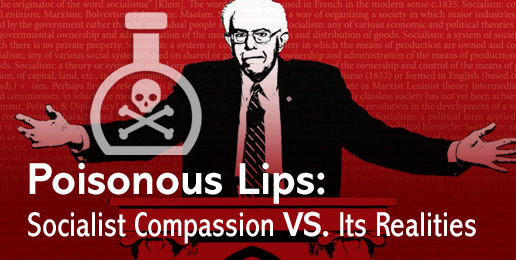
This article is one in a series that examines claims about how socialism would improve America. Each article examines a promise, and contrasts it with the reality that shows the hollowness of that promise.
Socialists like U.S. Senator Bernie Sanders promise the moon concerning what socialism can do:
“It is my very strong belief that the United States must reject that path of hatred and divisiveness and instead find the moral conviction to choose a different path, a higher path, a path of compassion, justice and love,” Sanders said to applause at George Washington University.
“And that is the path that I call democratic socialism.”
Of course, he can promise anything because his friends aren’t yet in power. But he does know how to sell the “sizzle” of socialism.
Claim: Socialism means compassion in society
Socialists believe in tearing down our society, replacing it with their new democratic world. A world that they call nicer, and more compassionate, than our current society. The Democratic Socialists of America describe it this way:
Capitalism is a system designed by the owning class to exploit the rest of us for their own profit. We must replace it with democratic socialism, a system where ordinary people have a real voice in our workplaces, neighborhoods, and society.
…
We want a democracy that creates space for us all to flourish not just survive and answers the fundamental questions of our lives with the input of all. We want to collectively own the key economic drivers that dominate our lives, such as energy production and transportation. We want the multiracial working class united in solidarity instead of divided by fear. We want to win “radical” reforms like single-payer Medicare for All, defunding the police/refunding communities, the Green New Deal, and more as a transition to a freer, more just life.
Socialists trust in “Big Government” to solve our ills. From this concept came the boondoggles of the New Deal and the Great Society. These programs were meant to fix society and, of course, failed.
Calling socialist programs compassionate is meant to occupy high moral ground. Associating compassion with government freebies is addressed by Daniel Cohen:
If compassion can be redefined as support for bigger government, then disagreement no longer becomes a policy debate. It becomes a moral failure. Questions are replaced with accusations.
Reality: Government handouts are vote buying, not compassion
Where is the charity, the compassion, in a government collecting taxes and then giving that money to others? There isn’t any. Stephen Moore, formerly a presidential adviser, showed that government and compassion don’t go together.
But government, by its nature, is not compassionate. It can’t be. It is nothing other than a force. Government can only spend a dollar to help someone when it forcibly takes a dollar from someone else. At its core, government welfare is predicated on a false compassion. This isn’t to say that government should never take collective action to help people. But these actions are based on compulsion, not compassion.
Government largesse might be good politics, gifting money to curry favor with voters. But it never rises to become actual compassion.
More reality: Government “compassion” extinguishes individual compassion
When government strives to be an agent of compassion it displaces individuals from that role. It taxes resources that could have been used by people to offer relief. And it discourages people from being compassionate in the first place.
The famed author Alexis de Tocqueville toured Europe, studying wealth and poverty. He wrote of his findings in his 1835 Memoirs on Pauperism. Regarding charity in England, he saw that the way assistance was given alienated both the givers and the recipients. An excerpt follows:
There is a second observation found in Tocqueville’s memoir. This deals with the role of public welfare in modern society. He claimed that when government establishes public charity on a permanent basis, it creates an idle class living at the expense of the industrious, and corrodes character. In fact, Tocqueville affirmed, “it depraves men even more than it impoverishes them.”
That is not to say that public aid should be abolished. There are times when aid is needed especially in times of disasters, extreme cases and catastrophes. Public assistance should then be swift, ample…and temporary. However, the best charity is that of private alms-giving which should be personal, natural…and voluntary.
When public charity replaced individual alms-giving, it served to break a valuable tie that traditionally existed between rich and poor. In the act of individual alms-giving, the benefactor took a personal interest in those whom he endeavored to aid. Likewise, the beneficiary expressed personal gratitude for the help given. A bond of affection was thus formed. As Tocqueville noted, “A moral tie is established between those two classes whose interests and passions so often conspire to separate them from each other, and although divided by circumstances they are willingly reconciled.”
The tie of widespread individual charity unites a people in a single bond while public welfare based on the idea of entitlement creates division and resentments. The industrious resent being relieved of their money without consent. The poor no longer express gratitude but resentment about benefits that are now deemed entitlements and which are never seen as sufficient.
Government “compassion” breaks the links between those who can help and those who need help. The needy must then look to the government for help. Which, of course, is the plan all along.
Conclusion
Socialism is all-in on Big Government, making it their preferred way to deliver good things. But it’s a mistake to replace private charity with public, for that path deconstructs a community. Lawrence Reed, of the Foundation for Economic Education, summarizes this mistake:
The plain fact is that government compassion is not the same as personal and private compassion. When we expect the government to substitute for what we ourselves ought to do, we expect the impossible and we end up with the intolerable. We don’t really solve problems; we just manage them expensively into perpetuity and create a bunch of new ones along the way.
Mr. Reed was also asked to comment on Biblical charity. Surely the Bible justifies government compassion! Quoting from the same article, his response is instructive:
In a television interview in Nassau, Bahamas, last November, host Wendall Jones, an unrepentant welfare statist, asked me, “Mr. Reed, what about the Good Samaritan in the New Testament? Doesn’t that story show that government should help people?” My reply: “Wendall, what made the Good Samaritan good was the fact that he personally helped the stricken man along the road. If he had simply told the helpless chap to ring up his congressman, no one to this day would have the gall to call him anything but a good-for-nothing.”
“But what about Christ himself?” Jones then asked me. “Wasn’t he in favor of redistribution to help the poor?” Fortunately, I know a few things about the Bible and Christianity. My reply: “Wendall, the Eighth Commandment says ‘Thou shalt not steal.’ It doesn’t say, ‘Thou shalt not steal unless the other guy has more than you do or unless you’re convinced that you can spend it better or unless you can find a politician to take it on your behalf.’ And even more to the point, when Christ was approached by a man (Luke 12:13–15) who wanted him to do some redistributing, Christ rebuked him with this admonition: ‘Man, who made me a judge or divider over you?’”
We do need a compassionate society. But socialism, along with our current lust for Big Government, gives us instead social isolation and an indifference to suffering. America needs to recapture charity from the statists, and renounce these socialist siren songs.