Washington Gives Illinois Two Weeks on School Mental Health Exams
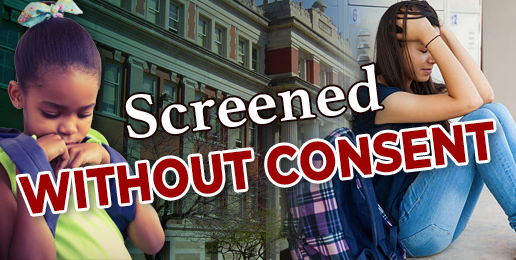
On Friday, October 30, the U.S. Department of Education gave the Illinois State Board of Education (ISBE) until November 13 to rewrite its rules for mental health screening of schoolchildren. The federal Student Privacy Policy Office says ISBE’s August guidance lets schools question children as young as eight about depression, anxiety, trauma, and suicidal thoughts without their parents’ written permission. The state rules also let schools keep the children’s answers away from parents.
Both practices, the Department says, put Illinois in conflict with two federal laws in force for fifty years: the Family Educational Rights and Privacy Act (FERPA) and the Protection of Pupil Rights Amendment (PPRA).
“Students should not be pressured into disclosing intimate information, including mental health, about themselves without their parents knowing and consenting,” said Frank Miller, the office’s director.
He added that parents “should be able to access critical information about their child’s wellbeing without schools hiding or separating such information.” Illinois can fix the guidance, or it can face enforcement that could result in the loss of federal funds.
What can parents do now?
TAKE ACTION: Because the current law is in violation of the two aforementioned federal laws, the U.S. Department of Education has given the Illinois State Board of Education (ISBE) until November 13th to rewrite the rules to administer mental health screenings to 8-yr-olds in school and comply with federal protections.
Click HERE to email ISBE Superintendent Dr. Tony Sanders, ISBE Chair Dr. Steven Isoye, and Members of JCAR*.
*JCAR is the Joint Committee on Administrative Rules. It consists of 6 members from the Illinois State Senate and 6 members from the Illinois State House. Once ISBE rewrites the rules, they will be approved by JCAR.
What the law requires
The screening mandate is Public Act 104-0032, which began as Senate Bill 1560. Sen. Sara Feigenholtz (D-Chicago) introduced it in the Senate, and Rep. Lindsey LaPointe (D-Chicago) sponsored it in the House. The Senate passed it 52 to 0 on April 11, 2025. Every Republican present voted for it. The House passed it 72 to 36 on May 21, 2025, on a straight party-line vote after Republicans asked for an opt-in requirement and were refused. Gov. JB Pritzker signed it at a middle school in Evanston on July 31, 2025, and called it “a national first worth celebrating.”
Beginning with the 2027–28 school year, every district must provide mental health screening to every student in grades 3 through 12 at least once a year. The requirement will not take effect until the state buys a screening tool that directs the child to answer questions about himself, such as his feelings, whether he is bullied at school or home, whether he has considered hurting himself or taking his own life, whether he gets in trouble. The state has to provide the screening tool free of charge to the district.
The statute says schools must “offer” the screening. Under the opt-out model ISBE prefers, every child is screened unless a parent intervenes — the screening is provided, and the offer is a formality.
ISBE was to publish model procedures by September 1, 2026, covering “the option to opt out, confidentiality and privacy considerations,” data sharing, storage of results and follow-up. The statute, now codified at 105 ILCS 5/2-3.203, is silent on parental consent.
What ISBE told the schools
In ISBE’s weekly message of September 16, 2025, announcing screening training with Lurie Children’s Hospital, it told districts:
“Schools must obtain signed, dated, written parent/guardian consent for student participation in mental health screening.”
Eleven months later, the instruction changed. ISBE released its 62-page Universal Mental Health Screening: Non-Regulatory Guidance for School Districts on August 25, 2026. Districts may now choose either model:
“an opt-out model in which screening occurs unless declined or an opt-in model requiring affirmative written consent.”
The guidance then told districts which way the state preferred. Passive consent,
“like what is typically used for vision and dental screening, is associated with considerably higher participation rates.”
ISBE has not explained who made that change or why.
The guidance does acknowledge the federal law. The document says PPRA “may apply” if the screener asks about “mental or psychological conditions, family relationships, or other sensitive topics,” and districts should “consult legal counsel.”
Every qualifying screener asks exactly those things.
The guidance also tells districts that whether a parent’s written consent is required depends on “the source of funding” for the screening, and that “offering an opportunity to opt students out of participation where required” may be all the federal law demands. The effect is a state manual for screening children without written consent inside the lines of the federal rules as they stood on August 25, the day ISBE published. Washington moved the lines the next day.
ISBE’s own FAQ says an acceptable tool must address internalizing and externalizing behavior, trauma, self-harm, and harm to others in ten minutes or less. The instruments the guidance lists as examples — the BASC-3 Behavioral and Emotional Screening System, the Pediatric Symptom Checklist, mySAEBRS, and the Strengths and Difficulties Questionnaire — ask children how often they feel sad, worthless, afraid, or want to hurt themselves.
Regarding the records, the guidance says screening results “generally are not the type of information maintained in a student’s permanent record,” and districts should decide whether to keep them as “temporary student records.” Under the Illinois School Student Records Act, a temporary record is still a student record, and parents may inspect it.
A bigger problem is the guidance tells districts that under the state Mental Health and Developmental Disabilities Confidentiality Act, students twelve and older have rights over their own mental health information, may object to disclosure, and “a therapist may deny parental access for compelling reasons.” When a school social worker administers the screen and records the result, the guidance says the activity “may more closely resemble an examination or evaluation” covered by that act. A separate Illinois law already lets a child of twelve receive outpatient counseling without a parent’s consent. Washington is fighting over whether a parent must agree before the questions are asked. Illinois has already arranged to keep the parent from the answers.
The federal position, and what changed
PPRA, 20 U.S.C. § 1232h, bars schools from requiring a student to submit to any survey, analysis, or evaluation that reveals “mental or psychological problems of the student or the student’s family” without prior written parental consent. For decades, the Department read that consent requirement narrowly, applying it to surveys funded by federal education programs that students were required to take, and treating everything else under a separate notice-and-opt-out rule Congress added in 2001. The Department’s own annual notice to superintendents, issued in March 2025 under Secretary McMahon, said exactly that: for surveys students are not required to take as part of a federal program, “the LEA should utilize the ‘passive’ consent requirement.” The Department’s 2020 PPRA guidance said the same. That document is now gone from the Department’s website, replaced by a note that it is “being reviewed and updated.”
The replacement is the Dear Colleague letter of August 26, 2026. Because a teacher or counselor hands out the survey, the letter reasons, students “commonly feel obligated to participate,” so the office will treat any survey involving protected subjects as “required” and subject to written consent, and “the opt-out provisions in PPRA do not apply as a way of securing parental consent.”
A section headed Mental Health Screening says behavioral health screeners that “probe students’ emotional or psychological states” fall squarely within the protected category. On October 5, Secretary Linda McMahon and Assistant Attorney General Harmeet Dhillon sent a joint letter to every state attorney general repeating the point: schools must “FIRST effectively notify the parent and obtain written consent,” and “Opt-outs are not sufficient in this regard.”
Illinois wrote its guidance to the old federal reading one day before Washington published the new one. ISBE will argue that the statute’s consent requirement applies only to federally funded, mandatory surveys. A screening a child may decline is not, and the Department said so itself seventeen months ago. The Department answers that a nine-year-old handed a questionnaire by her teacher does not experience it as optional.
No court has ruled on the new reading. Litigation will likely settle the question.
Meanwhile, the state is buying the tool. On October 19, nine days before the federal demand, ISBE posted an invitation for bid for a statewide screening platform: a budget not to exceed $7 million over three years, capacity for “an estimated 1.3 million students annually,” a consent-tracking module, “operational support for active and passive consent procedures,” and a vendor duty to “develop and implement strategies to maximize student participation.” The platform must connect to BEACON and to the state’s referral system.
Account permissions at the ISBE, district, and school levels “shall include the ability to view aggregate data only and the ability to view individual student screening results.” Bids open November 17, four days after ISBE’s answer to Washington is due. The contract may be “partially or totally funded with Federal funds.”
Twenty years of pushing
The idea of screening every schoolchild in Illinois for mental illness predates the elections of most current legislators in Springfield. President George W. Bush’s New Freedom Commission on Mental Health recommended in 2003 that schools expand mental health screening and pointed to Columbia University’s TeenScreen as a model. Illinois had just passed the Children’s Mental Health Act of 2003, and the draft state plan released in July 2004 called for periodic social-emotional screening of every child from birth to eighteen. Barbara Shaw, who chaired the Children’s Mental Health Partnership, described Illinois as a testing ground for the federal goals. The Illinois House adopted a resolution in May praising TeenScreen and declaring that every young person should be screened at least once.
Parents objected, loudly.
Rep. Patricia Bellock (R-Hinsdale) won a 114–0 House vote in 2005 for an amendment requiring that any screening be voluntary and with parental consent; the Senate let it die. The final 2005 state plan retreated to “voluntary” screening “with parental consent.” In Indiana, a fifteen-year-old named Chelsea Rhoades took a ten-minute TeenScreen questionnaire at school in December 2004 without her parents’ knowledge, was told she showed signs of obsessive-compulsive disorder and social anxiety, and became the plaintiff in a federal lawsuit that survived dismissal in 2008.
TeenScreen switched to active parental consent in 2006 and closed in 2012. Rep. Ron Paul introduced the Parental Consent Act four times to bar federal money for screening without written consent; it never left committee.
The second wave came with COVID. The Surgeon General’s December 2021 advisory and the American Academy of Pediatrics’ declaration of a national emergency in child mental health created a market for exactly what Illinois has now built.
The organization behind the push is Inseparable, founded in Washington in 2020 by Bill Smith, a Democratic campaign operative who ran Gill Action’s political program and co-founded Civitas Public Affairs.
It is built like a campaign: a 501(c)(3) for research, a 501(c)(4) for lobbying, and since 2024, a political action committee to elect legislators who sign its pledge. Its board includes the president of End Citizens United and a former executive director of the Democratic Senatorial Campaign Committee; former Rep. Patrick Kennedy is on its advisory board.
Its impact report claims “20+ dedicated lobbyists in target states” and 57 policy wins in 20 states since 2022. Its Hopeful Futures Campaign, a coalition of some thirty groups including NAMI, Mental Health America, the National PTA and the Kennedy Forum, issued a report card in 2022 grading every state on school mental health and recommending annual “well-being checks” for every student.
In Illinois, Inseparable counts among its wins the 2022 school wellness-check law, the requirement that the education and human-services agencies coordinate on student mental health, and the creation of the Children’s Behavioral Health Transformation Officer — the office that wrote the blueprint recommending universal screening. Its revenue rose from $1.4 million in 2021 to $7 million in 2024; it does not name its donors.
In March 2022, Pritzker named Dana Weiner of Chapin Hall at the University of Chicago to run a Children’s Behavioral Health Transformation Initiative. Her February 2023 Blueprint for Transformation made universal screening in schools and pediatric offices its Recommendation 9. Three Feigenholtz bills followed: the 2023 act that ordered a landscape scan (passed 112–0 in the House), the 2024 act that ordered a readiness report, and the 2025 act that imposed the mandate. ISBE’s scan found that 28 percent of districts were already screening every student with one of roughly forty different instruments, and that most of the rest lacked the staff and money to start.
Who lined up where
Witness slips filed on the bill were 434 opposed to 37 in favor; the opposition concentrated at the House hearing on May 1, 2025. The opponents were overwhelmingly individual parents, along with the Illinois Family Institute and the Illinois Family Life Coalition. The proponents were the institutions that will run the program or be paid by it: the Transformation Initiative itself, DCFS, the Department of Human Services, the ACLU of Illinois, the Illinois Association of School Boards, the Illinois Psychiatric Society, Thresholds, the Illinois Collaboration on Youth, the National Association of Social Workers, Cook County Health, and the trade associations for community mental health providers and county mental health boards.
Opposition has since grown stronger. Rep. Brad Halbrook (R-Shelbyville) filed HB 4114 to repeal the mandate and HB 4115 to require opt-in consent with three written notices a year; Rep. Chris Miller (R-Oakland) filed HB 4119 for opt-in. All three are currently in the House Rules Committee. U.S. Rep. Mary Miller (R-Oakland) introduced the Parents Opt-In Protection Act in Congress to write the consent rule into PPRA; Pritzker’s office said she was “stigmatizing young people.” On November 3, 2025, America First Legal filed a complaint with the Student Privacy Policy Office on behalf of Illinois parents, arguing the act is “facially incompatible” with PPRA’s consent mandate and warning that screening answers could trigger DCFS reports under the mandated-reporter law. Awake Illinois published a model opt-in-only policy for school boards in September 2026.
Abigail Shrier, whose book Bad Therapy documents the harm done by treating ordinary childhood distress as pathology, called the Illinois law “a disastrous policy that will do vastly more harm than good.”
The case for, and the case against
Supporters cite the growing numbers of suicides to justify the screening. Suicide is the second leading cause of death for Illinois children aged 10 to 14, and 213 Illinoisans between 10 and 24 took their own lives in 2021. Half of all lifetime mental illness, NAMI says, begins by age 14. The U.S. Preventive Services Task Force recommends screening adolescents for depression and children eight and up for anxiety. School, the argument goes, is the one place every child can be reached, and a child whose distress is caught in third grade costs less and suffers less than one who is caught in the emergency room. State Superintendent Tony Sanders put it this way:
“Too often, we only recognize a student’s distress when it becomes a crisis.”
The evidence for school screening is seriously flawed in ways supporters rarely mention. The Task Force recommendation is for a pediatrician’s office, with a parent in the room, and the same body found insufficient evidence that screening for suicide risk prevents suicide.
The largest school screening trial, in Pennsylvania, showed that screening finds more children who report symptoms; it did not show those children did better. A brief questionnaire given to a population where serious illness is rare produces mostly false positives, and the Manhattan Institute’s January 2026 review cites one study in which nine of ten children the screen flagged did not have the condition it flagged them for.
Duke psychiatrist Allen Frances, who chaired the task force that wrote the DSM-IV, warns that mislabeling children “stigmatizes and subjects them to unnecessary treatments.” A 2025 Australian trial of screening with feedback to parents found small gains in reported symptoms and attendance after a year, and no increase in children getting care; the authors could not say why. Sanders himself concedes Illinois has “not enough counselors and social workers” to follow up on what the screens will find. ISBE’s own readiness survey found half of districts had no capacity to communicate with families about the program, and its September FAQ says no additional state money is coming to districts for implementation.
Then there is the issue Washington has now raised with Springfield. A questionnaire about a child’s fears, sadness, and thoughts of self-harm, administered under a state mandate with a state-purchased tool, with referrals to a state portal built in partnership with Google, and governed by a law that lets the child, at twelve, keep the result from her parents, is a medical examination in everything but name.
The founding assumption of American law is that children belong to their families and that the state’s authority over them is borrowed, limited, and exercised openly. Illinois built a program on the opposite assumption, and told districts that opt-out produces “considerably higher participation rates.”
ISBE’s answer is due November 13, and its record offers some insight into what to expect.
In 2016, the Obama administration told schools to open girls’ locker rooms to boys who identify as girls; Palatine’s District 211 had already been the national test case, and Illinois complied. When the Trump administration withdrew that letter in 2017, nothing in Illinois changed. In March 2020, ISBE issued its own guidance telling every district that a school may not require a student to use the locker room that matches his biological sex.
The Biden administration wrote that position into the Title IX rules in 2024. A federal court struck the rules down, and the Trump administration reversed them in early 2025. A federal civil rights complaint against ISBE followed in March 2025, and ISBE said it “cannot comment on matters pending before” the Office for Civil Rights.
The 2020 guidance is still on ISBE’s website today.
In April 2025, ISBE refused the Department’s demand to certify it had ended DEI programs. Months later, ISBE issued a signed consent rule in September 2025 and dropped it eleven months after that. Because of its previous actions, nothing suggests ISBE will rewrite its guidance based on instructions from Washington. Parents should expect ISBE to argue, delay, or litigate, and should plan for that rather than expecting the state or school districts to comply.
The state wants children to answer its questions. Parents should insist on being asked first.