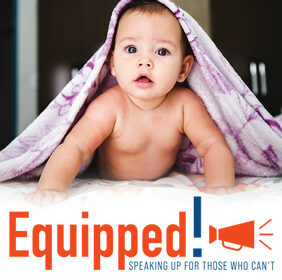
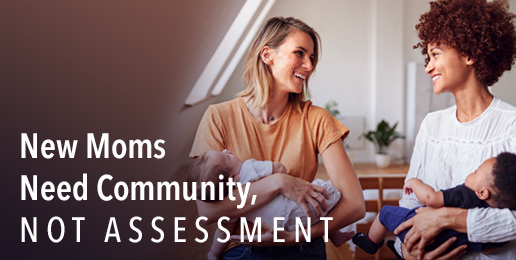
It used to be that babies were brought into the world within a community. If you were expecting, you would go through your pregnancy not only alongside other pregnant women in your family or clan, but also attended to by older, more experienced women. These practices remain in some cultures, especially in the global South, but for a long list of reasons, those days are all but gone in the developed world.
The Making of a Void
Over time in the United States, communities have fractured, families have spread geographically, and isolation has grown due to technology and the destructive cult of radical individualism so revered by so many in our nation. Add to that the over-medicalization of pregnancy and birth that has taught women not to trust the God-given wisdom of their bodies, and many experience pregnancy largely in isolation, dependent upon their medical providers alone for input on how best to carry and deliver their babies. There is a growing segment of American women who have chosen to return to the old ways of pregnancy and birth (myself included), but it is by no means the norm.
As the church, family, and other mediating institutions, which used to call individuals to civic virtue and responsibility within the larger community, have given up their influence, the government has happily stepped in to take their place. Once again, Illinois democrats seek to take advantage of this void and increase their reach into homes and families, this time with HB 4606, a bill that would create
“a statewide program to provide voluntary short-term universal newborn home visiting services to all Illinois families with newborn infants for the purpose of promoting the physical, mental, and social well-being of newborn infants and their parents or caregivers.”
On its face, this sounds like a reasonable idea. Whether it’s the way it should be or not, many women do deliver their babies and then go home with no support system, no one to make sure they and the baby are thriving during those intense first few weeks and months. But are we certain this is the answer: putting a government program in the place of family, friends, and community, who ought to feel and be expected to rise to the expectation of looking out for newborns and their parents?
Terms That Need Defining
In the text of the bill appears the following section (emphasis mine):
“Include an evidence-based assessment of the physical, social, and emotional factors affecting the family and newborn infant, including, but not limited to, a health and wellness check of the newborn infant and an assessment of the physical and mental health of a person who has given birth, lactation support as needed, and screening for social determinants or drivers of health through query and validated screeners with clinical relevance in diagnosing for perinatal mood and anxiety disorders.”
This raises several red flags:
1.) What “factors” are we talking about here? It doesn’t take a lot of imagination to picture a variety of ways someone’s personal convictions, family rhythms, or relationships could suddenly become a liability. And what will the state’s response be if they uncover some “factor” they deem problematic? These terms need to be spelled out.
2.) Someone should tell them that a “person who has given birth” has another name that is easier to type – Mother. Oddly enough, the bill refers to “mothers” in one place, but as it was in reference to a 2018 report (the stone age in terms of today’s sexual mores), it was likely a mere slip that will be rectified in future drafts.
3.) What are “social determinants or drivers of health,” and how are these screeners equipped to diagnose psychiatric disorders during a home visit? Are we trusting Illinois health officials to define mental health, mood, or anxiety? After all, mental health is ignored on the path to “gender-affirming care,” even for minors in the state. Are the people who pretend gender dysphoria isn’t a mental health issue the same ones who will determine what a postpartum mother’s mental state ought to be?
4.) Where does all this information go once it is gathered? Who is in charge of it? Is it destroyed or catalogued? Can it be sold? Families need to make an informed consent.
Deceptive Marketing
This program is billed as voluntary, to be “offered at no cost to a family and carry no negative consequences for a family that declines to receive services or participate in the program.” But since when has the government’s appetite for power ever been satisfied? Programs like this may start as optional, but as long as Springfield can appropriate taxpayer money to pay for it, they have little incentive not to make it mandatory in the future.
Unsurprisingly, HB 4606 reveals the intellectual dishonesty of Illinois democrats where it comes to both women and babies. “Women need reproductive health care,” shout their social media posts and posters at various marches, but the mothers of newborns described in the bill are mere “persons who have given birth.” So too, many viable, unwanted babies are considered disposable and left defenseless against “reproductive healthcare,” but under HB 4606, newborns (some of the same gestational age as babies killed in the womb) are so vulnerable that they need the government to check on them. It’s not too much to call out these inconsistencies.
Meeting the Moment
HB 4606 is set to come up in a committee hearing on Wednesday, February 25. The bill is in the early stages of development and will likely change before heading to the Senate, but now is the time to speak up. Harmful, entrenched policies all have a beginning. This bill has the potential to become yet another law that encroaches on the privacy and freedom of Illinoisans in one of the most vulnerable seasons of life. Read the full text and let your representative know what you think.
The church (universal – you and me) can and should retake its place as a mediating institution that can meet this need, starting with our own communities, families, and friends. If you know a woman who is pregnant, let her know you are here for her and are praying for her. Support your local pregnancy resource centers in the crucial work they do to support moms and dads throughout pregnancy and beyond. And women, especially, if there is a woman in your life who is expecting, and you have the relational equity to come alongside her, do it. Invite her questions, share your story, bring her a meal, and look her in the eye and ask her how she’s really doing in the fog of the newborn days.
As a mom of three who has had a variety of birth and postpartum experiences, I understand the problems HB 4606 aims to address. Truly, women in our nation deserve better in terms of maternity care. But we must always consider how much freedom and privacy we are willing to trade for an unproven benefit, especially when it’s promised by the state.
TAKE ACTION: Click HERE to fill out a witness slip in OPPOSITION of HB 4606.
- Fill out your personal information.
- Under Firm/Business/Agency, Title, Representation, type “self” or “NA” if you are not representing an organization and do not have a title.
- Under Position, Add Legislation, select Original Bill.
- Under Add Position, select Oppose. Then click Add Position. (Your position will then appear in the box to the right with a red circle and an x inside of it.)
- Select Record of Appearance Only.
- Check that you agree to the ILGA Terms of Agreement.
- Check that you aren’t a robot
- Click Submit Witness Slip.