In response to California governor’s death- row blanket clemency
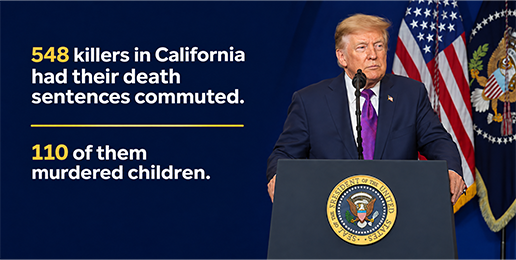
WASHINGTON – Monday, November 22, 2026, President Donald Trump held an event at the U.S. Department of Justice, focusing on families wounded by the murder of family members over the past several decades.
“Just days ago, California Governor Gavin Newsom granted clemency and mercy to 548 of the most evil monsters on the face of the earth. You’d have to read the biographies to see how bad they were. Some of them have levels of craziness and sickness I’ve never seen before,” Trump told the gathered audience.
Newsom granted clemency to more than 110 child killers, more than 100 rapists who killed their victims, and numerous serial killers who tortured and slaughtered dozens of victims, the president said.
Members of the victim families were invited to D.C. to share their thoughts about the governor’s action. They shared their heartache with the president and the event audience.
“Face me, Gov. Newsom. Tell me Michael’s life doesn’t matter. Michael deserved a Governor who would stand with the victims, honor their justice, and respect the will of the people,” said Sandy Friend, whose son, Michael Lyons, was kidnapped, tortured, and brutally murdered at just 8 years old.
“You may have taken our justice, but you will never take Michael’s voice.”
Marc Klaas, whose 12-year-old daughter, Polly, was abducted at knifepoint with two friends from a slumber party and strangled to death, said,
“For three decades, our family lived with the understanding that the justice system’s decision would stand. Today, I stand before you outraged — outraged — that Gov. Gavin Newsom unilaterally erased that sentence.”
Other families whose members were murdered by the death row prisoners now being allowed to serve life sentences shared their stories.
President Trump concluded the event emphasizing that far too often, capital sentences are delayed for years, if not decades, stalling the justice their victims’ families deserve. He promised to sign an executive proclamation that equips the Justice Department with tools to move death-sentence cases more efficiently than in the past.
He grieved the manner in which innocent American families have been treated and how criminals are given special treatment.
“Our opponents seek an America that empowers the most violent and dangerous elements, celebrates deviancy and enables dysfunction and demands empathy for serial killers and criminals while hard-working citizens are treated with hatred, scorn and contempt,” the President said.
“In the Trump Administration, we believe the exact opposite,” Trump said.
“We’re fighting to uplift the law-abiding, protect the most vulnerable and reward hard work and decency. To defend the innocent and punish the guilty.”
Governor Newsom’s clemency plan for those on California’s death row defies the majority of the state’s voters who expressed their opposition to a death penalty ban three times over the past two decades.
California legally retains the death penalty on its books, though executions were paused in 2006. Because state law, voter decisions, local prosecutors, and executive actions pull in different directions, California’s standing is split rather than a simple yes or no.
Illinois’ longtime death penalty ban
The state of Illinois is one of 23 lenient states where the death penalty is banned. Signed into law by Democrat Governor Pat Quinn in 2011, Republican Governor George Ryan instituted a 2000 moratorium in Illinois and granted blanket clemency to 167 death row prisoners in January 2003.
One Republican lawmaker, state Senator Neil Anderson of Aledo, IL, was first elected in 2015, but has made reviving the death penalty in Illinois a priority. Thus far, none of his attempts have progressed through a Democrat-controlled Illinois Senate.
His 2022 attempt focused on bringing back the death penalty for those who killed law enforcement or medical emergency officers.
“More than a decade ago, our state senselessly abolished the death penalty across the board,” Senator Anderson said at the time.
“It is important that we stand with our entire frontline line community and hold fully accountable anyone who kills a first responder or peace officer.”
“These are people who wake up every day to serve and protect our communities, the people on our streets, our homes and our loved ones,” he said. “We owe it to the first responder community to make sure that anyone who attacks them is held accountable to the highest level possible.”
Anderson submitted another version of the death penalty ban in 2026. The bill is described as permitting “the imposition of the death penalty for first- degree murder, criminal sexual assault, aggravated criminal sexual assault, predatory criminal sexual assault of a child, criminal sexual abuse,” with a variety of age exceptions.
Anderson received no support from fellow Republicans for his 2026 proposed death penalty bill.
Illinois is likely to maintain its position in favor of banning the death penalty. If a crime committed in Illinois affects federal law, the accused could face federal death penalty punishment.
(Illinois Family Institute was invited to attend the “Defending American Families” event as a courtesy of the national group, Moms for America.)