
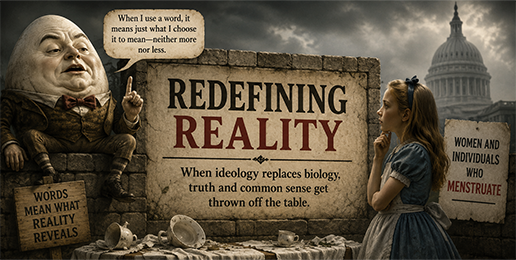
“A hill CAN’T be a valley, you know. That would be nonsense,” said Alice.
The Red Queen shook her head. “You may call it ‘nonsense’ if you like,” she said,
“but I’VE heard nonsense, compared with which that would be as sensible as a dictionary.”
. . .
“When I use a word,” Humpty Dumpty said, in rather a scornful tone,
“it means just what I choose it to mean — neither more nor less.”
“The question is,” said Alice, “whether you CAN make words mean so many different things.”
“The question is,” said Humpty Dumpty, “which is to be master — that’s all.”
Lewis Carroll wrote those exchanges in his 1871 book, Through the Looking Glass. This was his warning to the world at the time, a world in which people in positions of power were making the very argument Humpty Dumpty made to Alice — that words mean what those in authority choose them to mean, and that anyone who objects hasn’t grasped who is master.
In Illinois, the legislature just enacted yet another law that aligns with the view of Humpty Dumpty and the Red Queen.
The 1860s and 1870s, Carroll’s world, were marked by intensifying warfare over definitions. Three converging intellectual movements were doing to Victorian Britain what progressive politics is doing to us today — systematically dismantling shared, widely accepted definitions and, using their political power, replacing them with meanings that conform to their preferred vision of what reality should be.
The philosophical idealists — the British Hegelians, who were gaining influence at Oxford while Carroll taught there — argued that reality, as ordinary people understand it, is a mental construction. A school of predominantly German biblical scholars was applying historical analysis to Scripture and concluding that its words meant whatever a trained interpreter decided, thereby overriding what generations of readers had understood. And Charles Darwin had just demonstrated that species — one of the foundational categories of natural science — had fluid boundaries, that what counted as a distinct category was partly a matter of convention.
Carroll watched all of this from his rooms at Christ Church and grasped its political implications clearly. If meaning belongs to whoever holds interpretive authority, then Humpty Dumpty is a philosopher with a program. His claim — to be master, that’s all — is the logical conclusion of the idealist position. But whose ideal?
The Alice books are Carroll’s response. Alice keeps insisting on the obvious. A hill is a hill. “Glory” means “glory.” Words mean what the community of speakers has agreed they mean, as determined by shared use over time. The looking-glass world — the world where that principle dissolves — collapses into chaos. The banquet ends with the tablecloth pulled, the dishes crashing, and Alice shaking the Red Queen back into a kitten.
Carroll was right to be pessimistic about whether his contemporaries would heed the warning. The movements he satirized won. A century and a half later, the Humpty Dumpty program was enacted into law.
In Illinois, it just passed both chambers of the General Assembly. (Watch the House floor debate HERE.)
Senate Bill 3465, which amends the Construction Site Temporary Restroom Facility Act to require construction employers to provide separate toilet facilities, menstrual hygiene products, and lactation accommodations for what the bill calls “women and individuals who menstruate,” now awaits the governor’s signature.
Did you catch that? Women and individuals who menstruate.
In the English language as it has been used for the entirety of recorded history, those two categories were the same. Women are, by biological definition, individuals who menstruate — or who have the biological capacity to do so. The phrase “women and individuals who menstruate” in ordinary English is like saying “squares and equilateral rectangles.” The second half of the phrase adds words while subtracting meaning.
The only way that phrase does useful work is if “women” has already been redefined — as Humpty Dumpty redefined “glory” — to mean something chosen by the legislature rather than something agreed upon by observing reality. The decision embedded in the bill’s language is this: “women” now refers to a category defined by gender identity rather than by biological sex, so that some women do not menstruate and some individuals who menstruate are women only in the biological sense. Once you have made that decision, the conjunctive phrase becomes necessary because the two categories diverge.
The bill makes that decision silently. It announces no redefinition of “women.” It simply uses the new definition as settled fact and mandates that employers post it on the exterior of construction site facilities using, in the bill’s own words, “inclusive language for various gender identities, such as women and individuals who menstruate.”
Humpty Dumpty could not have drafted it any more efficiently.
The problem here is that the redefinition destroys the bill from the inside.
The bill’s stated purpose is to protect the health and dignity of workers who menstruate, because menstruation creates specific hygiene needs that the original gender-neutral facility requirements left unaddressed. That is a legitimate concern grounded in biology. Menstruation is a biological function. The workers who need the accommodations the bill provides are those who menstruate because of their biology.
The bill’s language simultaneously treats “women” as a gender-defined category. That detachment from biology requires the second half of the phrase — “and individuals who menstruate” — to carry the biological weight that “women” once carried alone. The result is a statute that operates on two irreconcilable definitions at once, producing contradictory answers.
Consider: a transgender woman — a biological male who identifies as female — is a “woman” under the gender identity definition. He is entitled to use the designated separate facility under that half of the phrase. He cannot menstruate at all, ever. Under the “individuals who menstruate” half of the phrase, access depends on that biological fact. The bill provides no resolution.
A transgender man — a biological female who identifies as male — may still menstruate. Under the “individuals who menstruate” half of the phrase, access to the separate facility follows. Under the “women” half, identity governs, and that identity runs the other way. The bill provides no resolution here either.
These are the predictable and immediate consequences of writing a statute whose foundational category is incoherent. Carroll’s Alice identified the principle: a hill is a hill. A category defined simultaneously by biology and identity, when those definitions yield different results, produces a statute that cannot identify its own beneficiaries. SB 3465 leaves that contradiction for the courts to resolve — at the employer’s expense and at the expense of the workers the bill claims to serve.
The definitional incoherence leads directly to constitutional defects serious enough to threaten the bill’s survival in court. Here is what they are, in plain English.
The U.S. Constitution requires that when a law treats different groups differently, the government must have a good reason that fits the distinction it draws. This bill creates a separate facility for “women and individuals who menstruate” at sites with ten or more workers of any gender. The biological need justifying it is real: menstruation requires privacy, time, and hygiene supplies. A function-based approach — requiring a private, lockable restroom with adequate time and supplies for any worker with a personal hygiene need — reaches the same workers, serves the same purpose, and rests on a classification the U.S. Constitution can sustain. The bill’s sex- and identity-based classification, by contrast, raises questions the bill does not answer. Courts demand answers.
The First Amendment protects the right to remain silent on ideological questions. SB 3465’s mandatory exterior signage requires employers to use “inclusive language for various gender identities, such as women and individuals who menstruate.” That formulation is an ideological position on one of the most contested biological and social questions of our time. The employer who posts it endorses it — publicly, permanently, and under penalty of criminal prosecution if he doesn’t.
A sign directing workers to a private restroom serves a legitimate regulatory purpose. A sign requiring the employer to affirm a contested definitional framework serves a different purpose entirely.
The U.S. Supreme Court addressed this in NIFLA v. Becerra (2018): the government must show that a compelled speech mandate is narrowly tailored to a substantial interest. Requiring ideological affirmation to identify a restroom fails that test.
Criminal statutes must define prohibited conduct with sufficient precision so an ordinary person knows in advance what conduct will result in prosecution. SB 3465 imposes a petty offense — a fine of up to $100 for a first violation — that then escalates to a criminal conviction for each subsequent day of noncompliance, with no maximum fine specified and no classification stated. Under Illinois law, that unspecified “conviction” could be a petty offense, a misdemeanor, or something else entirely — a question prosecutors and courts would be unable to resolve, because the bill’s drafters left it open.
That ambiguity compounds daily: a contractor who receives notice on Monday and cannot determine whether his break schedule provides “adequate time for multiple layers of clothing,” or whether his site refrigerator qualifies as “convenient hygienic refrigeration,” accumulates separate criminal convictions — of indeterminate classification and uncapped financial exposure — for every day he remains uncertain.
Courts strike down criminal statutes for exactly this kind of vagueness because fair notice is a constitutional requirement. SB 3465 fails this requirement twice: once in the definition of the offense and again in the definition of the penalty. “Convenient hygienic refrigeration” has no distance standard and no alternative compliance option. “Sufficient supply” of menstrual products means at least ten units — but the bill specifies no product types, leaving a contractor uncertain whether ten tampons satisfy the requirement or whether ten of each product type is the standard. He discovers the answer when he receives a notice of violation and a criminal charge.
The bill takes effect on January 1, 2027. The Illinois Department of Public Health must adopt rules defining reasonable accommodation by that date. Employers have six months after rule adoption to achieve compliance. Rules adopted on the final permissible day set a compliance deadline of July 1, 2027 — six months after the Act is already effective. On January 1, 2027, employers face legal obligations defined by a standard the government has yet to write. In a statute carrying criminal penalties, that sequence is itself a due process violation. Criminal liability requires that the standard exist before the obligation attaches.
The federal PUMP for Nursing Mothers Act (2022) requires employers to provide break time and a private, non-bathroom space for lactation. SB 3465 adds requirements for refrigeration, milk expression equipment, and a water source — requirements that go beyond the federal floor. Illinois operates under a federal OSHA State Plan, which requires OSHA approval before any state standard exceeding the federal floor takes effect. The bill contains no provision for that approval process. Construction-site provisions that took effect without it are subject to federal preemption from day one. The bill’s undue hardship standard also uses different factors and weights than the federal PUMP Act standard, leaving employers with dual exposure and no guidance on how to reconcile them.
The underlying concern that motivated this bill is genuine.
Women who are breastfeeding carry a biological obligation that the workplace has historically treated as an inconvenience to be managed privately, without employer accommodation. A nursing mother on a construction site needs privacy, adequate time, and a sanitary place to express milk. For many infants, breast milk is a medical necessity — the difference between an infant who thrives and one who does not. A mother whose employer gives her no time or place to express milk will lose her supply. The loss is permanent. The baby bears the consequence.
That reality deserves serious legislative attention. Construction sites have been among the least accommodating environments for female workers managing biological needs. The women who work on them have earned better accommodations than portable toilets and inadequate break schedules. I support requiring employers to provide them.
But the answer this bill provides will tie up courts for years, impose criminal liability on employers who cannot determine what compliance requires, compel ideological speech as a condition of regulatory compliance, and conflict with federal law in ways that may render the entire scheme unenforceable. The women on construction sites who need relief will wait while the lawyers sort it out.
A well-drafted bill directly accomplishes its goal: a private, lockable facility providing genuine privacy; adequate paid break time for any worker with a personal hygiene management need; accessible refrigeration for expressed milk; and supplies sufficient for the purpose. Defined terms. An undue hardship standard aligned with the federal PUMP Act. Signage identifying the facility as private, nothing more. Classification grounded in biology and function, carrying no ideological declaration about the relationship between biological sex and gender identity.
That bill advances through committee on the basis of documented need, withstands constitutional challenge, and delivers relief to the workers it describes. It earns bipartisan support because its foundation is solid.
Carroll’s Alice understood the standard. A hill is a hill. The legislature’s power to pass bills does not include the power to turn hills into valleys or to make words mean whatever is politically convenient that session. Building workplace protection law on an incoherent foundation produces litigation, not protection.
We can write the bill that actually helps. We should.
Let’s start by electing conscientious men and women who are dedicated to solving problems rather than signaling a claimed virtue or posturing for the media.