
How Food Bank Executives Get Rich Managing “Free” Food
This past December 2025, I published my article, “The Hunger Industrial Complex: How America Manufactured a Food Insecurity Crisis.”
In that piece, I explained how what was supposed to be a multi-billion-dollar charitable food distribution service had turned into a monopoly with inflated salaries for top executives. Additionally, Feeding America and its network of regional food banks operate with almost no public oversight, despite being funded almost entirely by taxpayer dollars and tax-deductible personal and corporate donations.
The lack of oversight shows.
When you compare what food-bank executives earn to the work these organizations actually do, the picture that emerges isn’t one of modest, volunteer-driven charity. It’s a professional system of administration and logistics with executive pay that warrants serious scrutiny.
Let’s begin with what the IRS Form 990 filings reveal.
The table below displays the compensation of the CEO of the national umbrella organization for The Emergency Food Assistance Programs (TEFAPs), Feeding America, and the six regional food banks that serve as the nearly exclusive distributors of TEFAP commodities—the federal food purchased by the USDA and distributed through state agencies.
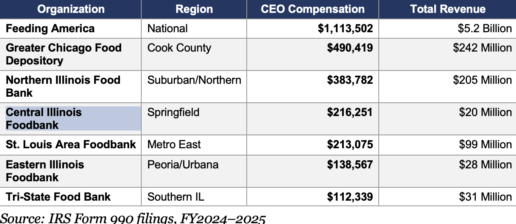
Feeding America’s 2024 filing reports approximately $5.05 billion in revenue and about $7.41 million in compensation for top leadership. Greater Chicago Food Depository’s latest filing shows revenue of around $242 million and pay of roughly $2.31 million for its top officers. Northern Illinois Food Bank’s recent reports also indicate revenue in the $180 million range and CEO pay in the high-$300,000 range.
These organizations form the core of Illinois’s charitable food infrastructure and oversee large amounts of food, money, and public attention.
The CEOs in the Chicago area earn significantly more than several of their downstate counterparts. While this difference alone doesn’t prove misconduct, it does raise obvious questions:
Why has executive pay increased so sharply in organizations whose public image centers on distributing donated and taxpayer-supported food?
And why is it so high in the first place?
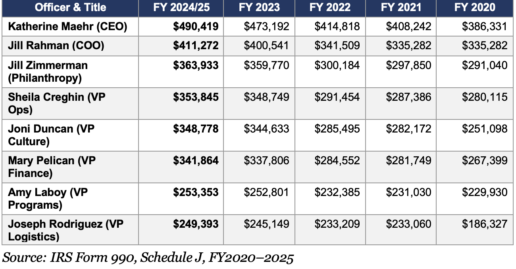
But CEO pay is just the start. At the Greater Chicago Food Depository, the Form 990 filings show a substantial executive layer below the top leadership. Total compensation for senior officers exceeds $2.3 million annually. Katherine Maehr’s pay has increased significantly since 2020, and several officers now earn well over $250,000 a year.
The titles themselves reveal part of the story: Vice President of Culture. Vice President of Philanthropy. Vice President of Policy, Advocacy & Engagement. Vice President of Research Evaluation & Business Analytics. These are not warehouse-floor roles. They are managerial and administrative positions within an organization that still heavily relies on the language of emergency charity for its public image.
The broader financial pattern is also significant.
During the pandemic years, charitable food revenue increased dramatically. At Greater Chicago Food Depository, revenue rose sharply during the COVID emergency and later declined from its peak, but executive compensation did not decrease proportionally. The same general pattern is evident at the Northern Illinois Food Bank: pandemic-era revenue spikes have lessened, yet senior pay remains high. The main conclusion is not that every dollar is unjustified, but that temporary “crisis” conditions helped establish a higher long-term compensation baseline across the sector.
At its core, a food bank functions as a warehousing and distribution system. It receives products, stores them, sorts them, tracks them, and moves them to downstream agencies. This does not make food bank executive roles identical to private-sector distribution center leadership. Food-bank officers also manage fundraising, grant compliance, donor relations, public policy, and public messaging. However, the logistics comparison remains fair in one key aspect: these organizations are not just charities in the old neighborhood-church sense. They are large institutional supply chain operations.
Therefore, comparisons to private-sector logistics pay should not be ignored. Bureau of Labor Statistics wage data for transportation, storage, and distribution managers in the Chicago area show compensation significantly lower than what several senior food-bank officers currently earn.
Anyone who has worked in both the private sector and NGOs knows that private-sector jobs are more difficult, have greater operational consequences, and face higher accountability. They are therefore more stressful than the nonprofit roles being compared. That makes the current compensation structure at large food banks more—not less—worthy of examination.
So what does the private sector pay the people who run these operations?
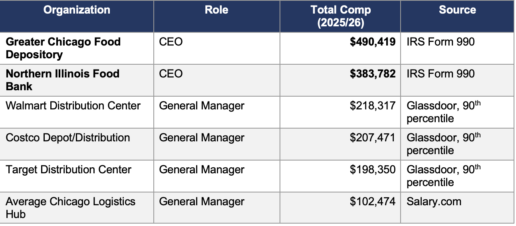
Read that again. A Walmart General Manager is the top leader at a facility responsible for billions of dollars in inventory and hundreds of employees. That person earns $218,317, which is at the high end for that role. Meanwhile, the Vice President of Operations at the Greater Chicago Food Depository—who has a much less demanding logistical role—earns $353,845. That’s $135,000 more than the top executive at a for-profit organization.
Remember, the Walmart manager works under high accountability, in a competitive environment where inefficiency can lead to lost market share and potential job loss. The food bank VP, on the other hand, operates in a system where “revenue” comes mostly from donors and government grants, with almost no accountability. That’s why these salaries don’t seem like compensation for sacrifice; they appear to be tribute from a protected system.
According to the Bureau of Labor Statistics, several of these officers earn double or triple what comparable private-sector logistics professionals earn, while the rest fall into a compensation range most Americans would never associate with a food charity.
If you want a single number that captures this system, it’s this: how much product value does each manager oversee per dollar of their compensation?
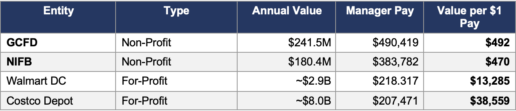
Walmart DC value derived from ~$385B U.S. revenue across 115 regional centers. Costco generated ~$192B in U.S. revenue across ~24 depots.
Here’s another way to view the income of each officer at the Greater Chicago Food Depository: what is the percentile of their salary compared to all workers across the United States?
Greater Chicago Food Depository: Executive Compensation
National Income Percentiles for All U.S. Workers
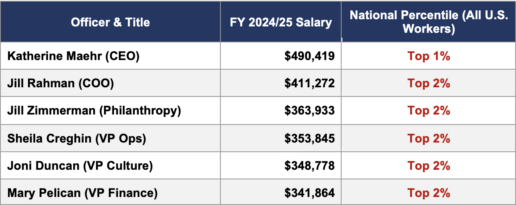
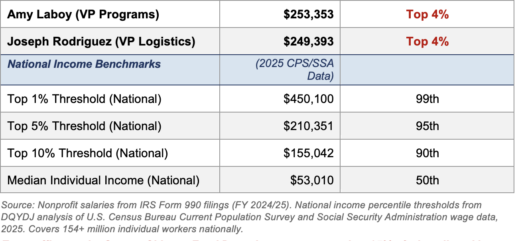
Every officer at the Greater Chicago Food Depository earns more than 95% of what all working Americans earn. The CEO is in the top 1%. They run a taxpayer-supported food bureaucracy that still markets itself as a charity.
Most people think that when food is donated to a food bank—whether by corporations or the federal government—it is free for local pantries and soup kitchens. That assumption is too simple.
In practice, food banks often charge downstream agencies various fees, usually called shared maintenance fees or program service fees, at least for some types of food and services. Northern Illinois Food Bank’s audited financial statements report over $5.5 million in program service fees and describe these fees as stemming from its purchased and donated food program, including shared maintenance on donated food. That is a matter of record.
This fee structure should receive much more public attention than it currently does. Churches and small food pantries are often told, in effect, that they are part of a charitable partnership, even as substantial fee revenue is generated upstream in the distribution process. Even when those fees are lawful, they are part of the business model and must be disclosed transparently and clearly understood by donors, legislators, participating agencies, church officials, and members.
The clearest federal rule I found regarding fees is 7 CFR 251.9(d), which states that states may not charge fees for the distribution of USDA Foods to eligible recipient agencies. USDA guidance also clearly states that TEFAP foods must be provided to recipients free of charge. However, these authorities do not automatically mean that every fee charged within the broader charitable-food system is unlawful.
They do establish a boundary: USDA foods should not become an open revenue stream through direct distribution charges, and any fee arrangement involving TEFAP inventory should be carefully reviewed, contract by contract and policy by policy.
That distinction is important. Some food banks and related organizations clearly separate free USDA commodities from other donated food that may incur handling or maintenance charges. The Greater Chicago Food Depository’s audited financial statements confirm that USDA and certain TANF-funded commodities are distributed without service fees. Therefore, the most supportable criticism is not that all fees are illegal, but that the system is so unclear that local pantries, churches, and donors often cannot easily identify what they are paying for, which inventory is free, and which inventory generates upstream fee revenue.
That opacity matters because the public sees a simple story: corporations donate food, taxpayers fund emergency food programs, and food banks serve the poor. But behind that public story, there’s a more complex financial reality in which food can bring tax benefits, fee income, administrative costs, and organizational growth for those in the middle of the chain.
In Part I, I argued that a large portion of the food distributed through food banks consists of highly processed surplus categories that would not be anyone’s ideal of healthy nutrition. Whether or not every estimate in that category can be pinpointed precisely, the broader accounting issue is real. Food banks report donated food inventory using standardized per-pound valuation methods, which can produce very high program expense ratios on paper. This does not necessarily violate accounting rules, but it can make the organizations appear more efficient than an ordinary reader might assume based on the underlying quality or market value of the food itself.
This matters because watchdog-style efficiency claims are often used to defend large administrative structures and growing executive pay. If the system’s estimated performance relies heavily on valuation methods the public does not understand, public discussion is already biased.
The Illinois system needs special attention. Illinois now relies on a limited network of regional food banks to distribute TEFAP-related assistance across all 102 counties. It used to have seven listed TEFAP organizations, but the counties formerly served by the Peoria Area Food Bank have been absorbed into the Eastern Illinois Foodbank. The system has become more centralized, with fewer organizations controlling access to USDA food and food supplied by companies within the state.
Feeding Illinois serves as the statewide organization for the network, with its board composed of leaders from member food banks. This setup does not inherently suggest wrongdoing. However, it means that the same group of institutional leaders serves both the operational organizations and the coordinating association. This should naturally raise questions about independence, transparency, and oversight.
Those questions became more urgent after a recent audit of Feeding Illinois identified a material weakness in internal controls. “Material weakness” is not a minor bookkeeping issue. It means the auditor found a deficiency serious enough to indicate a reasonable possibility of a material misstatement in the financial reporting. Even without accusing of corruption, that finding alone is enough to prompt further investigation into how both state and charitable funds are managed.
On October 30, 2025, Governor Pritzker issued Executive Order 2025-08, allocating $20 million in state support to food banks in anticipation of increased demand due to federal policy changes. That is a matter of public record. Regardless of one’s opinion about that decision, it is fair to note that Illinois chose to direct additional resources through the existing food-bank infrastructure rather than a more decentralized approach. That is a policy choice critics are entitled to scrutinize.
The same is true of disclosure.
IRS Schedule I instructions require providing identifying information for domestic organizations that receive more than $5,000 in grants or assistance. I cannot confidently assert, without stronger evidence, that every omission or restriction in public disclosures is intentional. However, I can say that large food-bank organizations often make it significantly harder than it should be for an average member of the public to trace where assistance went, in what amount, and to which downstream entities.
For institutions managing huge amounts of charitable and public resources, that lack of transparency is a valid concern.
One of the clearest lessons from this investigation is that the modern food-bank system is not best understood as a loose collection of local charities. Instead, it is a large, centralized, bureaucratic network with executive pay, fee income, government partnerships, accounting practices, and professional administration. The public is encouraged to picture church basements and volunteers sorting cans. However, the financial records tell a more institutional story.
The most valid criticism of this system is not that every executive is corrupt, or that every maintenance fee is illegal, or that every food bank officer acts in bad faith. It is that a network designed to deliver food to the poor has become highly centralized, heavily bureaucratic, and insufficiently transparent. The compensation remains high. The fee structures are real. Oversight is weak. Reporting is hard to understand. And when more public funds become available, they are often spent in the same established channels.
That is enough to justify a serious public debate.
What I reported in my previous article is even more significant for that debate. An analysis of the indicators used to measure hunger levels in this country shows that the food pantry network and the SNAP program are ineffective at reducing hunger. Even as food distribution to local recipients rises or falls and as the SNAP program expands or shrinks, these changes don’t influence the reported hunger indices.
In other words, the programs are not working. They are not solving the problem.
That should come as no surprise to anyone familiar with the changes in the system over the years. While the TEFAP system was created to address a temporary increase in hunger caused by rising poverty due to economic disruptions in the 70s, it has become a permanent system no longer tied to poverty measures.
The hunger industrial complex not only pays its executives like corporate CEOs but also systematically erodes every safeguard meant to ensure that food reaches those who truly need it. Under federal TEFAP regulations (7 CFR 251.5(b)), states set income eligibility at up to 300% of the Federal Poverty Level. In Illinois, the limit is exactly at that maximum. For 2026, this means a family of four earning up to $99,000 a year qualifies for free government food.
A household of five can earn $116,040 and still access the program. Regardless of what defenders of the current system claim, such a high threshold greatly expands the definition of “emergency food assistance” beyond its original intent. A program designed to address urgent material needs now covers many households that wouldn’t traditionally be seen as experiencing a true food emergency.
But even that absurdly generous threshold is meaningless in practice because food pantries receiving TEFAP commodities are explicitly prohibited from verifying income. The Illinois DHS procedures manual states directly that “distribution sites are prohibited from verifying income.” No pay stubs. No tax returns. No financial documentation of any kind. Eligibility is established entirely by self-attestation — a person signs a sheet saying they qualify, and the pantry is legally barred from challenging it. In practice, a pantry may have every reason to doubt a claim and yet still lack the tools to test it meaningfully.
One Food Bank’s TEFAP manual spells it out:
“Food pantries, soup kitchens, and homeless shelters are NOT ALLOWED to ask for social security cards, pay stubs, or income data.”
Then the Biden administration delivered the final blow to accountability. On October 31, 2024, the USDA’s Food and Nutrition Service issued a final rule titled “Food Distribution Programs: Improving Access and Parity,” codifying the change at § 251.5(b)(3) to specify that length of residency, address, or identification documents shall not be used as eligibility criteria when determining household eligibility.
Effective December 30, 2024, regulations at 7 CFR 251(b)(3) prohibit state agencies from requiring applicants or participants to provide their address or identification documents — such as a photo ID, mail, residency proof, or similar documents — to receive USDA Foods.
As of the final days of the Biden Administration, a person receiving federally purchased food at a TEFAP distribution site cannot be asked to prove their identity, residence, or income. The only information a pantry can collect is a name, city, and county, household size, and a signature attesting to income eligibility.
No verification, no identification, no address confirmation. It is not permitted to verify who the person is.
This regulatory demolition was not accidental, and the timing was not coincidental. Whatever the official reason for the rule change, its actual impact was to further weaken already fragile screening. It established a system where food can be distributed with little to no documentary proof of identity, residence, or income — a framework that critics can rightly argue is more vulnerable to exploitation, more susceptible to politicization, and more difficult to monitor.
When I first began this investigation, it was because food banks in my area — mainly funded by the USDA through TEFAP — started making anonymous food deliveries to people who were reportedly afraid to visit the food bank for fear that ICE agents might pick them up and deport them. Whether called humanitarian outreach or institutional resistance to immigration enforcement, the result was the same: food distribution practices were being changed in ways that made legal scrutiny harder.
One federal agency — the USDA — is now effectively undermining the mission of another — Homeland Security. They did this by eliminating every verification mechanism that could have identified who was receiving the food, where they lived, and whether they were legally in the country.
Additionally, the system has been entirely separated from its original purpose. Whether described as humanitarian outreach or institutional resistance to immigration enforcement, the outcome was the same: food distribution methods were being altered in ways that made legal review more challenging. The hunger industrial complex doesn’t need hungry Americans; it simply needs names — any names — signing the attestation sheets.
The contradiction at the heart of this system is brazen.
In 1996, Congress enacted the Personal Responsibility and Work Opportunity Reconciliation Act (PRWORA), codified at 8 U.S.C. § 1611. Section 401 of PRWORA states that aliens who are not “qualified aliens” are ineligible for any “Federal public benefit” as defined in 8 U.S.C. § 1611(c).
The statute’s definition of “Federal public benefit” includes:
“any retirement, welfare, health, disability, public or assisted housing, postsecondary education, food assistance, unemployment benefit, or any other similar benefit for which payments or assistance are provided to an individual, household, or family eligibility unit by an agency of the United States or by appropriated funds of the United States.”
TEFAP food is purchased with federal funds allocated by the USDA and distributed to individuals as food assistance. It is, at minimum, a federal benefit program, which prompts a clear question: how can a government program enforce immigration restrictions when identity, residence, and income are hardly documented at the point of distribution?
In July 2025, the Trump USDA clarified that PRWORA’s restrictions are important and that illegal aliens should not receive government funding. The Attorney General also revoked the old 2001 order that had been used for years to soften or bypass those restrictions in community programs.
Yet, just weeks before the current administration took office, the outgoing Biden USDA published a final rule, effective December 30, 2024, codifying at § 251.5(b)(3) that neither length of residency, address, nor identification documents shall be used as eligibility criteria when determining household eligibility for TEFAP food.
That is the real scandal. Defenders can point to regulatory cover all they want, but a system based on self-attestation and minimal verification makes meaningful screening nearly impossible in practice. Congress drew the lines. The bureaucracy blurred them. This is not stewardship. It is administrative sabotage disguised as compassion.
At minimum, this regulation deserves serious legal and policy scrutiny because it weakens the usual safeguards a reasonable person would expect in any publicly funded, needs-based distribution system. However, it hasn’t been challenged — because those who control the system don’t want it to be. They want the names on the sign-in sheets. They want the numbers that justify the next round of grants, the next executive salary boost, the next $37.6 million marketing campaign about “record hunger.”
According to a USDA study, approximately 67% of food pantries and 65% of emergency kitchens in the United States are faith-based. It was churches and faith communities that established the food pantry system in this country. When hunger suddenly became an emergency in the 1970s, it was people of faith who stepped up first — not because they were paid, or because a 501(c)(3) board told them to, but because we are called to serve the poor.
But what are we called to do when a system we started becomes so twisted and distorted that it no longer resembles what we helped to create? What are we called to do when the food we collect is controlled by a network of insiders who pay themselves half a million dollars annually, charge our pantries for food that was initially free, use inflated valuations to produce fake efficiency ratings, and then deploy what we’ve built in a manner that violates federal immigration law — all while telling us we should be thankful for the privilege of participating?
We are not called to go along with that. We are called to something better.
The system has become irretrievably corrupt. It cannot be reformed from within because the people who control it — from Feeding America’s national office to the Feeding Illinois network to the six regional hubs that control the distribution of federal food in this state — have no interest in reform. Reform would require accountability, which means lower salaries, published fee schedules, verified eligibility, and an honest assessment of whether 30 years and billions of dollars annually have actually reduced hunger. They will never allow that honest assessment to happen voluntarily.
Every church-run pantry in America should withdraw from the TEFAP system. Step away from the federal food, the Shared Maintenance Fees, the self-attestation sheets, and the regulations that dictate what you can and cannot ask of the people you’re trying to help.
Return to what worked: every church member shopping for food and bringing it to their pantry for distribution to people who are confirmed to be in genuine need — and who, because the government is no longer standing between you and them, can be offered spiritual encouragement and guidance along with their groceries.
Some churches might find a better solution. But any solution that involves government control of the food your congregation provides is the wrong choice. The hunger industrial complex has taken what the faith community built out of love and turned it into a multi-billion-dollar racket.
It’s time to take it back.