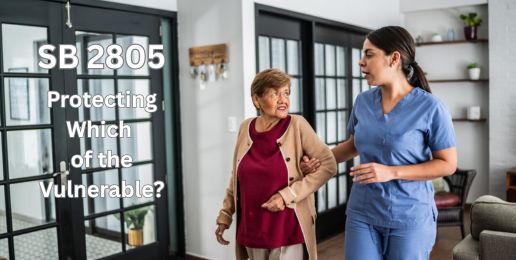
A bill that appears to be moving rapidly through the Illinois legislature — SB 2805 — deserves a closer look from anyone who cares about the elderly.
This proposed law, which seeks to address the needs of vulnerable populations requiring long-term care, contains ideas most people would support. Still, it also raises serious questions about enforcement, balance, and the protection of all residents in shared living environments.
SB 2805 aims to establish a ‘Bill of Rights’ for LGBTQ residents in long-term care facilities and those receiving home-care services. Its goal is to prevent discrimination based on sexual orientation, gender identity, gender expression, or HIV status. Among other provisions, the bill would:
- require facilities to: respect residents’ chosen names and pronouns
- allow residents to use bathrooms and other gender-designated spaces according to their gender identity
- enable residents to participate in gender-specific programs and activities based on their gender identity, and provide regular staff training on these issues
- and permit individuals to take legal action if they believe their rights under the act have been violated.
Take ACTION: Click HERE to send a message to your state senator to urge him/her to vote NO on SB 2805. Ask your state senator to amend this bill to protect privacy, religious freedom, and the dignity of ALL nursing home residents. Ask him/her not to advance this bill until critical issues are addressed.
Background
One of the bill’s stated goals is to prevent the mistreatment of LGBTQ residents in nursing homes and similar settings. Supporters argue that those are genuine concerns, and although the data is imperfect, it still supports the need for legislative action.
A national survey of LGBTQ older adults in long-term care found that 89 percent of respondents believed a staff member would discriminate against an openly LGBTQ resident, and only 20 percent felt comfortable being open about their sexual orientation in such settings.
A separate study conducted in partnership with the advocacy group SAGE found that 67 percent of LGBTQ seniors feared nursing home neglect, and 62 percent feared outright abuse.
These are perceptions, not confirmed rates of abuse, and the surveys used non-representative samples — an important limitation. What the data consistently documents is a widespread expectation of discrimination among LGBTQ seniors, not a verified record of it. That distinction matters legislatively: fear of mistreatment, however understandable, is a different evidentiary foundation than documented abuse.
Illinois has at least one documented and litigated example. In 2014, Marsha Wetzel, a lesbian woman, moved into the Glen Saint Andrew Living Community in Niles, Illinois, after her longtime partner passed away. Within months, other residents subjected her to ongoing verbal harassment, physical assault, and homophobic slurs. She repeatedly reported the abuse to the facility’s administration, but according to court filings, no meaningful action was taken.
Lambda Legal filed a lawsuit in 2016 under both the Federal Fair Housing Act and the Illinois Human Rights Act. The U.S. District Court initially dismissed the case. Still, in 2018, the Seventh Circuit Court of Appeals reversed that decision, ruling that a landlord can be held liable under the Fair Housing Act for failing to protect a tenant from known, discriminatory harassment by other tenants. The case set an important precedent but also highlighted how challenging and expensive it is to enforce existing protections.
That enforcement difficulty reveals a real gap in current legislation. Illinois has comprehensive anti-discrimination protections written into law. The Illinois Human Rights Act prohibits discrimination based on sexual orientation and gender identity in employment, housing, financial credit, and public accommodations.
However, enforcement requires an affected individual to file a complaint with the Illinois Department of Human Rights, risk dismissal, and pursue a claim through the administrative process or, if needed, in court.
Nursing home residents — often elderly, frail, cognitively impaired, and dependent on the very facility they might sue — are at a disadvantage. The current law offers protection in theory; SB 2805 seeks to strengthen it at the facility level through proactive training, complaint procedures, and civil penalties.
These are the sponsors’ legislative goals.
There is another reason why LGBTQ seniors might depend more on institutional care: about 90 percent of LGBTQ elders have no children, compared to around 20 percent of elderly heterosexuals. LGBTQ seniors tend to be single, live alone, and be estranged from family, which means they have fewer informal caregivers, rely more on paid and institutional care, and have fewer advocates when something goes wrong.
Supporters of SB 2805 are right that facilities cannot legally discriminate in admissions based on sexual orientation or gender identity. The Illinois Human Rights Act forbids this, and federal Medicaid and Medicare regulations also prohibit it.
However, the law on paper and the reality of its enforcement often differ, and the evidence shows a substantial gap between them.
A 2013 study found that same-sex couples applying for senior housing were less likely to get responses to their applications, more likely to face unfavorable treatment, and often steered, such as being offered a two-bedroom unit instead of a one-bedroom when applying as a couple. This form of separation achieves exclusion without explicitly admitting it.
Accounts from facility operators themselves reveal the same pattern. The CEO of Rose Villa, a senior community in Oregon that actively courts LGBTQ residents, described learning that a competing facility had suggested a lesbian couple would be ‘more welcome if they posed as sisters.’
In 2022, a 79-year-old transgender woman in Maine filed what was believed to be the first formal admissions discrimination complaint of its kind in U.S. history, alleging that the Sunrise Assisted Living facility in Jonesport refused to admit her because she is transgender. The facility denied the allegation; the case was settled with a policy reform agreement.
The Illinois Human Rights Act doesn’t prevent these problems from happening in Illinois. Instead, it provides a solution only after the fact — and only if the person affected has the ability, resources, and documentation to take action. As a result, the official ban on admissions discrimination exists alongside a documented pattern of subtle exclusion that often goes unchallenged. This remains a significant issue.
Recognizing a real problem, however, does not mean that the legislative solution is the right or complete answer. SB 2805 raises tough questions about how the rights and privacy of all residents will be protected in shared living spaces — and on those questions, the bill remains largely silent.
Nursing homes differ from most public settings. Residents often share rooms, bathrooms, and common areas. Many are elderly, fragile, or cognitively impaired. Data from the Alzheimer’s Association and peer-reviewed research published in Health Affairs show that about 49 percent of nursing home residents have a diagnosis of Alzheimer’s disease or another form of dementia; among long-stay residents, that number rises to nearly 58 percent.
These residents often cannot fully process environmental changes or advocate for themselves. A policy that may be straightforward for a healthy adult becomes much more complicated when applied to a population where roughly half cannot reliably understand what is happening around them.
Consider room assignments. Under SB 2805, in facilities where rooms are assigned by gender, residents would have the right to occupy a room matching their gender identity.
This could place a resident who is biologically male but identifies as female in a room with a female resident who may be unaware of this arrangement, unable to consent to it, and without a way to object.
The bill does not give the second resident a similar right to request a different roommate based on biological sex.
Access to bathrooms and personal care raises similar issues. Elderly residents often need staff help with bathing, toileting, and dressing—activities that are highly private and sensitive. Many are already upset by the loss of privacy that comes with institutional care.
The bill does not provide a clear way for residents to request sex-based privacy during personal care and have that request respected.
The bill also designates ‘intentional misgendering’ as a form of abuse under the Adult Protective Services Act. That is a significant step. It may accurately capture genuine mistreatment in some circumstances—deliberate, repeated harassment of a resident is wrong regardless of motivation. However, the definition as written does not distinguish between willful harassment and inadvertent error by an overworked caregiver who has learned different norms over a lifetime. Mandated reporters will be required to treat the latter the same as the former.
One of the bill’s most noticeable omissions is its failure to address the religious rights of other residents—and this is not just a policy issue.
It poses a potential conflict between statutory and constitutional law that the legislature has overlooked.
Illinois has its own Religious Freedom Restoration Act (RFRA). Under that law, the government cannot substantially burden a person’s exercise of religion, even through a rule of general applicability, unless it proves that the burden serves a compelling governmental interest and that it uses the least restrictive means to achieve that goal. This is a strict scrutiny standard.
SB 2805 does not mention the RFRA and does not provide any accommodation mechanism for residents whose sincerely held religious beliefs — such as those from Orthodox Jewish, Catholic, traditional Muslim, and other faith backgrounds that consider cohabitation with a person of the opposite biological sex a serious religious violation — conflict with the room assignment provisions of this bill.
That conflict is not hypothetical. A resident of devout Orthodox Jewish faith who objects on religious grounds to sharing a room with a biologically male person assigned to her under this bill has a recognizable claim under the Illinois RFRA. The same applies to a Catholic woman whose religious beliefs about modesty extend to shared intimate spaces.
The legislature has drafted a bill that establishes rights for one group of residents while seemingly eliminating the RFRA-protected religious activities of another group without explicitly stating that it does so. That is careless drafting at best and a constitutional minefield at worst. Any legal challenge that reaches the courts will require judges to resolve a conflict the legislature chose not to address.
The primary concern regarding SB 2805 is not that it fails to address a legitimate issue— it does. The issue is that it addresses one set of rights while creating unresolved conflicts with the rights of other residents and with existing Illinois law. Good policy must resolve those conflicts explicitly rather than leave them to litigation.
Before passing this bill, lawmakers should address several unresolved questions.
- What explicit protections are in place for residents who request sex-based privacy during personal care?
- How will facilities resolve conflicts between residents with competing preferences for room assignments — and what role, if any, does the Illinois RFRA play in those conflicts?
- How does the ‘intentional misgendering as abuse’ provision apply in facilities where a significant portion of the population suffers from dementia?
- Does the civil litigation provision create liability risks that might lead facilities to quietly and subtly avoid admitting LGBTQ residents altogether—the very discrimination the bill aims to prevent?
These are the kinds of questions that careful legislation should consider, including both the intended and unintended consequences. The vulnerability of nursing home residents affects multiple areas — this is why proponents say this bill is necessary, and why the bill must be crafted with precision that this version does not demonstrate.
Protecting LGBTQ residents from documented mistreatment and subtle exclusion is a valid goal. Likewise, safeguarding elderly residents’ privacy, dignity, religious freedom, and sense of safety in shared living spaces is equally important.
SB 2805, as currently written, focuses on the first issue while largely ignoring the second and creating statutory conflicts it does not specify. Lawmakers should require amendments addressing all of these concerns before advancing this bill further.