Illinois Senate Bill 3138 is scheduled for its Third Reading on April 14, 2026—just a few days away. If it passes, most people won’t notice. There will be no dramatic headlines. Springfield will call it a routine governance update to an existing children’s mental health law. This is the intent—stay low-key; the less noticeable, the better.
But look beneath the surface of this bill. You will find a troubling set of facts: a sitting state senator who is simultaneously the sole officer of a private consulting corporation and a founding board officer of a nonprofit that lobbies for the very industry her legislation is designed to expand — and a network of multimillion-dollar behavioral health organizations positioned to profit from every referral the system generates.
Take ACTION: Click HERE to send a message to your state senator to urge them to vote NO to SB 3138. This legislation would expand LGBTQ+ influence over children’s mental health policy in Illinois—moving from advisory roles to shaping programs, data, and policy. With new K–12 mental health screenings already signed into law, now is the time to speak up.

Background
Introduced on February 2, 2026, by Senator Sara Feigenholtz (D-Chicago), SB 3138 amends the Children’s Mental Health Act. It restructures a state body most Illinois taxpayers have never heard of, the Illinois Children’s Mental Health Partnership.
The Partnership was created by the Children’s Mental Health Act of 2003. It is a governor-appointed advisory board whose official mission is to shape how Illinois designs and allocates its mental health dollars for children from birth to age 25. It advises the state agencies that control those budgets — the Department of Human Services, the Department of Children and Family Services, the Department of Public Health, the Department of Healthcare and Family Services, and the State Board of Education, among others.
When the Partnership identifies a “gap” in services, that gap justifies new state contracts and spending. When it recommends a policy direction, the agencies that control billions in state and Medicaid funding are expected to follow. It is not a passive think tank.
It is the brain of a multi-agency, multi-hundred-million-dollar behavioral health system — and Senator Feigenholtz has been shaping it, piece by piece, since 2003.
The Partnership also connects directly to the Behavioral Health Care and Ongoing Navigation (BEACON) — the state’s AI-powered behavioral health portal, launched by Governor JB Pritzker in January 2025. BEACON is a centralized “no wrong door” platform that uses artificial intelligence to match children with behavioral health providers, enables state agencies to share case data in real time, and serves as the primary referral mechanism when a school screening flags a student.
Think of it as the digital pipeline that moves a child from a school questionnaire to a state-approved mental health contractor — automatically, efficiently, and at scale.
SB 3138 now requires the Partnership to regularly review the aggregate data flowing through BEACON to identify where the state is “failing” to provide enough providers. In policy language, that sounds neutral. In practice, it means the Partnership — which, by statute, must include a seat for the behavioral health industry’s own lobbying association — will use real-time school screening data to make the case for more state spending on the very organizations its members represent.
Beyond the BEACON mandate, the bill also:
- Shifts the Partnership’s core duty from “conducting research” to “reviewing or facilitating needs assessments” — moving it from studying the system to actively managing the demand for services
- Expands the youth adjunct council from 6 to up to 10 members, ages 16–25
- Mandates that community-based organizations on the adjunct council be led by LGBTQ-identified persons, persons of color, and women
- Requires public members of the full Partnership to “reflect a diversity of sexual orientation”
- Removes the Partnership’s ability to convene independent study groups — eliminating one of the few mechanisms for outside, neutral review
- Authorizes the Partnership to accept monetary gifts and grants from federal, state, philanthropic, or other “reputable” outside sources to fund its operations
That last provision deserves special attention. The bill creates a governance body with statutory authority to accept outside funding — from the very same foundations and industry associations whose member organizations it is charged with overseeing. A body that recommends how the state spends money on mental health services will now also be empowered to accept money from the people who provide those services.
That is not a governance reform. That is a closed loop with a legal seal.
The bill passed the Senate Behavioral and Mental Health Committee on March 11, 2026, by a 5-3 vote, a closer margin than advocates would care to admit. It cleared Second Reading on March 26, 2026, and is now scheduled for a full Senate floor vote on April 14.
SB 3138 does not exist in isolation. It is one half of a carefully constructed two-part policy strategy. The first half was enacted: Public Act 104-0032, signed by Governor Pritzker in July 2025, which requires Illinois school districts to offer annual mental health screenings to students in grades 3 through 12, beginning in the 2027–2028 school year.
The screening law creates the pipeline. SB 3138 creates the governing board that manages the pipeline, and the organizations on that board are the same ones that receive referrals and state contracts from the pipeline. As the research supporting this article explains, the relationship is clear: the screening law is the execution, and SB 3138 is the brain that directs the execution and monitors the data.
Both laws share the same sponsor: Senator Feigenholtz.
Every parent should know that the state is now on record as requiring that your child’s school offer an annual mental health screening beginning in the third grade, when children are as young as eight.
The law includes a technical opt-out for parents, but that protection is far weaker than it sounds. Schools will be under administrative pressure to screen. Community-based providers are integrated into the referral chain. The BEACON portal — which SB 3138 now mandates the Partnership monitor regularly — routes flagged children to state-approved mental health services, many of which are private nonprofit contractors billing Medicaid.
The fundamental question is this: who decided that the school — not the parent — should be the first stop for assessing a child’s mental health? The evidence for universal school-based mental health screening is far weaker than advocates admit.
The U.S. Preventive Services Task Force states that the evidence is “insufficient” to assess the benefits and harms of depression screening in children 11 and younger — the exact age range Illinois now targets beginning in third grade. A 2019 systematic review found that the effectiveness and cost-effectiveness of school-based mental health identification programs were “underdeveloped.”
A more recent randomized trial noted that universal school screening had become widespread “despite the lack of prior randomized evidence showing it improves pediatric mental health.”
This is a sweeping expansion of state authority over children, built on a weak evidentiary foundation, driven by industry interests, and moving through the legislature at the speed of a bill no one is watching.
There is another problem with the bill. There is no “fiscal note” accompanying SB 3138.
Before you can understand the significance of this and why it matters, you need to understand what a fiscal note is — and what it is intended to do.
A fiscal note is a written, independent estimate of the actual cost of a proposed law — in state funds, local government funds, and agency resources — before lawmakers vote on it. It is the most basic financial transparency tool in the legislative process: a document that tells every senator and every taxpayer what they are actually buying before they sign the check.
A proper fiscal note covers both direct costs — new positions, contracts, administrative overhead, and appropriations — and indirect costs, such as regulatory burdens, Medicaid billing exposure, and federal funding implications. Critically, it is prepared by a neutral, independent legislative fiscal office — not by the bill’s sponsor or by the people who want the bill to pass.
In many states, fiscal notes are mandatory before a bill can be heard in committee. The model Fiscal Note Act, used as a legislative template across the country, explicitly requires that any bill affecting:
“the receipt, expenditure, or allocation of state or local funds, either directly or indirectly, shall have attached to it before its consideration by any committee a fiscal note which shall include a reliable estimate of the fiscal impact.”
Illinois has a Fiscal Note Act, codified at 5 ILCS 420, but it is not automatic. A legislator must formally request one, and in Illinois, the chamber can vote it down.
Senate Republicans introduced legislation in 2026 to fix this problem — requiring that fiscal note requests always be honored — but that reform has not passed.
The result is a process that allows politically convenient bills to move through committee, onto the floor, and to a final vote without anyone being legally required to put a price tag on them.
That is precisely what happened with SB 3138. There is no fiscal note attached to this bill. None.
The Illinois Senate is being asked to vote on April 14 on a bill that restructures the statewide behavioral health oversight system, authorizes it to accept external grants, and connects it to a screening program that could generate hundreds of thousands of referrals annually, with a zero public-cost estimate on the record.
The implications of that absence are not minor:
The Partnership restructuring has no price tag. SB 3138 significantly expands the Children’s Mental Health Partnership’s duties — from passive research to active facilitation of statewide needs assessments, regular BEACON data review, and an enlarged youth council. Each activity requires staff time, agency support, and administrative infrastructure. There is no estimate of the cost of any of it.
The grant-acceptance authority is completely unpriced. The bill explicitly authorizes the Partnership to accept monetary gifts and grants from federal, state, philanthropic, or unspecified “reputable” outside sources. A fiscal note would require the legislature to account for what that authority is expected to generate — who is expected to give, how much, and on what terms. Without one, the public has no visibility into whether this provision could route millions of dollars from outside sources through a quasi-governmental body with no public bidding, no legislative appropriation, and no independent oversight.
The downstream cost of the screening pipeline has never been publicly calculated. SB 3138 is the management arm of the school screening mandate already enacted in P.A. 104-0032. When screenings begin in the 2027-28 school year for grades 3-12, they will generate a massive volume of referrals to Designated Mobile Crisis Response providers — organizations such as Thresholds, Kenneth Young Center, and LSSI — that bill Medicaid and collect state service contract payments for every case they handle. A fiscal note would compel the legislature to confront the full projected cost of that referral pipeline before committing to it. That number has never been made public.
Senators will vote blind. The primary purpose of a fiscal note is to give legislators “a dependable estimate of how proposed legislation will affect state finances” before they vote. Without one, Illinois senators will vote on April 14 with no idea what they are committing the state to spend on — now, next year, or a decade from now. When Texas examined a proposed tax exemption and found its first-year cost was $413 million, legislators had the information they needed to walk away. Illinois senators voting on SB 3138 will not have that information.
No one with the power to demand it chose to do so.
Passing legislation without a fiscal note is the Springfield equivalent of signing a contract without reading the price. That is not responsible governance. It is how you spend money you don’t know you’ve committed — and how the people who benefit from that spending prefer it to remain hidden.
Senator Sara Feigenholtz has represented Chicago’s North Side in the Illinois General Assembly since 1995, first in the House and now in the Senate. She is the sponsor of both the 2025 screening law and SB 3138. She is also a founding board member and Vice President of The Kennedy Forum Illinois, a nonprofit whose mission is to expand the mental health system — and whose leadership council includes the CEOs of the very provider organizations that her legislation benefits.
She also serves on the Senate Behavioral and Mental Health Committee — the same committee that voted to advance her own bill by a 5-3 margin.
Beyond her nonprofit role, Feigenholtz is the sole President, Secretary, and Director of SKF Consulting, Inc., an Illinois corporation she founded in February 1990 and that operates from her personal Chicago address on North Wilton Avenue. The firm is a 100% female-owned corporation with all property in Illinois. It has no employees on record, no disclosed clients, no industry classification, no website, and no TIN on file with any public database.
Here is what her 2025 Statement of Economic Interests — filed on April 10, 2025 — reveals about her outside income: none.
Under Question 2, which requires disclosure of any income source exceeding $7,500 beyond her legislative salary, she lists “NA.” She reports no consulting income, no outside employer, and no clients disclosed.
An active corporation that reports no disclosed income while its sole officer introduces legislation worth hundreds of millions of dollars to the industry she serves. The public has no way to know who, if anyone, is paying SKF Consulting — and that opacity is the point.
Over her career, the Citizens for Sara Feigenholtz campaign committee has received approximately $5.24 million in total contributions across 5,486 recorded transactions. Of that total, contributions from healthcare, pharmaceutical, behavioral health, and related industries total nearly $750,000 — roughly 14 cents of every dollar raised.
In her Senate era (2020 to present), the committee has received approximately $1.95 million. The healthcare industry’s footprint in that period is significant.
The top healthcare-related donors since she moved to the Senate include:
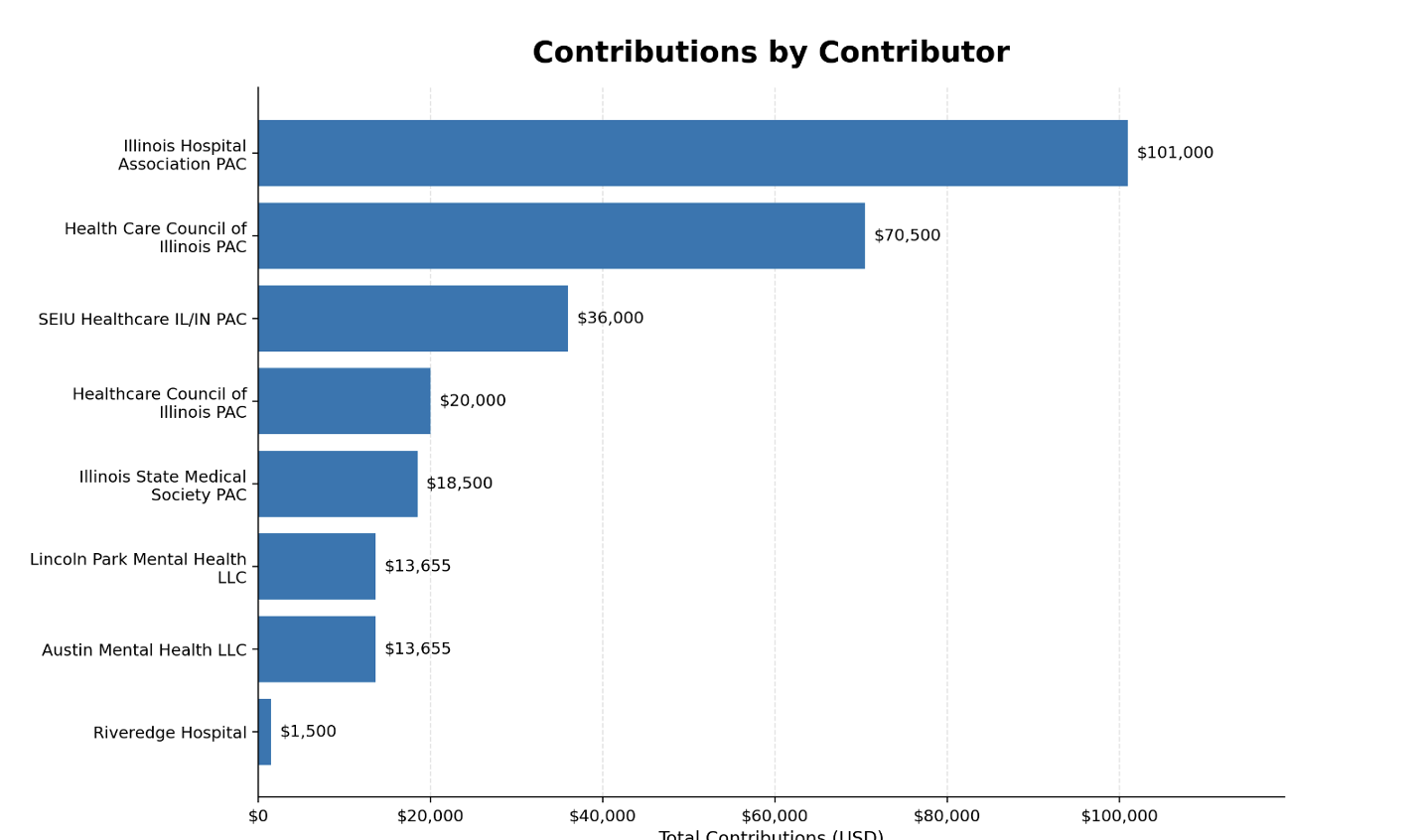
Since 2020 alone — her time in the Senate — The Illinois Hospital Association PAC gave $101,000, and the Health Care Council of Illinois PAC contributed $97,500 to her campaign.
She has received “Hero” or “Champion” awards from Thresholds, NAMI Illinois, and Trilogy Behavioral Healthcare — organizations whose policy agenda advances directly through her legislative work. The Community Behavioral Healthcare Association (CBHA) named her its Legislator of the Year in 2003 and has supported her consistently since.
The bill explicitly requires a seat on the Partnership for a “representative of a statewide association representing community-based mental health substance use disorder treatment providers.”
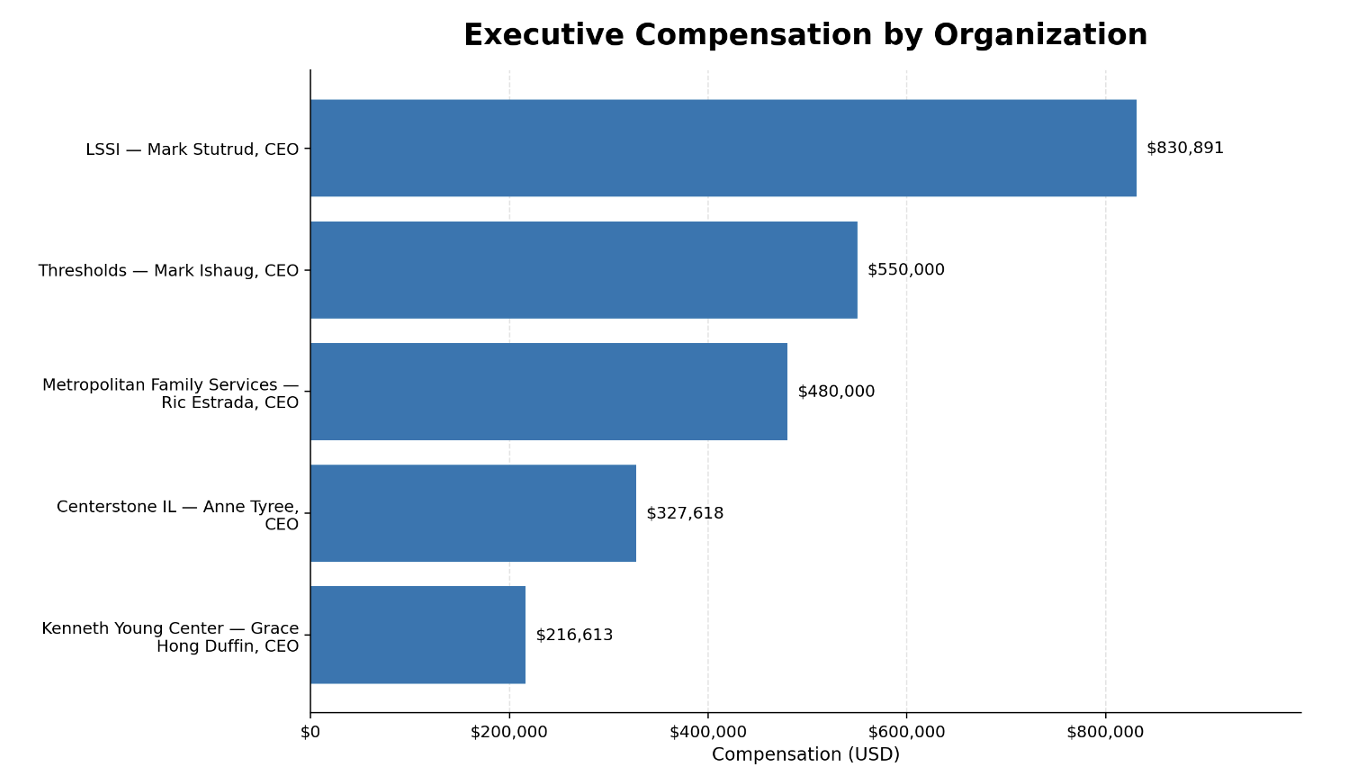
Only one organization fits that description: the CBHA of Illinois — the industry lobbying arm for the state’s major behavioral health contractors. Those contractors include organizations such as Thresholds, Kenneth Young Center, Metropolitan Family Services, Lutheran Social Services of Illinois (LSSI), and Centerstone Illinois.
These are not small community clinics. Their executives receive substantial compensation from state-funded service contracts:
These organizations are the state’s Designated Mobile Crisis Response providers — meaning that when a school screening flags your child, these are the entities that receive the referral and the state contract revenue that follows. SB 3138 codifies their presence on the governing board overseeing the screening and referral system that generates their client base.
Mark Ishaug, CEO of Thresholds, also serves on The Kennedy Forum Illinois Leadership Council — alongside Senator Feigenholtz, who serves as its founding Vice President. The policy and beneficiary boards are, in significant part, the same people.
In plain terms, here is the mechanism:
- The Kennedy Forum — with Feigenholtz as VP — produces reports declaring a childhood mental health crisis and calling for more screenings
- Senator Feigenholtz sponsors legislation mandating the very screenings her nonprofit recommends
- The BEACON portal captures the data and routes flagged children to Designated Mobile Crisis Response providers
- Those providers — whose CEOs sit alongside Feigenholtz on the Kennedy Forum council — receive Medicaid billing and state contract revenue
- Those same providers and their lobbying association continue contributing to Feigenholtz’s campaign and presenting her with awards
In Illinois, this is legal, but that doesn’t make it right.
The Third Reading of SB 3138 is scheduled for Tuesday, April 14, 2026. You have days, not weeks, to act.
Contact your state senator. Tell them you oppose SB 3138 on three grounds: the complete absence of a fiscal note or cost estimate, serious conflicts of interest embedded in both the bill’s sponsorship and its governance structure, and the ongoing erosion of parental authority over their children’s mental and emotional health.
Illinois parents didn’t ask the state to screen their eight-year-olds for mental illness. They didn’t ask for a network of behavioral health contractors to be included on the governing body overseeing those screenings. And they certainly didn’t ask for it to happen before anyone in Springfield bothered to find out what it would cost.
When the same people who profit from a system are the ones governing it, when the legislator who sponsored the bill has received hundreds of thousands of dollars in campaign contributions from the organizations that will benefit from her legislation, when the law substitutes governmental care for parental care, that may not be illegal under Illinois’s permissive ethics statutes. Still, anyone with an ounce of common sense can see it’s outrageous.
Pick up the phone and object. Do it right now.