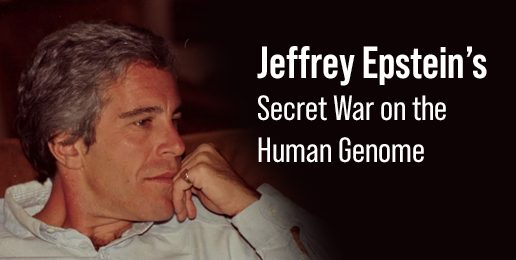
How America’s Elite Universities Became
Laboratories for a Billionaire’s Eugenics Agenda
When I first examined Jeffrey Epstein’s connections to Harvard University and the University’s Program for Evolutionary Dynamics last summer, the question I could not answer was: where are the investigative reports on Epstein’s connections to all those academics and his bizarre plans for his Zorro Ranch? Even the press corps avoided examining these relationships and the planned activities for Epstein’s New Mexico property. What was known was disturbing enough.
Between 1998 and 2008, Harvard University received $9.1 million directly from Epstein. Beyond that figure, Epstein also facilitated millions from associates he personally cultivated as donors — most significantly Leon Black, the CEO of Apollo Global Management, whose family foundation directed approximately $6 million to Martin Nowak’s research and $2 million to George Church’s work after Epstein made the introductions. The documented total flowing to Harvard through Epstein’s direct giving and facilitated gifts exceeds $17 million. The relationship was not arm’s-length philanthropy.
In 2003, after donating $6.5 million, Epstein was given a furnished office at One Brattle Square — Office 610, known to PED staff as “Jeffrey’s Office” — with a key card and a passcode granting him access to Harvard’s Program for Evolutionary Dynamics building. He brought his own rug and hung his own photographs on the walls, using the space as an operating base for meetings with some of the world’s most accomplished geneticists, physicists, linguists, and neuroscientists. He entertained them at his Manhattan mansion, his Zorro Ranch, and his private island, Little St. James.
What made Epstein’s Harvard relationship particularly troubling was its continuation after his prosecution. When Epstein was convicted in Florida in 2008 of solicitation of prostitution and procurement of a minor for prostitution — a charge that, as subsequent investigation would confirm, dramatically understated the actual offenses — Harvard did not revoke his office access, freeze his donations, or suspend the activities funded by his money. Epstein continued visiting Harvard’s PED more than forty times after his conviction, with documented visits as recently as October 2018. Access ended only after PED researchers complained directly to Professor Nowak. Harvard formally stripped the office arrangement in 2018, a full decade after his conviction.
That delay — ten years of post-conviction access — was not an oversight. It was a decision to ignore it. Understanding that decision requires understanding what Epstein was actually doing at Harvard and the institutional network that enabled Harvard’s tolerance.
Epstein planned to conduct eugenics experiments at Zorro Ranch — a remote 7,600-acre property in New Mexico — where he intended to impregnate up to 20 women at a time with his sperm, seeding the human race according to his own genetic preferences.
The New Mexico operation was no casual aspiration. It was a real plan. Court filings and investigative reporting established that Epstein’s Zorro Ranch was conceived as a ‘baby-making factory’ — a facility where he intended to implement his eugenic vision at scale. The ranch’s management was entrusted to Brice and Karen Gordon, a New Zealand couple who ran Zorro Ranch from the early 2000s before relocating in 2016 to manage operations at Epstein’s Little St. James Island in the U.S. Virgin Islands — placing them at the center of both his New Mexico and Caribbean operations during the most documented period of his trafficking activity.
The FBI interviewed Brice Gordon at Zorro Ranch in August 2007 as part of the initial Florida investigation. That interview is documented in the released files. The notes, however, are missing from the DOJ’s January 2026 document release — a release that was represented as comprehensive.
A federal agency conducted a documented interview of one of Epstein’s most senior property managers at one of his most significant properties, and the notes from that interview did not appear. The FBI has not explained their absence.
After Ghislaine Maxwell’s July 2020 arrest, the Gordons became unreachable to investigators and journalists alike. Their whereabouts remain unknown.
This is where the 2025 investigation left the matter: with evidence of a eugenics agenda tied to a major intelligence operation, an institutional cover-up at America’s most prestigious university, missing witnesses, and a press corps that declined to pursue the obvious questions. The newly released Epstein documents have now answered some of those questions — and raised others that are far more disturbing.
The Network Behind Harvard Hillel
Before turning to the genetics correspondence itself, there is a layer of Epstein’s Harvard penetration that the document releases have now clarified and that no published analysis has adequately examined: the relationship among Epstein, the Mega Group, and Harvard’s Jewish-affiliated institutions.
The Mega Group — formally the Study Group — was founded in 1991 by Leslie Wexner and Canadian billionaire Charles Bronfman as an invitation-only network of approximately twenty of the nation’s wealthiest Jewish-American business leaders. It met twice yearly for philanthropic and strategic seminars and, by the late 1990s, had become one of the most influential private funding consortia in American Jewish culture. Its philanthropic initiatives include Birthright Israel, the Partnership for Excellence in Jewish Education, and — critically — the strategic renewal of Hillel International. Israeli intelligence sources have described the Mega Group as a vehicle for influence operations in the United States, with documented contacts between the group’s network and the Mossad.
Epstein’s connection to this network is direct and documented. In 1991, the same year the Mega Group was founded, Epstein orchestrated a $2 million donation from Leslie Wexner to fund the construction of Harvard Hillel’s building — Rosovsky Hall. Epstein’s name appeared on the donor plaque alongside the Wexners until it was quietly removed years later. That year, Epstein also made a separate $50,000 contribution at a Hillel fundraising dinner. Wexner, Epstein’s primary patron throughout this period, gave Epstein power of attorney over Wexner’s financial affairs, allowing Epstein to act on Wexner’s behalf.
The significance is this: Epstein’s access to Harvard Hillel was not incidental. It predated his academic relationships at Harvard by more than a decade and ran through the same Wexner network that anchored the Mega Group’s Hillel revitalization effort. When Harvard Hillel president Bernie Steinberg wrote to Epstein in May 2010 — two years after Epstein’s conviction — soliciting his help in raising $25 million for Hillel, he was not making a naive overture to a wealthy donor. He was continuing a relationship with a man whose position in the Hillel network had been established through Wexner and the Mega Group nearly twenty years earlier.
Harvard Hillel fundraisers reached out again in 2011, encouraged by former FAS dean Henry Rosovsky — for whom the building was named — who had met with Epstein at least four times in Cambridge between 2011 and 2013. The DOJ documents include testimony from Ghislaine Maxwell that Rosovsky received a massage at Epstein’s New York townhouse; Rosovsky denied this before his death in 2022.
Harvard’s institutional relationship with Epstein, in other words, operated on at least two parallel tracks: the academic track through PED and the genetics network, and the philanthropic-institutional track through Hillel and the Wexner-Mega Group. Neither track has been examined in relation to the other. That examination is overdue.
The Document Releases: Epstein in His Own Words
The document releases that began in late 2025 and continued through February 2026 have done what years of investigative pressure could not: they have placed Jeffrey Epstein’s actual words in the public record. The email correspondence now available eliminates the need to speculate about his intentions. He stated them directly to some of America’s most credentialed scientists.
The correspondence with Noam Chomsky, one of the most widely cited intellectuals in modern American academic history, illuminates both Epstein’s methods and the engagement his targets were willing to maintain.
In one email exchange, Epstein pushed Chomsky directly on race and measured cognitive differences, writing: “The test score gap among African Americans is well documented. Making things better might require accepting some uncomfortable facts.” He then pivoted to gene editing: “Imagine that a set of genes used for working memory… could be found and adjusted. Not looking seems cruel.”
Chomsky’s response attributed the measured gap to the legacy of structural racism rather than to innate biology and argued that, if genetic engineering were possible, priority should be given to eliminating what he called “dedicated savagery” among those who seek power. The exchange continued. In a separate communication, Chomsky described the prospect of a visit to Epstein’s island as “tempting.”
The debate Epstein pursued — whether measured group differences in cognitive test performance have a genetic component — is a genuinely contested question in human genetics. Researchers, including Arthur Jensen, Linda Gottfredson, Charles Murray, and Philippe Rushton, have published peer-reviewed work arguing that heritability studies and cross-group adoption research support a partial genetic contribution to such gaps.
Critics of that position, including Chomsky, argue that environmental factors — educational inequality, generational poverty, and the documented neurological effects of chronic stress and malnutrition — are sufficient to explain the observed differences without resorting to genetic explanations. The scientific debate remains open, and serious researchers are on both sides.
The point that distinguishes Epstein’s interest from academic inquiry is not which position he held in that debate — it is what he intended to do with it. The question of whether heritable cognitive differences exist between populations matters to a man whose stated plan was to select women for breeding according to his own genetic preferences.
Whether or not the underlying science supports his view, his purpose was eugenics — and that purpose is what links the Chomsky correspondence to the Zorro Ranch.
Chomsky has since downplayed the relationship. The emails make it difficult to sustain that downplaying. He is a professor emeritus at MIT and holds a Laureate Professorship at the University of Arizona — not a Harvard affiliate, though his visits to PED events placed him in Epstein’s Cambridge orbit.
George Church and the Genetics Network
Among Harvard’s geneticists, no figure is more directly implicated in Epstein’s academic network than Dr. George Church, the director of Harvard’s Personal Genome Project. Church had long occupied the crossroads of cutting-edge genetics with transhumanist thinking. The New York Times described him as “a molecular engineer who has worked to identify genes that could be altered to create superior humans.” He had also pursued a genome-based dating application — effectively a modern eugenics matching program dressed in Silicon Valley aesthetics.
The Epstein files confirm that Church and Epstein corresponded extensively and that Epstein set up an investment company with Church — a previously unreported arrangement in which Church would serve as the nominal head while Epstein controlled the money. Epstein named it “Georgarage,” an apparent reference to “George’s Garage,” a newsletter Church was developing.
Church proposed a ten-stage, $10 million investment program covering gene editing, aging reversal, virus-resistant animals, and cold-resistant elephants, a reference to Church’s long-running mammoth resurrection project. Epstein’s stated reason for interest in the Personal Genome Project was to determine whether “beauty resides in DNA.” The project, had it been funded on Epstein’s terms, would have provided him with a database linking genetic profiles to assessments of physical attractiveness — precisely the kind of information useful for a man whose stated ambition was to identify and select women for breeding.
Church’s institutional lineage is worth tracing. His doctoral advisor was Walter Gilbert, who, for 15 years, co-directed what Harvard colleagues called the Watson-Gilbert Laboratory with James D. Watson — the late Nobel laureate, first director of the Human Genome Project, and committed eugenicist who was stripped of his honorary titles in 2019 after repeating claims that genetic differences explained racial disparities in intelligence.
Watson’s Cold Spring Harbor Laboratory once housed the Eugenics Records Office, which sought to compile a comprehensive genetic registry of the American population. Its early funding came from the Rockefeller and Carnegie foundations. The intellectual genealogy running from Cold Spring Harbor to Harvard’s PED, with Epstein’s money flowing through it, is no coincidence.
In 2019, Church apologized for his association with Epstein. The newly released files suggest the relationship was closer than his apology acknowledged, including a planned December 2018 lunch — weeks after the Miami Herald’s investigation exposed the full scope of Epstein’s crimes.
Church has not responded to press inquiries about the investment company arrangement.
The Social Texture of Institutional Tolerance
Beyond the substantive scientific correspondence, the newly released files document how Epstein maintained his access to Harvard after his 2008 conviction — through casual social cultivation that treated his criminal record as an irrelevant administrative matter.
Harvard theoretical physicist Lisa Randall emailed Epstein during a Caribbean trip, asking about his island. “Wow, haven’t you had enough house arrest?” she joked — a remark that treated the legal consequences of his crimes as a logistical inconvenience rather than a moral signal.
Dr. Bernie Steinberg, then president of Harvard Hillel, wrote to Epstein while he was still under house arrest to solicit his help raising $25 million for the Hillel center — a request that, as documented above, continued a relationship rooted in the Wexner-Mega Group network dating to 1991. UCLA neurologist Mark Tramo, in a separate communication, discussed with Epstein whether girls were ‘cute’ — language that, in the context of the full documentary record of Epstein’s activities, carries weight beyond casual conversation.
Harvard statistician Donald Rubin separately discussed with Epstein the potential for investment in “female Viagra” compounds and in a venture called “Emotional Brain” — research into chemically influencing emotional states. Whether these represent the genuine scientific curiosity of an eccentric billionaire or the research portfolio of an intelligence operation seeking tools for behavioral control is a question that the institutions involved have shown no interest in pursuing.
Then there is Lawrence Summers.
As documents released in late 2025 revealed, the former Harvard president maintained a close personal relationship with Epstein that continued well after Epstein’s 2008 conviction. In the correspondence, Epstein referred to himself as Summers’ “wing man” in Summers’ relationship with a woman Summers described as a mentee.
Harvard launched a new investigation in November 2025 specifically because of these emails — an investigation its 2020 review had entirely failed to uncover. That 2020 review, which interviewed more than 40 individuals and examined 250,000 pages of documents, somehow missed five years of post-conviction correspondence between Epstein and Harvard’s former president.
Summers subsequently stepped back from his teaching role, resigned from the OpenAI board, and ended affiliations with multiple institutions, including the Center for American Progress, the Center for Global Development, and the Budget Lab at Yale.
He described his association with Epstein as a “major error in judgment” and said he was “deeply ashamed.” That a former Harvard president was in this relationship — and that Harvard’s 2020 review did not uncover it — underscores the limits of institutional self-investigation.
Taken together, these exchanges portray not a man tolerated despite his conviction but a man valued for what he could provide — money, connections, access to power — and whose crimes were treated by elite academic culture as an unfortunate footnote rather than a disqualifying fact.
Arizona State University and the Intelligence Intersection
The Harvard connection, as disturbing as it is, does not capture the full scope of Epstein’s academic penetration. The newly released documents identify Arizona State University as the most frequently named academic institution in the entire Epstein file corpus. The centerpiece of that relationship was Lawrence Krauss and his Origins Project — but the most significant detail is the man who runs ASU.
Michael Crow became president of Arizona State University in 2002. He also serves as chairman of In-Q-Tel, the venture capital arm of the Central Intelligence Agency, which funds technology companies developing capabilities of intelligence interest.
The juxtaposition — the same individual overseeing a major American research university and the CIA’s investment vehicle — is not, in itself, evidence of wrongdoing. It is, however, essential context for understanding why ASU appears so prominently in the files of a man whose relationship with intelligence agencies has been documented by sources including Alexander Acosta, the federal prosecutor who negotiated Epstein’s 2008 plea deal and who reportedly told Trump transition officials that he had been instructed to back off because Epstein “belonged to intelligence.”
Lawrence Krauss founded the Origins Project at ASU in 2008 to probe what he described as life’s “big questions” — evolution, genetics, and the origins of consciousness. Epstein became a major financier of the project, and Krauss became one of Epstein’s closest academic confidants. When Krauss faced sexual misconduct allegations in 2018 that ultimately led to his removal from ASU, he turned to Epstein for advice. In a documented email exchange that followed, Krauss detailed the terms of his negotiated voluntary leave — and then, in a remark that captures the social world these men occupied, added: “I wish they would indict Trump or something right now.”
The Krauss correspondence is not primarily significant for what it reveals about Krauss. It is significant for what it reveals about Epstein’s role: he served as a counselor and crisis manager, a man whose judgment was sought by prominent figures at their most vulnerable moments. That is the profile of an intelligence asset running influence operations, not a wealthy amateur interested in science.
The Designer Baby Project
The most specific document in the entire genetic research file is the correspondence between Epstein and Bryan Bishop — a Bitcoin Core developer who would later become Chief Technology Officer at Avanti Financial Group. Bishop approached Epstein with a formal proposal for what he explicitly labeled a “designer baby project.”
The pitch was not casual. Bishop provided a use-of-funds spreadsheet outlining a $1.7 million annual budget for up to five years, plus $1 million in laboratory setup costs. The goal, as Bishop stated it, was “the first live birth of a human designer baby, and possibly a human clone, within 5 years.” He was explicit about the need for security, asking Epstein pointed questions about “requirements for secrecy and privacy, specifically regarding reputational risk and also any financial involvement.”
“Once we reach the first birth, everything changes and the world will never be the same again, much less the future of the human species.”
— Bryan Bishop to Jeffrey Epstein
Epstein’s response was not dismissive. He replied in an email: “im traveling in mid east until the 1st. let’s do it after that, i have no issue with investing the problem is only if I am seen to lead.” The framing — active financial support, insistence on concealed leadership, and concern about reputational exposure — mirrors exactly the structure Epstein used across his intelligence and financial activities. He invested. He directed. He did not appear.
Bishop subsequently updated Epstein on technical challenges surrounding CRISPR gene editing, including fallout from the 2018 Chinese “CRISPR babies” scandal involving scientist He Jiankui, who was subsequently imprisoned. Bishop pivoted to an embryo-editing technique he described as “more similar to cloning.” Epstein’s response: “great.” In one particularly revealing note, Epstein outlined his preferred operational timeline: “implant embryo, wait 9 months.. great ending.”
This was not a theoretical discussion. This was a project plan with a budget, a timeline, a technology roadmap, and financing designed to obscure Epstein’s involvement. The question that remains unanswered is whether any laboratory actually received funding under this arrangement and whether any research was conducted.
The ‘Horny Virus’ Research and Behavioral Modification
Beyond human cloning, the files document Epstein’s interest in research into sexually transmitted behavioral modification. Stanford visiting professor Nathan Wolfe — a virologist who founded the global health organization Global Viral — corresponded with Epstein about what the documents describe as a ‘horny virus’ concept: studying or potentially engineering pathogens that could alter sexual behavior in their hosts. Wolfe sought Epstein’s funding to conduct a formal study.
The implications of a sexually transmitted behavioral modification pathogen in the hands of an operation that ran a honeytrap intelligence-gathering operation across multiple decades require no elaboration. Wolfe’s correspondence also included descriptions of interns’ physical attractiveness communicated to Epstein — a pattern documented by The Stanford Daily.
His status in the documentation warrants further investigation.
The Consolidated Picture
The consolidated picture that emerges from the 2025 summer findings and the newly released 2026 documents is not of an individual operating at the margins of legitimate science. It is of systematic institutional penetration — a network of endowed relationships, funded positions, maintained access, and cultivated loyalty that extended across America’s most prestigious research institutions for more than two decades.
Harvard received money, tolerated a convicted sex offender in a furnished office for ten years after his conviction, and produced no internal review of which research had been influenced by Epstein’s funding priorities.
Its own 2020 investigation failed to surface the Summers correspondence.
ASU’s primary connection to Epstein centered on a project led by a man who was subsequently removed for sexual misconduct, while the university’s president simultaneously chaired the CIA’s venture capital firm.
Stanford’s visiting faculty corresponded about behavioral modification research.
UCLA’s neurology department produced email correspondence that, when read alongside the full record, raises questions no one in authority has asked.
The pattern that intelligence analysts would recognize is not that of innocent institutions compromised by a charming fraudster. It is the pattern of institutional capture — a process by which financial dependency, social cultivation, and reputational management combine to make an entire system complicit in protecting a source it has come to need. Epstein’s documented giving was not a gift. It was an investment in institutional cooperation and silence.
The Gordons represent the most immediate unresolved thread in the entire investigation. As New Zealand nationals who managed both Zorro Ranch and Little St. James Island during Epstein’s peak period of activity, they are among the most knowledgeable surviving witnesses to what occurred at those properties.
The FBI interviewed Brice Gordon in 2007 — and those notes are missing from the 2026 comprehensive release. They became inaccessible after Maxwell’s 2020 arrest. The property they managed was never formally examined: as a December 2019 email from federal prosecutors to Epstein’s estate executors — now part of the released DOJ files — confirmed, no federal investigator ever conducted a formal on-site investigation of Zorro Ranch.
When New Mexico Attorney General Hector Balderas attempted to launch a state probe in 2019, federal prosecutors told him to halt it to avoid a “parallel investigation.” He complied. The ranch was sold in 2023 to the family of Texas Republican Don Huffines, renamed San Rafael Ranch, and is now planned as a Christian retreat.
In February 2026 — more than six years after Epstein’s death — New Mexico lawmakers unanimously authorized a bipartisan “truth commission” to conduct what Romero described as the first comprehensive investigation of the property. The commission has subpoena power and a $2 million budget. New Mexico Attorney General Raúl Torrez simultaneously reopened the criminal investigation. That this is only now occurring — and that it took state-level action after federal inaction — is consistent with the pattern of protected suppression that has characterized every dimension of the Epstein investigation.
The following tables present the current known picture of Epstein’s genetic research network, drawn from court records, the 2026 document releases, investigative reporting, and newly unsealed email correspondence. This record is acknowledged to be incomplete. The full scope of Epstein’s academic funding, the identities of all correspondence partners, and the status of projects such as the Bishop designer baby proposal remain unknown.
Table 1: Institutions and Their Epstein Connections
| Institution | Funding / Connection | Key Figures | Research Area |
| Harvard University | $9.1M direct (1998–2008); additional $8M+ facilitated through Black and others | Nowak, Church, Chomsky, Randall, Rubin, Dershowitz, Steinberg, Summers | Evolutionary dynamics, genome engineering, race/cognition research, ‘beauty in DNA’ genome project |
| Harvard Hillel / Mega Group Network | Wexner $2M (1991, facilitated by Epstein); Epstein $50K direct; post-conviction solicitations 2010–2011 | Bernie Steinberg, Henry Rosovsky, Les Wexner (Mega Group) | Jewish institutional philanthropy; Epstein used as access channel to Harvard network since 1991 |
| Arizona State University | Major financier of Origins Project | Lawrence Krauss, Michael Crow (In-Q-Tel chair) | Origins Project, transhumanist research, genetics-AI convergence |
| Zorro Ranch, NM | Epstein-owned property | Brice & Karen Gordon (NZ; managers 2000s–2019) | Planned eugenics ‘seeding’ facility, designer baby infrastructure |
| Stanford University | Correspondence / funding discussions | Nathan Wolfe (visiting professor) | ‘Horny virus’ behavioral modification research |
| UCLA / other institutions | Correspondence | Mark Tramo (Neurology) | Neurological research; disturbing minor-related correspondence |
| Cold Spring Harbor Lab (historical) | Network antecedent | James D. Watson (former director) | Eugenics Records Office lineage; Human Genome Project origin |
Table 2: Key Individuals in Epstein’s Genetic Research Network
| Person | Affiliation | Epstein Connection / Action | Current Status |
| Martin Nowak | Harvard — PED Director | Received $6.5M for PED founding; gave Epstein unrestricted office access through 2018; appeared in 4,000+ DOJ documents | PED shut down 2020; sanctioned 2021; sanctions lifted 2023; remains Harvard professor |
| George Church | Harvard — Personal Genome Project | Proposed investment company ‘Georgarage’ with Epstein; genome dating app; NYT: ‘create superior humans’; planned lunch Dec. 2018 post-Herald expose | Apologized 2019; remains Harvard faculty; did not address investment company |
| Larry Summers | Harvard — former President | Epstein called himself Summers’ ‘wing man’ re female mentee; close post-conviction correspondence; not surfaced by 2020 Harvard review | Resigned OpenAI board; ended multiple affiliations; Harvard reopened investigation 2025 |
| Noam Chomsky | MIT (emeritus); Univ. of Arizona Laureate Professor | Exchanged emails on race/cognition and gene editing; called island trip ‘tempting’ | Subsequently denied closeness to Epstein |
| Lisa Randall | Harvard — theoretical physicist | Casual post-conviction emails; asked about island during Caribbean trip; joked about house arrest | Downplayed contact |
| Lawrence Krauss | ASU — Origins Project founder | Major Epstein financee; emailed Epstein for advice during 2018 sexual misconduct investigation | Resigned from ASU 2018 |
| Michael Crow | ASU President; In-Q-Tel chair | Led ASU during Epstein’s primary funding of Origins Project; CIA venture capital intersection | Remains ASU President and In-Q-Tel chairman |
| Bryan Bishop | Bitcoin Core developer; Avanti Bank CTO | Pitched Epstein formal ‘designer baby and human cloning’ project with $1.7M/yr budget; sought ‘deniability’ structure | Epstein responded enthusiastically: ‘lets do it’ |
| Nathan Wolfe | Stanford visiting professor; Global Viral founder | Pitched Epstein funding for ‘horny virus’ study; separately described interns’ physical attractiveness to Epstein | Named in DOJ correspondence; warrants further investigation |
| Donald Rubin | Harvard statistician | Corresponded with Epstein about ‘female Viagra’ and ‘Emotional Brain’ investment | Known contact |
| Mark Tramo | UCLA — Neurology | Email to Epstein discussing whether girls were ‘cute’; disturbing framing in context of full record | Known contact |
| Bernie Steinberg | Harvard Hillel president | Solicited Epstein for $25M donation while Epstein under house arrest, 2010; relationship rooted in Wexner-Mega Group network since 1991 | Known contact |
| Alan Dershowitz | Harvard Law (emeritus); Epstein defense attorney | Admitted Epstein’s eugenics interest; continued association; negotiated 2008 plea deal; listed in Epstein’s social circles by multiple sources | Publicly distanced; subject of ongoing civil litigation |
| Les Wexner / Mega Group | L Brands founder; Mega Group co-founder | Primary Epstein patron; gave Epstein power of attorney; $2M to Harvard Hillel facilitated by Epstein 1991; Mega Group backed Hillel International renewal | Wexner deposed by Congress Feb. 2026; testified he was ‘duped’ by Epstein |
| Brice & Karen Gordon | Zorro Ranch managers (2000s); Little St. James Island managers (2016–2019); New Zealand nationals | Managed Zorro Ranch (early 2000s) and Little St. James Island (2016–2019); Brice Gordon interviewed by FBI at ranch Aug. 2007 — interview notes missing from Jan. 2026 DOJ release; became unreachable after Maxwell arrest July 2020 | Whereabouts unknown; NM truth commission (launched Feb. 16, 2026) and NM AG criminal investigation both reopened; Rep. Romero describes disappearance as “alarming” — subpoena possible |
| James D. Watson | Cold Spring Harbor Lab (historical) | Network antecedent; racist eugenicist; first HGP director; Epstein cited his views in emails | Stripped of honors 2019 |
What Remains Unknown
The picture assembled here represents what is documented. What is not yet documented is, in many respects, more important.
We do not know whether any laboratory received funding under the Bryan Bishop designer baby proposal or whether any research was conducted under that arrangement.
We do not know the current location or status of Brice and Karen Gordon — New Zealand nationals who managed both Zorro Ranch and Little St. James Island, were interviewed by the FBI in 2007, and whose notes have since gone missing from the DOJ’s comprehensive release. They became unreachable after Maxwell’s arrest in 2020.
We do not know the full recipient list for Epstein’s academic funding — $9.1 million directly to Harvard alone, with facilitated giving beyond that, and additional grants to ASU and potentially other institutions.
We do not know what research priorities were shaped by that funding, what findings were suppressed, or what applications were pursued quietly under institutional cover.
We do not know which of the correspondence partners listed in these documents provided Epstein with information beyond the purely scientific — and in the context of a documented intelligence operation that ran a honeytrap collection against senior political figures, that question is not academic. Epstein’s operation did not separate the social from the operational.
Access, information, leverage, and scientific inquiry were all tools of the same enterprise.
What we do know is this: for more than two decades, with the knowledge of federal authorities and the active cooperation of institutional leadership, a man credibly identified as an intelligence asset operated a network of influence within America’s premier research universities.
He funded eugenics-adjacent research. He pursued plans for human genetic engineering and cloning under explicit secrecy requirements. He corresponded with the world’s leading geneticists about engineering superior humans while simultaneously running a sex-trafficking operation that gave him leverage over the most powerful figures in Western governments. He died in federal custody under circumstances that a medical examiner’s own investigator found inconsistent with suicide.
And the institutions that housed, funded, and protected him have conducted no serious public reckoning.
The sex trafficking was the mechanism. Eugenics was the mission. The universities were the laboratory. What they built together has not yet been fully inventoried — and that is precisely the point.
The standard for accountability in this case is not conviction. The standard is disclosure.
Every institution that received Epstein’s money, every researcher who corresponded with him, and every administrator who maintained his access after his conviction owes the public a full accounting of what that relationship produced. Until that accounting is compelled — by congressional subpoena, prosecutorial action, or sustained investigative pressure that elite institutions have successfully evaded for twenty years — the Epstein case remains an open wound in American institutional life.
The documents exist. The questions are known. The people who can answer them are, in most cases, still employed by the institutions they served while Epstein’s money flowed.
What is missing is the will to ask.