
“Physician Assisted Suicide is fundamentally incompatible
with the physician’s role as healer.” American Medical Association
Indications
Under Physician Assisted Suicide (PAS) laws, eligibility hinges on one medical gatekeeper only, a physician’s judgment that a patient has a terminal illness and is expected to live six months or less. That is it. Other factors, such as how much pain someone is in, how much they are suffering emotionally, or how poor their quality of life feels, are not part of the legal requirement. Many supporters still frame PAS as a response to unbearable suffering and a way to preserve dignity and control. Those aims sound compassionate. However, compassion in medicine must include protecting patients from avoidable harm, especially when the outcome is irreversible
This may be surprising because supporters of PAS often talk about avoiding unbearable pain or suffering at the end of life. They also speak about personal choice, dignity, and control. Yet these ideas, while frequently mentioned in public discussions, are not actually written into the law.
To understand what truly drives these decisions, it helps to look at long-term data. Oregon has allowed PAS since the 1990s and publishes yearly reports. According to the most recent report, the most common reasons people give for PAS are not physical pain. Instead, people most often mention loss of independence, being unable to do the things they once enjoyed, and feeling a loss of dignity.
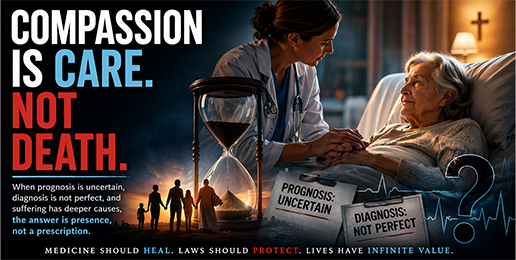
When the main drivers are fear, isolation, loss of independence, and perceived loss of dignity, the most compassionate response is often not a prescription, but presence and support. Hospice and palliative care can address pain, anxiety, nausea, breathlessness, and other distressing symptoms, and skilled teams can also address spiritual and emotional suffering. Many people ask for control because they feel alone or like a burden, so the answer is often community, not hastened death.
In simple terms, most people who choose PAS are not doing so because their pain cannot be controlled. They are struggling with fear, loss of independence, and a sense that life no longer feels like it used to. These are very real and painful struggles, but they are not the same as a medical emergency that cannot be treated.
When people feel this way, the most compassionate response is care, support, and presence. Help with pain, emotional support, counseling, spiritual care, family support, and planning for the future are all ways medicine and community can respond without ending a life. These struggles can often be eased, even when a disease cannot be cured. Sadly, in much of the medical discussion of PAS, the role of Christian faith and church family support is underemphasized, even though these supports can be central for helping people endure suffering and not feel alone. With that narrow legal “indication” established, the next question is whether medicine can accurately make the six-month prediction that the law requires.
Prognosis
The six-month prognosis requirement is the law’s central medical test, but it is also the most medically uncertain and therefore the most dangerous to use as permission for an irreversible act. This most crucial component of this law also represents the weakest aspect from a medical perspective. When you are considering the death of a person as the treatment option, which once administered is irreversible, the margin for error becomes critical. There is no going back.
I am going to tell you a truth about medical care. Physicians are often inaccurate at predicting prognosis, including the life expectancy of their patients. This matters for autonomy. A choice is only truly informed if the information is reliable. If the six-month estimate is uncertain, then the patient may be making an irreversible decision based on information that could be wrong, even when the physician acted in good faith. This is not a matter of negligence most of the time. Predicting the timing of death is extremely difficult and complex, with multiple variables involved, and some diagnoses are far more difficult to predict than others.
There are multiple medical studies examining the accuracy of prognosis. These studies show that physicians can be off by weeks, months, and even years. One large analysis reported that only about 20 percent of physicians’ survival predictions were accurate within one-third of actual survival, using a strict definition of accuracy. The literature on prognostic inaccuracy raises serious ethical and clinical concerns when prognosis is used to authorize PAS. The reality is that physicians cannot reliably predict life expectancy, especially within a narrow window such as less than six months.
Using prognosis, a tool that medicine itself acknowledges is frequently inaccurate, to authorize a decision that results in certain and irreversible death represents a profound failure of medical judgment. When the margin for error is life itself, proceeding without reliable certainty cannot reasonably be called compassionate and instead reflects unacceptable risk. If prognosis is often wrong, then the next safeguard must be the diagnosis itself, because the entire six-month estimate rests on whether the underlying “terminal illness” is correctly identified.
Diagnosis
PAS depends not only on predicting time left, but on getting the diagnosis right, yet clinical medicine and pathology studies show diagnostic certainty is never perfect, even in serious disease. I suspect many of you will find my discussion of diagnosis unsettling. The second most important aspect of the MAID law is the determination of a terminal illness, which rests on the accuracy of the diagnosis. When a person is deciding upon a treatment option that is intended to be both definitive and lethal, the diagnosis must be as accurate as possible. In ordinary care, uncertainty can be tolerated because time allows reassessment, second opinions, and response-to-treatment to clarify the picture. In PAS, uncertainty is uniquely dangerous because the decision cannot be revisited once the medication is taken.
Unfortunately, the medical literature does not support the concept of perfect diagnostic accuracy. Studies of diagnostic performance show that serious diagnostic errors occur in roughly 10 to 15 percent of cases across various clinical settings, even in routine medical practice, and cancer diagnoses are not exempt. While most diagnostic disagreements are minor, pathology studies examining mandatory second opinions demonstrate that approximately 1 to 3 percent of biopsy results contain major discrepancies significant enough to change clinical management and, in some cases, prognosis. Errors in interpretation of laboratory tests and imaging studies also occur and can further compound diagnostic uncertainty.
Many illnesses commonly cited in PAS cases, such as advanced cancer, neurodegenerative disease, heart failure, and chronic lung disease, do not follow a predictable course. Some patients stabilize, respond unexpectedly to treatment, or live far longer than anticipated. In routine medical care, a wrong or incomplete diagnosis can often be revisited, corrected, or refined over time. In physician assisted suicide, however, a mistaken diagnosis cannot be corrected because the outcome is immediate and irreversible.
The law’s requirement that only two physicians determine the presence of a terminal illness is, in my view, insufficient. To strengthen this safeguard, I would require at least two specialists in the relevant field to independently review all available data, including secondary reviews of biopsy specimens and diagnostic test results, before a patient could even be considered for death. Even with these additional safeguards, however, diagnostic certainty would still fall short of absolute certainty.
Questions
1.) Have you personally, or has someone close to you, ever been given a prognosis or diagnosis that later turned out to be wrong, incomplete, or far more uncertain than first presented? How does that experience shape how you think about physician assisted suicide?
2.) What parts of your own conscience resist being around suffering, and how might God be calling you to grow in compassion, patience, and courage as you walk with others?
3.) If Scripture says your life is not your own (1 Corinthians 6:19-20), how does that shape the way you view “personal choice” as the main argument for PAS?