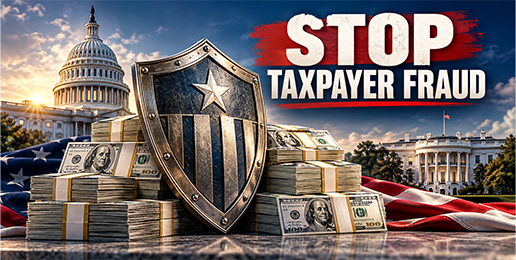
For decades, American taxpayers have watched their earnings siphoned into a sprawling federal apparatus that seemed either unable or unwilling to protect the public purse. Massive welfare programs, block grants, and emergency spending pools became magnets for criminal enterprises, international scammers, and negligent state bureaucracies.
Now, an aggressive, coordinated counter-offensive is taking shape at both ends of Pennsylvania Avenue. With the White House Task Force to Eliminate Fraud spearheading an administration-wide crackdown and conservative lawmakers in Congress moving to mandate strict accountability, the era of turning a blind eye to public theft is meeting decisive resistance.
Taking Aim at Systemic Fraud
At the center of the executive effort is Vice President JD Vance, who leads this task force. This month, the administration mobilized a nationwide coalition of federal secretaries, state governors, and law enforcement leaders around a unified pledge: protect vulnerable citizens, restrict taxpayer benefits strictly to American citizens, halt improper disbursements before the money leaves federal accounts, and prosecute criminal syndicates.
The scope of the financial drain targeted by the task force reaches deep into the administrative state. Federal leaders are already reporting significant recoveries and uncovering extensive vulnerabilities across major agencies.
Treasury Secretary Scott Bessent announced that federal efforts have halted hundreds of millions in fraudulent transactions, including $175 million in payments directed to deceased individuals and over $100 million routed overseas to international schemes. The Treasury has also ordered an audit of roughly $9 billion in agency contracts and placed sanctions on foreign scam cartels targeting elderly citizens.
Other departments report similarly staggering numbers. Secretary of Labor Keith Sonderling revealed that the Department of Labor has already uncovered $22 billion in labor fraud. At the FBI, Director Kash Patel announced the capture of six “Most Wanted” fraudsters tied to more than $2 billion in alleged schemes, while Secretary of Education Linda McMahon confirmed the prevention of over $2 billion in fraudulent student aid disbursements through real-time verification systems.
Across the cabinet, from HHS Secretary Robert F. Kennedy Jr. to Transportation Secretary Sean Duffy, the message remains uniform: programs meant to serve law-abiding Americans cannot serve as slush funds for international cartels, illegal operations, or domestic grifters.
Closing the Loopholes
Executive enforcement, however, requires permanent statutory teeth. While task forces can aggressively pursue offenders, federal law often contains weak administrative language that allows negligent state agencies to escape accountability when taxpayer funds are mismanaged.
U.S. Representative Mary Miller (R-Taylorville) is leading the charge with H.R. 7726—the Stop Child Care Scams Act. Miller’s bill tackles systemic exploitation within the federal Child Care and Development Block Grant program, where improper payments drain an estimated $600 million every year. The U.S. House passed the bill on June 3, 2026, by a vote of 217 to 207 and is now pending in the U.S. Senate.
“Criminals have exploited government assistance programs for years, stealing millions of taxpayer dollars and diverting resources away from vulnerable children and working families,” Miller said following the bill’s passage. “The House’s passage of my Stop Child Care Scams Act ensures that fraud will no longer be met with inaction.”
A key provision of Miller’s legislation would strengthen enforcement by changing “may” to “shall” in the law governing the withholding of funds from noncompliant states.
The bill would also require stronger fraud controls, permanently bar providers following final fraud determinations, and establish corrective-action requirements for states with excessive improper payment rates. These measures would make it harder for state agencies to ignore persistent failures in program oversight.
U.S. House Republican Conference Chairwoman Lisa McClain (R-MI) underscored the necessity of statutory reform, noting that hardworking families have borne the cost of government incompetence for too long. “House Republicans are restoring accountability and making sure these programs serve the people they were created for, not fraudsters looking for an easy payday,” McClain stated.
A Duty to the Citizenry
The twin efforts from the White House and Capitol Hill point to a fundamental truth of governance: proper stewardship of the public treasury is not a bureaucratic technicality, but a moral duty. When billions of dollars are stolen by criminal syndicates or lost to bureaucratic negligence, the burden falls directly upon the productive citizens whose labor funds the system.
By combining stronger payment verification, coordinated enforcement, and mandatory statutory penalties, this effort seeks to dismantle the fraud that has flourished around federal benefit programs. For American taxpayers who have long shouldered the cost of administrative negligence, meaningful accountability is necessary and long overdue.