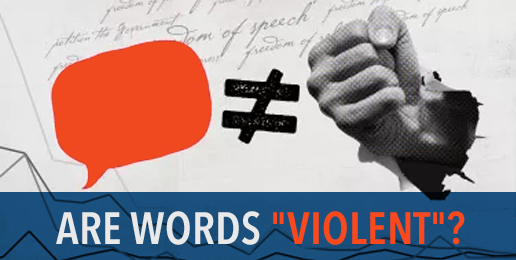
More than 90% of all college students in America today believe that words are “violent.”
This data was compiled in the aftermath of the assassination of Charlie Kirk when the Foundation for Individual Rights and Expression (FIRE) polled more than 2,000 college students in October 2025, and asked them about their perception of free speech in the United States.
Sean Stevens, the chief research advisor for FIRE, chillingly noted:
“When people start thinking that words can be violence, violence becomes an acceptable response to words.”
There is no doubt that the aftermath of Charlie Kirk’s assassination sent ripple effects across the country in varying degrees.
The FIRE study reveals that 68% of students (specifically Utah Valley University students) feel more uncomfortable sharing their opinions on controversial subjects in the classroom. Sixty-five percent are less comfortable attending public events on campus.
Fifty-four percent are less comfortable even attending class in person.
Not surprisingly, conservative students report feeling emotions of unease surrounding political opinions.
The FIRE study clarifies, however, that these feelings of unease have nothing to do with any specific policies that have been put in place. It has to do with fear.
Fear of being harmed or killed for simply having a differing opinion.
After all, 91% of college students believe that words themselves are “violent.”
How did we get here?
How did we, as a country that was founded on principles of freedom of speech, arrive at a place in time where our own places of thought (colleges) are now un-safe places for engaging in the exchange of ideas?
The problem is not as simple as “it’s the Left’s fault.” Although the Left’s rhetoric of “conservatives are nazis” and “Trump is Hitler,” has certainly aided these feelings, the blame does not necessary lay at the feet of the Left entirely.
I personally believe the root of so many college students believing that words themselves are “violent” lays at the feet of our higher academic institutions.
In the 1950s, Speech Act Theory came into the higher academia field with philosopher J.L. Austin pioneering this theory.
To put this theory in simple terms, Austin believed that when you speak, you don’t just say things.
You do things.
Fast forward to today, and Austin’s Speech Act Theory is the engine behind the idea that speech does not merely express actions, it does them.
Critical Race Theory (CRT), an ideology that has covertly infiltrated a great many public schools, teaches that people fall into one of two groups – the oppressed, or victim, and the oppressor. According to CRT, racist speech does not merely express an idea, but rather it becomes an oppressive action that must be righted.
If this is one of the ways of how we got here– where words themselves are “violent,” how do we rectify this?
How do we go back to a country that peacefully debates ideas without interpreting these ideas as personal attacks and harmful?
I believe the solution is two-fold.
First and foremost, we need our country to repent of its wickedness and self-idolatry and turn back to God (Romans 1:21-23; Ezekiel 14:6; 2 Chronicles 7:14).
Secondly, we need a complete overhaul of our academic institutions and colleges. It is not difficult to see that our institutions have failed our students.
- Exploding cost of tuition.
- Declining academic standards.
- Promoting ideologies rather than encouraging questions and debates.
If we want to ever go back to our roots where freedom of speech is cherished, we as a country need to recognize our need for repentance and for our colleges to once again be institutions of growth, not indoctrination.