
Illinois lawmakers are now being asked to write into statute a view of sex and identity that is increasingly contested in medicine, law, and public policy.
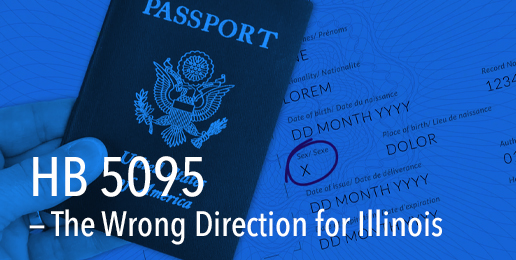
Last month, State Representative Mary Beth Canty (D-Arlington Heights) introduced House Bill 5095, legislation that would amend the Illinois Identification Card Act and the Illinois Vehicle Code to allow applicants for a driver’s license, permit, or state identification card to designate their sex as male, female, or “X.”
The bill also establishes a simplified process for changing the sex marker on an existing Illinois ID: an applicant only needs to submit a gender designation form with basic identifying information, a requested designation, and an attestation under penalty of perjury.
The Secretary of State would be prohibited from demanding medical documentation, certification, or other verification.
Take ACTION: Click HERE to send a message to your state representative to urge Illinois lawmakers to vote NO on HB 5095. State IDs should reflect biological reality — not subjective identity claims. Illinois must reject this reckless effort to write gender ideology into law.
Background
In some ways, the bill is modest. Illinois already permits a third option on state ID documents, and the bill largely replaces the written term “non-binary” with the marker “X.”
However, the measure has a more significant impact as well. It formalizes the process for changing a sex designation on state ID and limits the Secretary of State’s authority to demand documentation or verification beyond a signed gender designation form.
By establishing these rules directly in law instead of leaving them to administrative policy, the bill would make the current process harder to change in the future.
And that matters because the broader legal and political environment is no longer heading in the same direction.
At the federal level, the trend has shifted. The U.S. State Department’s current passport policy states it will issue passports only with an M or F marker matching a customer’s biological sex at birth. It will not honor requests for an X marker or a sex marker different from sex at birth. That policy followed Executive Order 14168, which directed the federal agencies to recognize only two sexes—male and female.
That does not mean every state law is automatically preempted. However, it does imply that Illinois is moving its identification system further away from the current federal approach in an area where state and federal laws and practices frequently interact.
Identification documents are not just local papers.
They function within a national and international system of travel, security, databases, interstate recognition, and federal management. A state may deviate from that system, but it cannot avoid the real-world effects of doing so.
Internationally, HB 5095 also aligns Illinois with a minority stance. According to the Equaldex global tracker, only 17 countries recognize a non-binary or third-gender category, with 4 more offering only limited recognition; the vast majority of countries do not. In other words, even if Illinois adopts the “X” designation more clearly, it would still be adopting an approach that remains uncommon worldwide.
That global point matters because supporters often claim these measures reflect an inevitable modern consensus. They do not. Even among wealthy, liberal democracies, the situation varies. The United Kingdom, for example, still does not recognize a third legal sex category on passports. The United States briefly moved in that direction at the federal level, then reversed course. The bigger picture is not a one-way march toward endless expansion of gender categories. It is a contested debate, and in many places, a retrenchment.
To understand how Illinois arrived at this point, it helps to examine the intellectual history of the idea that gender is distinct from biological sex.
For most of history, law and medicine viewed sex as a fixed biological fact. The modern effort to separate gender from sex is a relatively recent development. Late nineteenth-century sexologists like Richard von Krafft-Ebing were some of the first to treat sexual behavior and identity as topics of psychological and psychiatric analysis, rather than just moral or legal issues.
Krafft-Ebing was a trailblazer in studying sexual psychopathology, part of the larger movement that medicalized and psychologized questions previously understood in biological or moral terms.
In the twentieth century, American psychologist I. Madison Bentley was one of the first writers to use “gender” in a psychological context. A historical review traces that use back to Bentley’s 1945 work, which describes gender as the “socialized obverse of sex.”
But it was John Money who did the most to turn these scattered ideas into a system. The term “gender role” first appeared in print in 1955 in Money’s work and refers to the things a person says or does to indicate whether they are a boy or a man, a girl or a woman. Money considered the social environment very important in shaping gender identity.
That was the real turning point.
Money wasn’t just about masculine and feminine stereotypes. He helped create the idea that gender identity can differ from biological sex and, in practice, can even go beyond it. Over time, these ideas moved from psychology into pediatrics, psychiatry, education, law, and public administration.
What started as a theory became policy.
The most notorious test of Money’s ideas was the David Reimer case. After a botched circumcision in infancy, Reimer was raised as a girl based on Money’s recommendation. Money published papers describing the reassignment as successful. However, the case later became infamous precisely because it had not succeeded: Reimer ultimately rejected the female identity imposed on him, resumed living as a male during his teens, and eventually committed suicide by a self-inflicted gunshot wound at the age of 38.
His brother, Brian, had died two years earlier, also by suicide, but from an intentional drug overdose.
Money’s experiment was a catastrophic failure.
The case came to be seen as a devastating blow to the idea that sexual identity could be changed through socialization. That incident matters not just because it hurt Money’s reputation. It revealed the fragility of the larger theory. If one of the most well-known cases supporting the social construction of gender instead ended up questioning it, then the intellectual foundation was not as strong as its supporters claimed.
Since then, these ideas have continued to develop, but they have also faced increasing scrutiny. The Cass Review in the United Kingdom found that the evidence supporting pediatric medical interventions in this area was weak and uncertain, and the U.K. government later stated that the rationale for early puberty suppression was unclear, with limited evidence on its effects.
Regardless of one’s view of adult identification policy, the broader movement that popularized gender identity as a guiding concept is clearly facing much more skepticism than it did a decade ago.
That is what makes HB 5095 more important than it first seems.
On the surface, it appears to be a bureaucratic cleanup bill. In fact, it enshrines in Illinois law a controversial idea: that legal sex designatgion should align with a subjective identity rather than biological sex, and that the state should formalize this change without requiring any significant verification.
Supporters argue this is about dignity, inclusion, and administrative consistency. However, laws do not just reflect culture; they shape it. They establish categories, reinforce assumptions, and turn contested theories into official practice. Once codified, ideas take on the appearance of settled truth, even when their premises are still highly debatable.
That is the bigger issue with HB 5095. It doesn’t just change a label from “non-binary” to “X.” It pushes Illinois further away from the current federal stance, further from the legal practices of most of the world, and deeper into a theory of sex and identity with a less solid intellectual background than its supporters want to admit.
The bottom line is that HB 5095 moves Illinois further in the wrong direction.