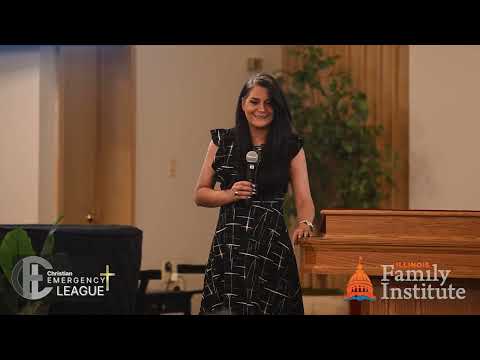
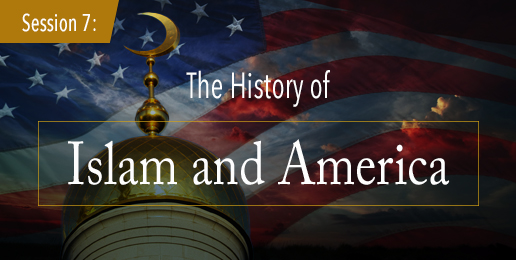
In this final session, Pastor Paul Blair traces America’s long, often overlooked history of conflict with Islamic powers and explains how modern Islamist movements operate inside the United States.

Summary
The lesson begins by noting Islam’s global ambition to bring all nations under Allah’s rule, including the United States—long viewed in Islamic teaching as “the Great Satan.” It then contrasts America’s Christian foundations with the modern push toward multicultural symbolism, such as Rep. Keith Ellison’s 2007 swearing-in on Jefferson’s Quran. The transcript explains that Jefferson owned a Quran not out of admiration but to understand the ideology behind the Barbary pirate attacks that seized American ships, enslaved sailors, and demanded tribute. These attacks led directly to America’s first foreign military confrontation under President Thomas Jefferson and the birth of the U.S. Navy and Marine Corps.
A major portion reviews the Holy Land Foundation trial, where U.S. federal prosecutors proved that numerous American Islamic organizations—including CAIR, ISNA, NAIT, and others—were tied to the Muslim Brotherhood and Hamas. Internal documents revealed a strategic plan to undermine Western civilization from within through gradual infiltration, media influence, lawfare, control of language, educational penetration, and the long-term goal of establishing Sharia law.
The transcript highlights the Islamic doctrinal principles that justify deception, treaty-breaking, and armed jihad, emphasizing the shift in Muhammad’s own life from peaceful persuasion to violent conquest. This shift forms the blueprint for modern Islamist political strategy: peace when weak, force when strong.
The session concludes by stressing that Islam—as a political-religious system—seeks global supremacy and is fundamentally incompatible with the U.S. Constitution. Yet Muslims themselves are people made in God’s image who need the gospel. The goal of the study is to equip Christians with historical clarity and biblical discernment in an age of growing cultural confusion.
The session then moves to the 20th century, explaining how the fall of the last Islamic caliphate after World War I birthed a revival movement—most notably the Muslim Brotherhood (1928)—which sought renewed global expansion. Hamas later emerged from this network. The lesson details how Western diplomatic missteps, especially the Oslo Accords, empowered Islamist organizations that publicly moderated their language while privately committing to Israel’s destruction.
Learn more:
| Session 1 | Session 2 | Session 3 |
| Session 4 | Session 5 | Session 6 |
| Session 7 |