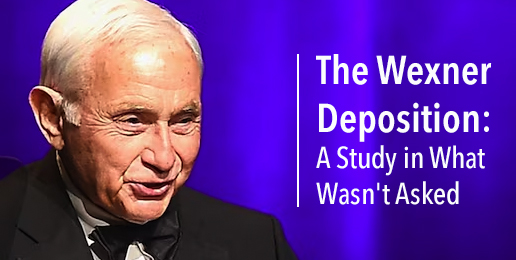
On February 18, 2026, Leslie H. Wexner sat for a five-hour congressional deposition at his New Albany, Ohio, estate. Members of the House Committee on Oversight and Government Reform conducted the session. Wexner arrived with prepared counsel and a prepared statement. He left after answering every question he was asked, while the most important questions were never put to him.
That is the story of this deposition.
Wexner’s central narrative — I was a victim, I knew nothing, Epstein was the greatest con man who ever lived — went largely unchallenged. Not because it was necessarily true, but because the committee failed to pursue the record that would have forced him to confront the full dimensions of what his resources built, what his properties housed, and what his network enabled.
I have spent years documenting the Epstein case. In prior reporting, I traced the Mega Group — the organization that provided the broader context for Epstein’s operation — to founding members with documented ties to organized crime figures, intelligence services, and multiple presidential administrations. That context is what makes the committee’s silence on the subject so significant.
The Silence on the Mega Group
The single most stunning deficiency in the deposition is the failure to ask a single question about this group. As previously reported, Wexner and Edgar Bronfman Sr. founded the Mega Group in 1991.
I have documented in prior reporting that the Mega Group’s founding members brought decades of relationships with organized crime figures and activities, legitimate businesses, political influence, and intelligence officials and organizations. Max Fisher — Wexner’s mentor and an early Mega Group member — was tied through his Aurora Gasoline Company to Joseph “Scarface Joe” Bommarito, documented in Federal Bureau of Narcotics records as the most prominent numbers operator in the Detroit area and a leading figure in organized crime.
Fisher, despite — or because of — those connections, served as an informal presidential adviser on Middle East policy for every administration from Eisenhower through George W. Bush, deliberately avoiding Senate confirmation, which would have required an FBI background check. When Fisher advised presidents, the Secret Service had already run his background check. They knew. Access was granted anyway.
Epstein entered this network in 1987 as Wexner’s financial manager. In July 1991, official records confirm that Wexner granted Epstein power of attorney over his entire personal financial empire. That same year, the Mega Group was formally established. The date Epstein was granted power of attorney over Wexner’s personal financial empire is documented in real estate filings, trust records, and the DOJ’s own 2019 investigative memorandum.
The committee asked Wexner zero questions about the Mega Group. Not about its founding. Not about its membership. Not about its purpose. Not about whether Epstein ever performed services related to it. Not about whether any of its members had relationships with Epstein beyond Wexner’s own. This was not an oversight. Every serious investigator who has examined the Epstein case regards the Mega Group as a central curiosity.
The committee had five hours with one of the two co-founders, yet they asked not one question about it.
The significance of this cannot be overstated. The existence and purpose of the Mega Group directly challenge Wexner’s insistence that Epstein was merely a personal financial manager. The committee chose not to challenge it.
The Cameras That Were There Before Epstein Arrived
The Manhattan townhouse at 9 East 71st Street — the Herbert N. Straus House — is the central physical asset of the entire Epstein operation. In that building, federal agents in 2019 found what prosecutors described as an extraordinary volume of photographs of nude and partially nude young women and girls. Victims testified about a network of hidden cameras throughout the property. Maria Farmer, who worked as a doorwoman at the mansion, told CBS News about a dedicated media room housing stacked monitors displaying feeds from cameras throughout the building. Surveillance cameras were documented in Epstein’s third-floor suite, including one mounted directly above his bed.
The committee examined the property extensively. They asked when Wexner purchased it, what he paid, when he transferred it to Epstein, and at what price he transferred it. They also asked about the deed transfer timeline. They never once asked about the surveillance system.
That omission becomes considerably more serious in light of a finding I have now confirmed from the record. The New York Times, in its detailed account of the property’s history — cited by CBS News in its coverage — reported the following about Wexner’s renovation of the mansion after his 1989 purchase:
“Mr. Wexner then spent at least that much on artwork — including multiple works by Picasso — Art Deco furnishings, Russian antiques, rosewood tables and doors and a gut renovation of the home. Security devices, including a network of cameras, were installed.”
The camera network was installed during Wexner’s renovation, before Epstein moved in around 1995, and before Ghislaine Maxwell, whom I and others have identified as the manager of Epstein’s intelligence honeytrap, entered the picture. The surveillance system that became the means of collecting some compromising information to support Epstein’s intelligence operation was installed while the property was still Wexner’s.
This raises the most fundamental questions. Did Wexner authorize the installation of that camera network? Why would he do that? Who specified its scope — cameras in bedrooms, in bathrooms, throughout the residence? Was it standard security equipment, or was it configured to go beyond ordinary residential security? When Epstein took possession, did he expand it? Did Wexner know? When federal agents seized the property in 2019 and recovered thousands of videos and images, did anyone ask what the original camera installation looked like and who ordered it?
The committee never asked any of these questions.
Wexner was permitted to testify about the property’s financial history without being confronted with the fact that the surveillance apparatus pre-dated Epstein’s occupancy and was installed under his watch.
The $77 Million Question Wexner Was Allowed to Minimize
Wexner’s position on the Manhattan townhouse transaction was consistent throughout the deposition: he sold it to Epstein for approximately $20 million, believed that was fair market value at the time, and characterized any suggestion that it was discounted as part of the theft his attorneys later identified. He was mildly surprised when told of the DOJ’s representations that the sale was at a deeply discounted price. But he did not further explain the discrepancy.
The committee allowed him to leave it there. They should not have.
The relevant figure is not merely what comparable properties were selling for in the mid-1990s. It is the valuation placed on the property by the United States Attorney for the Southern District of New York (SDNY) in 2019: $77 million. That figure — the federal government’s own appraisal at the time of Epstein’s arrest — appears in public records for the Herbert N. Straus House.
Wexner purchased the property in 1989 for $13.2 million and then spent at least as much on a renovation that included Picasso artworks, Russian antiques, Art Deco furnishings, and the installation of a camera network. The SDNY’s $77 million valuation reflects the federal government’s assessment of the property Wexner transferred to Epstein.
Wexner sold it for approximately $20 million — roughly 26 cents on the dollar compared with the SDNY’s valuation. Even after aggressive discounting for the difference between Manhattan real estate values in the mid-1990s and 2019, the transaction still falls far short of an arm’s-length sale at fair market value.
The committee asked Wexner whether he thought the sale was fair. They did not present him with the SDNY’s $77 million valuation and ask him to reconcile the gap. They did not ask how a property he purchased for $13.2 million and then invested millions in renovating — with Picasso paintings and custom millwork — was later sold to his financial manager for $20 million, with no formal appraisal on record.
The deed, as the committee established, did not officially transfer until 2011 — more than a decade after the purported mid-1990s sale. What was the property’s legal status between the mid-1990s sale and the 2011 deed transfer? Wexner could not answer that. He did not know. For 15 years, the property remained in a legal no-man’s-land, with Epstein claiming ownership, Wexner’s trust retaining the deed, and no formal transfer on the public record.
That arrangement was never examined.
The Brunel-Victoria’s Secret Thread: The Question That Was Never Pursued
When Wexner was asked about Jean-Luc Brunel, he said he had never heard of him. The committee accepted that answer and moved on.
What?
Jean-Luc Brunel was a key player in Epstein’s procurement network. He co-owned Karin Models, one of Europe’s most prestigious agencies, and founded MC2 Model Management in 2005 with approximately $1 million from Epstein. A former MC2 bookkeeper testified to the FBI that Brunel flew teenage models from around the world to be housed in Epstein’s Manhattan apartments at East 66th Street — a building whose ownership history is examined separately in this article.
In a 2015 affidavit, Virginia Giuffre stated that Epstein once bragged to her that he had slept with over one thousand of Brunel’s girls. Brunel appeared on Epstein’s flight logs twenty-five times between 1998 and 2005. He visited Epstein in jail during Epstein’s 2008 Florida incarceration. He was listed alongside Wexner, Maxwell, and others in an FBI email identifying Epstein’s ten co-conspirators.
None of this was raised with Wexner. Here is what should have been.
Victoria’s Secret did not merely share an industry with Brunel’s agencies. It did business with them — documented, ongoing business — for years after the Epstein allegations became public. According to Bloomberg’s reporting, confirmed by Business Insider and Business Today, three MC2 models walked the runway in the 2015 Victoria’s Secret Fashion Show. MC2 models were present at Victoria’s Secret auditions in 2017 and 2018.
This continued after Wexner purportedly severed ties with Epstein in 2007. It continued after Virginia Giuffre’s 2015 court filings named Brunel as a trafficker of underage girls and described MC2 as a cover for sex trafficking. It continued, apparently, without anyone at L Brands asking whether the modeling agency Epstein had financially created, whose models were housed in Epstein’s own apartments, perhaps warranted scrutiny before its talent walked the Victoria’s Secret runway.
Wexner said he had confronted Epstein at least twice about Epstein’s use of the Victoria’s Secret name to approach women, and that Epstein denied it both times. Wexner said he believed him.
The committee raised the 1997 reported assault on Alicia Arden, in which Epstein identified himself as a Victoria’s Secret talent scout and allegedly sexually assaulted her in a Santa Monica hotel room, and the 2004 incident involving Elizabeth Thai, in which a woman was brought to Epstein’s Manhattan home under the representation that he could help her get a Victoria’s Secret job. But the committee stopped there — and in doing so, it missed the most significant element of the issue entirely.
The Victoria’s Secret connection was not merely a claim Epstein made to women who had no way to verify it. It may have been true in practice, despite Wexner’s denial. The deposition transcript itself contains a question — unanswered by Wexner — about a published report of a Romanian model who allegedly obtained a Victoria’s Secret job through Epstein.
MC2, the modeling agency Epstein created and funded, supplied models who walked the runway at the Victoria’s Secret Fashion Show as late as 2015, and whose talent appeared at Victoria’s Secret casting calls in 2017 and 2018. Epstein could deliver. The question is whether Wexner intentionally misled the committee or didn’t know.
Wexner’s denial of knowing Brunel by name might be true. But whether Wexner knew him by name is beside the point. The question was never about his personal knowledge of Brunel. The question was whether the institution he ran — Victoria’s Secret, the world’s most famous lingerie brand, the brand Epstein used as a recruitment cover for over two decades — was doing business with the man who provided the backbone of Epstein’s procurement operation. That question was never asked.
It strains belief that the modeling agencies a company like L Brands used were not subjected to standard due diligence investigations by the organization’s security department, with the findings reported up the chain to those in the C-suite.
Additional Questions Left on the Table
The 2007 Non-Prosecution Agreement
The extraordinary Non-Prosecution Agreement negotiated by U.S. Attorney Alexander Acosta in 2007 — an agreement that extended immunity not only to Epstein but also to unnamed co-conspirators — was never raised with Wexner. This is the agreement Acosta reportedly described to colleagues as necessary because Epstein “belonged to intelligence” and the matter was “above his pay grade.” Wexner is the man whose resources largely built Epstein’s intelligence operation. His Manhattan mansion’s surveillance system may also have been the model Epstein used to install similar systems in his other properties. Whether the NPA’s immunity for unnamed co-conspirators encompassed Wexner, whether his attorneys communicated with prosecutors in connection with the agreement, and whether he was ever told of its national security implications were not asked.
But the agreement’s reach is only part of the question. The more fundamental question is who was sitting across from Acosta when the terms were negotiated — and why?
Who were the Unnamed Co-Conspirators?
One fact from the deposition transcript has received no public attention that I’ve seen. At the 3:18 mark, a questioner referenced a New York Times account stating that Epstein had served as master of ceremonies at a Wexner birthday party, introducing guests including Alan Dershowitz and former Israeli Prime Minister Shimon Peres.
Wexner neither confirmed nor denied Dershowitz’s presence; he said only that he didn’t remember Epstein being there. The questioning moved on without follow-up. What was never raised was the relationship between those two facts — Dershowitz in Wexner’s social circle and Dershowitz as one of the defense attorneys who negotiated the 2007 Non-Prosecution Agreement.
It was Dershowitz and his colleagues who secured the NPA’s most extraordinary provision: blanket immunity, covering not only Epstein’s four named assistants but also “any potential co-conspirators,” language deliberately amended from an earlier draft that had limited co-conspirator immunity to the Southern District of Florida. The amended version extended that protection nationally to an unlimited class of unnamed, unknown people.
Dershowitz has since publicly claimed that the NPA even protects him personally.
The question that has never been formally posed — to Dershowitz, to Wexner, or to any member of Congress — is this: a defense attorney negotiating solely for his named client has no apparent reason to insist on unlimited national immunity for unnamed third parties. If there is a reason, what is it? That provision protected someone.
If the Mega Group provided the core direction for Epstein’s operation, then the organization’s membership, which overlapped directly with Wexner’s social circle, represents precisely the kind of unnamed potential co-conspirators the NPA was written broadly enough to cover. Whether that outcome was the provision’s purpose or merely its effect is a question that cannot yet be answered.
It is also a question the committee never asked.
The 301 East 66th Street Sale
There is a second real estate transaction involving Wexner and the Epstein family that the committee never examined — one that, in some respects, is more troubling than the 71st Street transfer because of what the building later became.
301 East 66th Street is a sixteen-story, approximately two-hundred-unit residential building on Manhattan’s Upper East Side. Wexner owned it. In the early 1990s, he sold it to Mark Epstein — Jeffrey’s younger brother — through a company called Ossa Properties. That sale occurred during the same period that Wexner was granting Jeffrey full power of attorney over his personal financial empire.
Ossa Properties was not an arm’s-length buyer. Mark Epstein served as its president, and a court filing identified Ossa as formally affiliated with J. Epstein & Company, Jeffrey’s investment management firm — a characterization Mark Epstein disputed to Crain’s New York Business. Jeffrey Epstein, as Wexner’s financial manager with power of attorney, was on both sides of the transaction: managing the seller’s financial interests. At the same time, the buyer was his brother’s company, formally connected to his own firm. No one has asked whether a formal conflict-of-interest review was conducted, whether the sale price reflected an independent appraisal, or whether Wexner’s own counsel flagged the structural problem at closing.
What the building became is now documented in federal court records and the January 2026 document release. Jean-Luc Brunel’s former MC2 bookkeeper testified to the FBI that Brunel flew teenage models from around the world to be housed in Epstein’s Manhattan apartments, specifically including the properties at East 66th Street. The building housed victims who were charged approximately $1,000 per month in rent by their trafficker and made available to Epstein’s network. Sarah Kellen, Nadia Marcinkova, Adriana Ross, and Lesley Groff — all four named in the 2007 Non-Prosecution Agreement as Epstein’s staff — lived and conducted business at 301 East 66th Street.
The connection between the two properties is not merely geographical or familial. The legal entity that held title to Jeffrey Epstein’s East 71st Street mansion — the property transferred from Wexner — listed 301 East 66th Street as its registered mailing address. In corporate filings, these were not two separate Epstein properties. They were formally linked nodes within the same legal structure.
The January 2026 document release added a further dimension. Israeli government officials, working through the Israeli UN mission in New York, installed and managed a surveillance system at 301 East 66th Street beginning in 2016, in connection with extended visits to the building by former Israeli Prime Minister Ehud Barak. The surveillance was coordinated directly with Epstein’s staff. By 2016, a building that Wexner sold to Epstein’s brother, through Epstein’s affiliated company, had become a property where foreign government officials connected to intelligence were managing security systems — the same building federal prosecutors later documented as housing trafficked minors.
The committee asked Wexner extensive questions about 71st Street, but none about 66th Street. They did not ask whether he knew that the building he sold was being used to house Epstein’s trafficking victims. They did not ask whether he was aware of the corporate affiliation between Ossa Properties and J. Epstein & Company at the time of the sale. They did not ask whether Jeffrey Epstein was involved in structuring the transaction, negotiating its terms, or receiving any financial benefit from it — all questions that follow directly from the fact that Jeffrey held power of attorney over Wexner’s finances at the time of the sale.
They did not ask those questions.
The committee had Wexner under oath. The answers to at least some of them almost certainly exist in documents Wexner’s attorneys have reviewed. The building that was the subject of those unasked questions served for years as one of the primary addresses of the enterprise that harmed over one thousand victims.
Robert Maxwell and the 1991 Convergence
Robert Maxwell — Ghislaine’s father, a confirmed Mossad asset — died under unexplained circumstances in November 1991. That was the same year Wexner formalized Epstein’s power of attorney, and the Mega Group was established. Epstein’s connection to Robert Maxwell was reportedly brokered by Steven Hoffenberg, Wexner’s one-time financial associate and the man who ran the Towers Financial Ponzi Scheme for which Epstein served as a paid consultant. Whether Wexner knew of Epstein’s relationship with Robert Maxwell or with Hoffenberg, and what he understood about the intelligence networks Maxwell’s death left Epstein to inherit, was not asked.
“Always Be Careful”
During the deposition, the committee introduced a message Wexner sent Epstein after Epstein’s 2008 guilty plea to soliciting a minor for prostitution. Wexner wrote:
“Abigail told me the result. All I can say is I feel sorry. You violated your own number one rule. Always be careful.”
Epstein replied: “No excuse.”
The committee asked Wexner what he understood that rule to mean. Wexner said it meant being a careful fiduciary — accurate with tax returns, avoiding risky positions, and reliable and prompt with a client’s money.
The committee accepted that answer. They should not have.
Epstein had just pleaded guilty to procuring a minor for prostitution. That is the specific event that prompted Wexner’s message. In that context, “you violated your own number one rule — always be careful” does not read as a rebuke of accounting practices. It reads as the response of someone who understood that Epstein’s exposure was the result of a failure of caution — that he had been doing something for a long time, and this time he got caught.
If Wexner understood “be careful” to mean fiduciary diligence, his response to a sex crimes conviction is simply incoherent. The natural follow-up — what, precisely, did you understand him to be failing to be careful about, given what he had just pled guilty to? — was never asked. Wexner’s own contemporaneous words, written before any investigation closed in on him, are in direct tension with the victim narrative he has maintained ever since. The committee had those words before them and did not press the point.
The Kroll Investigation
Late in the deposition, a more complex picture emerged than has been publicly reported. The committee established that there were three separate post-arrest investigations of Epstein, commissioned by people associated with L Brands — two by law firms retained by the board in 2019 and 2020, and a third by a single unnamed board member who went outside the company to retain Jules Kroll on his own.
The committee did not request the names of the law firms that conducted the investigations following Epstein’s 2019 arrest.
Additionally, Wexner testified that he learned of the Kroll engagement only two weeks before the deposition, during a private conversation with the former board member. The board member told Wexner he had been concerned about Epstein and had asked Kroll to investigate him without informing the company’s founder. Kroll’s reported conclusion was that Epstein was “not a good guy.” When the board member pressed Kroll for specifics, Kroll declined to provide any.
Jules Kroll, after a career in federal law enforcement, built his firm into what Wexner described as the largest international private investigation firm in the world — one whose client base has included intelligence agencies, sovereign governments, and major financial institutions. In my experience as an investigator, when a firm of that caliber returns a conclusion and then declines to elaborate, there is a reason. It means the findings implicated interests the investigator was not prepared to commit to paper because disclosure would implicate protected parties, create liability for the client, or cross into national security territory. If a man with Jules Kroll’s background and experience says Epstein was “not a good guy” and then declines to say more, the refusal is the finding.
The committee identified the Kroll engagement and then walked away from it entirely. They never asked which board member commissioned the investigation. They never asked what prompted that board member’s private concern — a concern serious enough to go outside the company, in secret, to one of the world’s most sophisticated investigation firms. They never asked what Kroll was paid, what scope of investigation was authorized, or what categories of inquiry produced the unreportable conclusion.
They never asked why a sitting board member who received findings of that significance chose to withhold them from the company’s founder. It seems to me that the board member who commissioned the investigation saw Epstein as closely connected to the company. Wexner wasn’t challenged about that either.
None of these questions was asked.
The Intelligence Connections Wexner Observed
The committee asked Wexner whether Epstein or Maxwell ever told him they were part of an intelligence service. He said no. That question — which can elicit only a response about Epstein’s own self-disclosure — was the totality of the committee’s inquiry into Epstein’s intelligence connections.
The documented presence of Israeli intelligence operative Yoni Koren at Epstein’s Manhattan property for extended periods in 2013, 2014, and 2015 was never raised. The co-founding of Carbyne — a technology company staffed by veterans of Israeli intelligence units — by Epstein and former Israeli Prime Minister Ehud Barak was never raised. The $2.3 million transferred from the Wexner Foundation to Barak visibly shocked Wexner when the committee revealed it, but the follow-up — connecting that transfer to Barak’s documented relationship with Epstein through Carbyne and through dozens of visits to Epstein’s properties — was never made.
[Staff Name Redacted]: The Accountability Gap the Majority Built In
Every significant omission documented in this article — the Mega Group, the camera installation, the NPA’s unnamed co-conspirators, Jean-Luc Brunel’s connection to Victoria’s Secret, and the Kroll findings — was a decision. Someone decided not to ask those questions. That person led the Republican majority’s hour of questioning. And when the committee released the deposition video to the public, they redacted his identity.
The video does not merely fail to identify the questioner. At the moment he introduced himself — the standard protocol at the opening of every congressional deposition — the committee’s released video displays a deliberate title card: [Staff Name Redacted].
Someone reviewed the footage, identified the moment their lead questioner stated his name, and inserted a black screen with white text to suppress that identification. That takes deliberate action. It does not happen by accident.
The legal and procedural considerations in making this decision are significant. Congressional staff conducting depositions act in an official public capacity under the authority of the United States Congress. They are public employees exercising governmental power pursuant to a lawfully issued subpoena. There is no rule, precedent, or legal basis for withholding their identities from the public record of proceedings conducted in the public’s name.
Wexner’s attorneys are named in the transcript. The court reporter is part of the formal record. The Democratic members present are identified. The sole person whose identity was actively suppressed in the public release is the Republican majority staff member who led the questioning.
The questions that were not asked were not asked by anyone. That person’s professional background, prior employment, institutional connections, and oversight of his work are all relevant to understanding why the most consequential questions in the Epstein case were absent from the deposition of the one man best positioned to answer them. Those questions cannot be examined if the questioner’s identity is concealed.
Consider what a standard background examination of the lead questioner would ordinarily reveal: prior employers, including whether any have connections to entities implicated in the Epstein case; prior work in or proximity to the intelligence community; connections to legal or lobbying firms that represent clients seeking to limit the scope of the Epstein investigation; and the chain of supervision within the committee majority that approved the questioning agenda. All of that is redacted.
The Republican majority’s position throughout this investigation has been defined less by active inquiry than by strategic passivity. Chairman Comer issued the subpoena — bipartisan credit claimed — but was absent from the deposition due to a previously scheduled oral surgery. No Republican members attended. The majority’s questioning was conducted entirely by anonymous staff. The video was released with the questioner’s name suppressed. The net result is that the Republican majority can claim participation in the investigation without subjecting its questioning strategy, omissions, or personnel to public accountability.
The circumstances — a subpoena issued, members absent, staff unnamed, and video redacted — are revealing. They produce the appearance of oversight without the substance. They allow the committee to say it questioned Wexner under oath while ensuring that the person responsible for the scope and content of the questions cannot be identified, examined, or held responsible for what was left unasked.
The practice of redacting federal employees’ names from FOIA responses is established and legally grounded under Exemption 6 of the Freedom of Information Act. What occurred here is categorically different. Congress is not subject to FOIA. This video was not released in response to a legal request — it was voluntarily released to the public by the committee itself. There is no legal framework, no exemption, and no procedural basis for suppressing the identity of a congressional employee conducting sworn oversight in the public’s name.
I have spent more than 50 years conducting civil and criminal investigations at the federal and state levels, for legislative purposes, and in a private capacity. I have seen staff names redacted from documents produced in response to FOIA requests when a legal basis exists. I have never encountered a congressional proceeding in which the official conducting sworn questioning had their identity redacted from a video voluntarily released to the public. I’ve never seen that anywhere before.
The questions this raises are straightforward: Who redacted that name, on whose authority, and why?
Until it is answered, the [Staff Name Redacted] title card remains the most candid moment in the entire Wexner deposition — not a witness statement, but a statement by the committee itself about the limits of what it intended this investigation to uncover.
What This Deposition Was and Was Not
Leslie Wexner is 88 years old. He has spent years repeating a consistent claim: that he was deceived, stolen from, and the victim of the greatest con man he ever encountered. The committee gave him five hours to reinforce that narrative without serious challenge.
The failure is not that Wexner lied. He may well have answered every question truthfully as asked. The failure is that the questions were drawn entirely from within his own framing — from press accounts he has had years to prepare responses to, from financial documents his own attorneys identified and characterized, and from allegations he has denied in the same terms across multiple venues for years. The committee operated as though its job was to verify or refute Wexner’s existing narrative rather than to construct an independent record grounded in the full documentary evidence.
The Mega Group — never mentioned. The camera network installed during his renovation — never raised. The SDNY’s $77 million valuation of a property he sold for $20 million — presented but not pressed. The documented years that Victoria’s Secret did business with Epstein’s modeling agency after it was accused of trafficking — never connected. The 301 East 66th Street sale—its conflict of interest, its subsequent use, its Israeli surveillance connection — never examined. The 2007 NPA and its unnamed co-conspirators – never raised. The Robert Maxwell connection and the 1991 convergence of the three events — never explored. Wexner’s incoherent explanation of his “Always be Careful” comment—not challenged. The Kroll investigation’s actual findings — not pursued.
These are not peripheral questions. Each goes directly to the central unresolved issue in the Epstein case: not only the full range of what Epstein did, but also who knew, who enabled, and who has been protected. Wexner is the only man alive who is positioned to answer those questions more fully than anyone else. The committee had him under oath for five hours.
They did not use the time very well.
The record they created is incomplete. Whether by design or by deference to the forces that have consistently ensured the most sensitive questions in this case go unanswered, the outcome is the same.
That, too, is part of the story.