A Christian Look at Social-Emotional Learning
Eight of every ten American public schools now use social-emotional learning. It is more than a class. It runs through the school day and aims to shape who a child is: his feelings, his friendships, his sense of right and wrong. Christians call that discipleship. Some of the people who built it drew on Eastern meditation. Some who lead it today aim it at social change. Parents should know what its makers believe.
A September 2024 survey by the Collaborative for Academic, Social, and Emotional Learning (CASEL) and the RAND Corporation found that 83 percent of public school principals reported using a social-emotional learning curriculum during the 2023-24 school year, up from 46 percent six years earlier. Forty-nine states and the District of Columbia have at least one policy promoting it (CASEL, Sept. 17, 2024).
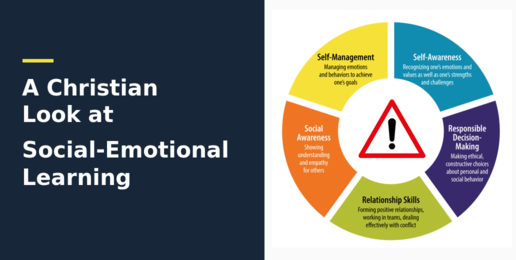
Social-emotional learning, or SEL, teaches five “competencies”:
- self-awareness,
- self-management,
- social awareness,
- relationship skills, and
- responsible decision-making.
CASEL, an organization originally based at Yale and now headquartered in Chicago, defines the whole as the process by which children “develop healthy identities, manage emotions and achieve personal and collective goals, feel and show empathy for others, establish and maintain supportive relationships, and make responsible and caring decisions” (CASEL framework).
A program that does these things is a program of formation.
What SEL gets right
Children are in trouble. Jonathan Haidt documents in The Anxious Generation (2024) the sharp rise in adolescent anxiety, depression, and self-harm that began around 2012. Teachers face classrooms where many children cannot sit still, settle a quarrel, or take correction. A child who can’t govern his temper can’t learn long division.
The research record favors the programs on their own terms. Joseph Durlak and colleagues pooled 213 studies covering 270,034 students and reported an 11-percentile-point gain in academic achievement for children in SEL programs (Child Development, 2011). Christina Cipriano of Yale led a 2023 review of 424 studies from more than 50 countries and found better school functioning, stronger social skills, and less anxiety and depression among participants (Yale School of Medicine, July 2023).
Much of what happens in an SEL lesson is ordinary and positive. Children learn to name what they feel, wait their turn, listen, and settle a dispute without fists. Scripture commends every one of those habits. Daniel Goleman, whose 1995 bestseller Emotional Intelligence carried the idea to the public, tied his argument to Aristotle and to character, called family life “our first school for emotional learning,” and warned against “a common pitfall of the self-esteem movement” (25th anniversary ed., 2020, pp. 167, 237).
Dr. Maggie Pope, writing for Summit Ministries in March 2026, observes that Scripture “clearly addresses the developmental realities SEL attempts to describe,” and counsels Christian schools to weigh SEL through Scripture, neither rejecting it outright nor adopting it uncritically (Summit Ministries).
Where the evidence thins
The studies measure hundreds of different programs, most over short periods, and many rely on rating scales and questionnaires. Cipriano’s own team calls for better measurement and more rigorous evaluation. Haidt, who shares the goals, describes a rural Ohio school that had “tried everything” and concludes that there SEL is “taught by adults as yet one more structured curriculum,” while free play teaches the same skills faster (pp. 247, 253). Free play, he writes, “may teach social skills and reduce anxiety better than any educational program” (p. 265).
Goleman concedes how thin the science is on the contemplative side of his work. In Altered Traits (2017), he and Richard Davidson report that of 231 reports on cultivating loving-kindness or compassion, 37 met top design standards and “8 or so” survived close scrutiny (p. 79).
England’s education department sponsored a national program called Social and Emotional Aspects of Learning. Kathryn Ecclestone of the University of Sheffield and Dennis Hayes of the University of Derby, both professors of education, report that the few evaluations of that program, of the PATHS curriculum, and of the Penn Resilience Programme “show highly inconclusive short-term results and no evidence of long-term positive impact.” They add that evidence of harm from such programs “is similarly fleeting” (The Dangerous Rise of Therapeutic Education, 2019 ed., p. xiv).
Karen Effrem, a physician, and Jane Robbins, an attorney, reviewed the field for the Pioneer Institute in 2019 in a paper titled Social-Emotional Learning: K-12 Education as New-Age Nanny State. They judged the research behind SEL’s claims “thin and unpersuasive” and reported that much of the monitoring of children’s attitudes “occurs without the consent of children or their parents.” Kevin Ryan, the Boston University professor who founded its Center for Character and Social Responsibility, wrote the foreword.
William Kilpatrick recounts in Why Johnny Can’t Tell Right from Wrong (1992) how values clarification and self-esteem programs swept schools in the 1970s and 1980s on confident promises, then failed their outcome studies. He records what one seminar leader told a teacher who asked what to do if parents objected: “You call it ‘life skills’ and you do it anyway” (p. 22). Sidney Simon, a leading author of values clarification, boasted that as a young teacher at Temple University he “always bootlegged the values stuff under other titles” (p. 23). When the research showed the method “ineffectual at best and potentially harmful,” its backers “adopted the simple tactic of changing the name while retaining the method” (p. 82).
Drug education took the same road. Relying on the psychologist William Coulson, a former associate of Carl Rogers, Kilpatrick traced the drug curricula of the 1970s to the nondirective method developed under Rogers at the Western Behavioral Sciences Institute in La Jolla and at the Esalen Institute, and reported that “these drug education programs increased drug use” (pp. 31-32). Studies of the Quest program in 1978 and 1985 found that drug experimentation rose after students took it. “Quest did not publish the results” (p. 45). In 1988, the U.S. Department of Education told schools to avoid curricula that emphasize “values clarification” and “therapeutic educational strategies” (pp. 46-47).
James W. Sedlak published Parent Power!! in 1992, a handbook drawn from parents’ disputes with seven school districts over family life education. It quotes the teacher instructions in one district’s curriculum guide: “DO integrate family life education topics with the other topics you are also teaching.” The handbook states what that meant for a family that used the opt-out: “their children will still get the topics covered in other courses” (p. 48).
Sedlak listed the organizations behind the programs and wrote, “The common denominator among all of these organizations is Planned Parenthood” (p. 6). He quoted a December 1989 article in Focus on the Family’s Citizen reporting that ETR Associates of California “began its corporate life as the Education Department of the Santa Cruz Chapter of Planned Parenthood” (p. 34) (Parent Power!!).
What is on CASEL’s list
CASEL writes no curriculum. It reviews programs sold by others and rates them. Many districts consult the list. CASEL’s highest rating is SELect. Of the 110 programs in its guide, 69 are rated SELect (CASEL).
CASEL also sells its own services to school districts. In April 2024, the Chicago Board of Education renewed agreements with 116 vendors for “social and emotional learning products and services” at up to $25 million a year (Board Report 24-0425-PR5). The vendors include the Committee for Children, which publishes Second Step, and CASEL itself. The district’s purchasing reports record $10.6 million in purchase orders under those agreements in the 2025-26 school year, $127,200 of it to CASEL and none of it to the Committee for Children (Board Reports 26-0129-PR7, 26-0625-PR17, and 26-0827-PR19).
One program with this rating is Get Real: Comprehensive Sex Education That Works, a middle-school curriculum from Planned Parenthood League of Massachusetts (CASEL Program Guide). ETR publishes it.
Grade 7, Lesson 3 of Get Real is titled “Gender and Sexual Identity.” Its goals include “Explain difference between sexual orientation and gender identity” and “Discuss LGBTQ+ issues respectfully.” The lesson plan names the social-emotional skills it teaches: self-awareness and social awareness. The answer it supplies to one discussion question reads: “The person does. Gender and sexual identity are self-identified.” A note tells the teacher to emphasize “the importance of identity being self-identified” (Get Real, Lesson 7.3).
CASEL rates Get Real on a 2014 trial of 2,453 middle-school students, published in the Journal of School Health, which found that students who took the program were less likely to have had sex by eighth grade. The rating is CASEL’s. The lesson on gender and sexual identity is Planned Parenthood’s.
Second Step, from the Committee for Children, also holds the SELect rating for its middle-school curriculum (CASEL Program Guide). The publisher has “curated a set of Learning for Justice lessons” matched to Second Step and to CASEL’s five competencies, and it tells schools: “We recommend teaching these lessons in tandem with your Second Step implementation.” Learning for Justice is the school program of the Southern Poverty Law Center. The lessons include “What’s So Bad About ‘That’s So Gay’?”, “Challenging Gender Stereotyping and Homophobia in Sports,” and “Female Identity and Gender Expectations” (Committee for Children).
CASEL’s own framework moved in the same direction. In 2019, Robert Jagers of CASEL and two co-authors proposed what they called transformative SEL. CASEL now describes it as one form of SEL, which “facilitates critical examination of individual and contextual factors that contribute to inequities” and gives students opportunities “to examine inequities and create solutions for social change” (CASEL).
The framework lists “integrating personal and social identities” under self-awareness. Four CASEL staff members, led by research vice president Robert Jagers, described transformative SEL in 2021 in American Educator, the magazine of the American Federation of Teachers, as a form of SEL aimed at “redistributing power to promote social justice” and “promoting justice-oriented civic engagement” (American Educator, Summer 2021). In June 2020, CASEL’s board of directors issued a statement on racial equity that included the words “Black Lives Matter now, and forever” (CASEL, June 2020).
The 2019 paper that set out transformative SEL names the source of its central idea. Jagers and two co-authors took their three kinds of citizenship from Joel Westheimer and Joseph Kahne. They chose the third kind: “justice-oriented citizenship is concerned with institutional and system change efforts” (Jagers, Rivas-Drake, and Williams, Educational Psychologist, 2019, p. 165).
Kahne taught education at the University of Illinois at Chicago (UIC) from 1993 to 1999 (Kahne, curriculum vitae). William Ayers, a leader of the Weather Underground in the 1970s, joined the same faculty in 1987 and became a Distinguished Professor of Education. In 1974 Ayers was one of four signers of the cover letter to Prairie Fire, the Weather Underground’s manifesto, which told radical teachers to “Radicalize other teachers, organize the parents, teach and encourage your students” (p. 140).
Ayers co-founded the Chicago Annenberg Challenge and co-chaired its advisory arm, the Chicago School Reform Collaborative, from 1995 to 2000. The Challenge helped fund Kahne’s research in those years. Ayers also co-founded the Teaching for Social Justice Series at Teachers College Press, and the series published Pledging Allegiance, a volume Westheimer edited, in 2007 (Teachers College Press).
In November 2006, Ayers addressed the World Education Forum in Caracas, opened with a salutation to President Hugo Chávez, and said of himself and his Venezuelan host: “We share the belief that education is the motor-force of revolution.” These are ties of faculty, funding, and publishing.
Ayers reviewed Paulo Freire for Teachers College Record in 1987, and in 2011 he and Rick Ayers, his brother, wrote in Monthly Review of “the project of conscientization and reading the world that Paulo Freire practiced.” The translator of Freire’s Pedagogy of the Oppressed (1970) defines the term as learning “to perceive social, political, and economic contradictions, and to take action against the oppressive elements of reality” (p. 17). Freire writes that it “prepares men for the struggle” (p. 100).
The year 2020 brought parallel changes in sex education, CASEL’s framework, and the Illinois teacher standards. The second edition of the National Sex Education Standards, published in 2020 by Advocates for Youth, Answer, and SIECUS, added social, racial, and reproductive justice and intersectionality to its guiding principles and says it was further informed by the Southern Poverty Law Center’s Social Justice Standards.
The section for parents that appeared in the first edition is gone. CASEL issued a revised definition of SEL that year, the one that speaks of “healthy identities” and “collective goals.” Its president, Karen Niemi, wrote that the revision attends to how “SEL affirms the identities, strengths and experiences of all children” (The 74, Dec. 15, 2020). In December, the Illinois State Board of Education approved Culturally Responsive Teaching and Leading Standards for the programs that train the state’s teachers, and the legislature’s Joint Committee on Administrative Rules allowed them to proceed on February 17, 2021. Both fields now teach children about identity, and both train them to advocate.
Four roads into social-emotional learning, each traced in its makers’ own documents.
Where it came from
Goleman went to India as a Harvard predoctoral fellow, studied with “Indian yogis and swamis, Tibetan lamas, and southern Buddhist laymen and monks,” and returned to Harvard to write his dissertation. He recounts that training in his first book, reissued in 1988 as The Meditative Mind (pp. xvii-xix, 163). The book is dedicated “To Neemkaroli Baba and Sayadaw U Pandita,” a Hindu guru and a Burmese Buddhist master. Goleman calls the first “my Guru” (p. xviii). In its introduction, he recalls the Tibetan teacher Chögyam Trungpa telling him in 1974, “Buddhism will come to the West as a psychology” (p. xxii), and he writes that “the true context of meditation is spiritual life” (p. xxiii). Meditation, he reports, was “vigorously marketed” as a stress-management tool “to schools, hospitals, and businesses” (p. 169). He describes himself today as a student of the Tibetan lama Tsoknyi Rinpoche. His next book, due from Penguin Press in February 2027, is titled Spiritual Intelligence: Paths to Awakening.
The Fetzer Institute of Kalamazoo, Michigan, supported the writing of Emotional Intelligence. Goleman says in the acknowledgments: “Support from the Fetzer Institute has allowed me the luxury of time to explore more fully what ‘emotional literacy’ might mean,” and it was Rob Lehman, the Institute’s president, who “urged me to write a book about emotional literacy” (p. 315). Goleman writes elsewhere that he “was a cofounder of the movement called ‘social/emotional learning,’ or SEL” (Altered Traits, p. 281).
CASEL dates its founding to 1994. Its own history names Goleman as “CASEL co-founder, author of Emotional Intelligence,” and lists among its founders Mark T. Greenberg and “David J. Sluyter, Senior Advisor, Fetzer Institute” (CASEL, Our History). Sluyter is the Fetzer program director Goleman thanked in 1995 for “an ongoing collaboration” (p. 315). The same history credits the New Haven Social Development program, which Timothy Shriver and Roger Weissberg led in that city’s public schools from 1987 to 1992, with pioneering SEL in K-12 classrooms (CASEL, Our History).
Fetzer also funded CASEL itself. The organization’s first guidebook, Promoting Social and Emotional Learning: Guidelines for Educators (1997), written by nine of its members, credits “Financial support for CASEL from the Fetzer Institute, the Surdna Foundation, and the University of Illinois at Chicago” and reports that Fetzer paid for the authors’ visits to schools and hosted the conference at which CASEL members met the publisher’s leaders to discuss the book (p. v).
According to his biographer, the Fetzer Institute was built to carry out its founder’s New Age vision. Brian C. Wilson, a historian of American religion at Western Michigan University whom the Fetzer Memorial Trust invited to write the founder’s spiritual biography (p. xvi), reports in John E. Fetzer and the Quest for the New Age (2018) that the foundation’s 1983 mission was drafted with a working document titled “Potential Goals from the Channelings,” messages received through a spirit medium, which called for “a network throughout the world of light” so that “the evolution of man shall be changed” (p. 177). The mission statement the board approved in July 1983 spoke of “body, mind, and spirit” and a “wellness philosophy” (p. 178). Wilson records that in the 1990s, after Fetzer’s death, the Institute funded “the work on education for emotional intelligence by Daniel Goleman” (p. 206).
Fetzer himself kept his public and private religion apart. John Fetzer joined a Presbyterian church in 1930 “only for the sake of his business interests” and “thereafter publicly identified as a Presbyterian for strategic reasons” (p. 32). In 1964, he restated ideas drawn from Theosophy in the language of positive thinking and parapsychology; Wilson suggests Fetzer found that vocabulary “more acceptable to his readers” (pp. 112-113).
Religion under another name
In March 1983, Educational Leadership, the journal of the Association for Supervision and Curriculum Development, published “Guided Imagery in the Curriculum” by Beverly-Colleene Galyean, director of the Center for Integrative Learning in Long Beach, California. Galyean sorted classroom imagery into three kinds: cognitive, affective, and transpersonal. The third, she wrote, means going beyond the ordinary way of viewing oneself and the world and “recognize as valid mystical, psychic, and spiritual dimensions as well” (p. 57). “Teachers and counselors who themselves believe in and are comfortable working with transpersonal dimensions of their own lives bring this awareness to their students,” she wrote, through imagery “designed to activate profound levels of consciousness” (p. 57).
Galyean printed a script in which children imagine the sun entering the top of the head and passing down through the body, then “see the light in your hands,” which she called “a transpersonal imagery that doubles as a language arts activity.” Of one Spanish class, she reported: “We taught the students to meditate for five minutes at the beginning of class” (p. 57). She told public school teachers to “be careful to distinguish” imagery that is “overtly religious in nature” from imagery that targets “inner awareness and expanded intellectual performance as general themes,” and she added: “Parent, community, and school support is always advised” (p. 57).
Fourteen years later, the same association published CASEL’s first guidebook, whose chart of the New Haven curriculum lists “Spiritual awareness” (p. 4).
In March 2000, Goleman moderated a private meeting in Dharamsala, India, between the Dalai Lama and a group of Western scientists, convened by the Mind and Life Institute, on whose founding board he sat. He published the record as Destructive Emotions (2003). In his foreword, the Dalai Lama set the purpose: if Buddhist methods “can be shown through scientific tests to be of benefit,” they should be made available to everyone, “whether or not they are interested in Buddhism itself” (p. xiv). Goleman told him the scientists wanted Buddhist practice that “could be applied, free of Buddhism” (p. 167).
Asked by Goleman about secular uses of Tibetan Buddhist methods, the Dalai Lama said his project of secular ethics needed “another term,” “something that does not have an ethical or anything like a religious connotation,” so that “it would be secularized” (pp. 220-221). Goleman told the group: “There are applications of mindfulness from Buddhism that are used in hospitals. Buddhism is never mentioned” (p. 222). The book prints that exchange under the heading “Secularizing Buddhist Practice.” Goleman reports that the Dalai Lama later told him the best way to approach the public was through health and happiness, “not talking about any specific set of ethics or morals or any religion” (p. 293), and that he counted the scientists’ findings as “ammunition” for his secular ethics (p. 345).
Mark Greenberg, co-developer of the PATHS curriculum and a research leader at CASEL, had been “a student of meditation” since college and “saw Eastern psychologies such as Buddhism as offering the West a missing expertise,” Goleman writes (p. 258). Greenberg asked the group how teachers could be given “lovingkindness training, or some kind of meditation training,” in a form “so secular they would find it acceptable” (p. 220). When the Dalai Lama said children should be taught in school to counter destructive emotions, Goleman told him the program already existed. “Which we call social and emotional learning,” Greenberg added (p. 221). The Dalai Lama said such training should be “just as imperative as standard science, mathematics, reading, and writing” (p. 221).
One participant argued for beginning with the schools. Matthieu Ricard, a French-born Buddhist monk at the meeting, said the work should start with the school system, and adult programs would then “derive or emerge from the children’s programs” (p. 227). Alan Wallace, a scholar and teacher of Tibetan Buddhism, told the group that a program to train children’s attention “doesn’t have to be Buddhist. You don’t have to talk about karma or the Four Noble Truths” (p. 233). The philosopher Owen Flanagan, speaking of moral education in American public schools, warned that such reforms “can be met with huge resistance unless they have the right name” (p. 232).
Jon Kabat-Zinn, whose hospital program launched the American mindfulness movement, described its yoga at an earlier Mind and Life meeting as “a form of Buddhist meditation without the Buddhism” (Healing Emotions, 1997, p. 125). He told the same meeting that if he “came in with my head shaved, wearing robes and beads, and chanting in Tibetan or Sanskrit or Korean, it would not go over very well with most people” (p. 111). In 2011, he wrote that “from the beginning” he had “bent over backward” to keep the program from being “seen as Buddhist, ‘New Age,’ ‘Eastern Mysticism’ or just plain ‘flaky’” (Contemporary Buddhism, 2011).
Candy Gunther Brown, a religious-studies professor at Indiana University, documents the same pattern in Debating Yoga and Mindfulness in Public Schools (2019). Trudy Goodman of InsightLA, who teaches both Buddhist and “secular” mindfulness, said in a 2014 podcast interview that teachers go into “hospitals, and universities, and schools” and “just use a different vocabulary,” and she recalled that her former husband “used to call it crypto-Buddhism, stealth Buddhism we now might say.” The interview ended with all three speakers laughing, which Brown reads as “recognition of the complexities” of “Stealth Buddhism” (pp. 176-177). Brown quotes Goleman: “The Dharma is so disguised that it could never be proven in court” (p. 175).
In Emotional Intelligence, Goleman made self-awareness the keystone of the five skills, and in an endnote he explained that he meant attention to one’s own experience, “sometimes called mindfulness,” citing Kabat-Zinn (p. 41; p. 289, notes 1-2). In the book’s 2020 introduction, he proposed adding mindfulness to SEL by name (p. xvi).
The practices are now in the classroom. Emory University’s SEE Learning (Social, Emotional, and Ethical Learning) follows CASEL guidelines and adds mindfulness and compassion training, Goleman writes (Emotional Intelligence, 2020 introduction, p. xvii). The Dalai Lama presided over its global launch in New Delhi in April 2019 (Emory University). Its project coordinator told Youth Today the program “sprang from the Dalai Lama’s vision” (Youth Today, 2019), and its funders include the Dalai Lama’s Gaden Phodrang Foundation (SEE Learning). The Mind and Life Institute built a school curriculum, Call to Care, with money the Dalai Lama donated; Goleman calls it “an evolution in social-emotional learning” (A Force for Good, 2015, p. 188).
In A Force for Good, Goleman records the Dalai Lama’s instruction to scientists about Buddhist methods: “Please take them outside the religious context, study them very rigorously, and, if you find there are benefits, spread them very widely” (p. 64). He reports the Dalai Lama’s view that the schools of the West were once “the domain of the Church,” that teaching about caring and responsibility waned as religion’s hold on education waned, and that these values “can be brought back into education” (p. 182). Part of the new curriculum “might even draw from ancient Indian psychology,” and this, the Dalai Lama suggests, “could itself become an academic subject” (p. 189).
Linda Lantieri, whom CASEL’s 1997 guidebook lists among its “Founders and Leadership Team” (p. v), published Building Emotional Intelligence: Techniques to Cultivate Inner Strength in Children in 2008, with an introduction and guided practices by Goleman. She recommends beginning “with children as young as five years old” (p. 9). She recounts that in 1971 her mother suggested they “be initiated in a certain meditation technique,” and that she has meditated daily since (p. 138). “In 2002,” she writes, “when we started to teach children these calming strategies in the New York City Schools, there were only a handful of such efforts.” On the same page she instructs: “We mustn’t put these strategies in the category of religious education.” She adds that teaching them respects “the religious convictions of some and the more secular beliefs of others.” Her publisher, Sounds True, states its purpose as “to disseminate spiritual wisdom” (publisher’s page).
CASEL lists MindUP, created by the actress Goldie Hawn, among its SELect programs (CASEL Program Guide). Brown reports that Hawn was initiated into Transcendental Meditation in 1971, later added Buddhist meditation, and accepted a personal mantra from the Dalai Lama (p. 189). In a 2013 speech at the Dalai Lama Center for Peace Education, Hawn recalled receiving that mantra from “His Holiness,” called the Center “where it all started,” and said: “We have to be able to bring contemplative practice into the classroom under a different name because obviously people that say, ‘Oh, meditation,’ they think, ‘Oh, this is Buddhist.’” She called the curriculum a “script” (pp. 177-178). Brown found that the script replaces the terms “Buddhism” and “meditation” with “neuroscience” and “Core Practice,” MindUP’s name for the mindfulness meditation children do in class three times every school day (pp. 189, 201).
MindUP answers the question of religion: “No. MindUP™ is a completely secular program based on neuroscience” (p. 189). Hawn has said she wants “a mandate for social and emotional learning absolutely mandated in every state” (p. 201). Jeff Wilson, a scholar of American Buddhism, observes that Hawn’s own book on the program “never once mentions religion,” and, of the mindfulness movement as a whole, concludes, “The strategy of promoting Buddhism by not promoting it as Buddhism seems to have worked amazingly well” (Mindful America, 2014, pp. 59, 103).
The 1995 book prescribes no meditation for children. Greenberg’s PATHS curriculum rests on Western developmental psychology and began in 1981 with deaf children. The Dalai Lama told the Dharamsala meeting that cultivating compassion “is not intrinsically a religious endeavor” (Destructive Emotions, p. 220), and Goleman writes that the Dalai Lama did not want to give the impression that he wanted to use the meeting “to propagate Buddhism” (p. 166). Brown recommends “a voluntary, opt-in model of informed consent,” with disclosure of the programs’ religious sources (pp. 5, 299, 302). Kilpatrick’s verdict on the earlier fads applies here: “I don’t see any conspiracy here” (p. 219). The record shows something else. Three of CASEL’s founders and early leaders, Goleman, Greenberg, and Lantieri, practiced meditation, and Lantieri brought contemplative practices to New York City schoolchildren. A foundation built to carry its founder’s New Age vision supported the book and helped fund the organization. The people who carried mindfulness into hospitals and classrooms, Kabat-Zinn and Hawn among them, said in their own words that they changed the vocabulary so the practice would be accepted.
Why a Christian looks twice
It teaches a doctrine of man. SEL begins with the self: know your feelings, manage them, build a healthy identity. Christianity begins with God and tells a different story about the heart. “The heart is deceitful above all things, and desperately sick; who can understand it?” (Jeremiah 17:9). A child taught to begin with himself has been taught a creed. The sociologist Philip Rieff saw the pattern in 1966: “all psychological retraining develops some of the characteristics of religious doctrine” (The Triumph of the Therapeutic, p. 28). He called the therapeutic “the unreligion of the age, and its master science” (p. 10).
Abigail Shrier reports that enthusiasts describe SEL as “a way of life” and that it takes “upward of 8 percent of teacher time” (Bad Therapy, 2024, p. 77). SEL has no category for sin, no need for repentance, and no Savior. Its remedy for the disordered heart is technique.
It reaches into every subject. Goleman titled a section of his book “Emotional Literacy in Disguise” and described programs that “infiltrate their lessons into the very fabric of school life,” an “invisible emotional and social competence course” (pp. 240-241). CASEL’s 1997 guidebook made it a guideline: formal instruction joined to “ongoing, informal, and infused opportunities to develop social and emotional skills from preschool through high school” (p. 139), with SEL serving as “an umbrella for related issues” that include “alcohol, tobacco, drugs, violence, and AIDS” (p. 94).
CASEL today calls for “integration of SEL and academic curriculum such as language arts, math, science, social studies, health, and performing arts.” Shrier writes that today’s teachers are “more likely to inaugurate the school day with an ‘emotions check-in’” than with the Pledge of Allegiance (pp. 71-72). A parent can review a health unit. A parent cannot review a worldview dissolved into the whole school day. Get Real shows the method at work: a lesson on sexual identity carries the SEL label and the SEL rating.
It names no standard. CASEL defines responsible decision-making as “caring and constructive choices” that weigh “ethical standards and safety concerns” and the consequences for “personal, social, and collective well-being.” The framework leaves open whose ethical standards those are. When a teacher’s answer and a parent’s answer differ, the child in the classroom hears the teacher’s. Christianity teaches that some things are true whether or not they keep the peace, and that love “rejoices with the truth” (1 Corinthians 13:6). Jeremiah had a word for teachers who put calm ahead of truth: “They have healed the wound of my people lightly, saying, ‘Peace, peace,’ when there is no peace” (Jeremiah 6:14).
A child trained to prize agreement above all learns to keep quiet about what he believes.
It carries a political view. Transformative SELgives students opportunities “to examine inequities and create solutions for social change.” The idea is older than SEL. George Counts of Teachers College, Columbia, put it in the title of a 1932 pamphlet: Dare the School Build a New Social Order? Dr. Krista Bontrager of the Center for Biblical Unity warns that SEL in practice promotes intersectionality and fluid gender identity and “often emphasizes subjective feelings over objective truth” (Center for Biblical Unity, 2024). Max Eden of the American Enterprise Institute made the political part of that case to a House appropriations subcommittee in April 2022.
It displaces parents. Goleman wrote that emotional literacy “implies an expanded mandate for schools, taking up the slack for failing families in socializing children” (p. 247). He and Davidson wrote in 2017: “Many families, of course, instill these values in their children, but many do not. Getting such programs into schools ensures that all children will have the lessons” (Altered Traits, pp. 279-280).
CASEL’s 1997 guidebook states: “Schools have become the one best place where the concept of surrounding children with meaningful adults and clear behavioral standards can move from faint hope to a distinct possibility” (p. 10). It tells educators that “in certain circumstances SEL will need to be taught effectively without active home collaboration” (p. 101). Bontrager observes that SEL “often positions schools as the central hub of a child’s life.” Shrier calls “the casual denigration of parents to their children” “a signal feature of social-emotional learning,” and she reports a Second Step homework sheet that tells the child, “You have been hired by an unnamed source to ‘spy’ on your family” (pp. 85, 87). God gave that charge to fathers and mothers: “You shall teach them diligently to your children” (Deuteronomy 6:7); “bring them up in the discipline and instruction of the Lord” (Ephesians 6:4).
Two accounts of man
The Declaration of Independence is based on a religious doctrine. All men are “created equal” and “endowed by their Creator with certain unalienable Rights.” Rights are a gift from a personal God who made each man and will judge him. Government exists “to secure these rights.”
The Constitution is based on a clear understanding of the human heart. “If men were angels, no government would be necessary,” James Madison wrote in Federalist No. 51. Men need restraint, so power is divided, checked, and set against itself.
The Founders held that a free people governs itself first through religion and morality. George Washington called religion and morality the “indispensable supports” of political prosperity, and he answered in advance the hope that education alone could do their work: “Whatever may be conceded to the influence of refined education on minds of peculiar structure, reason and experience both forbid us to expect that national morality can prevail in exclusion of religious principle” (Farewell Address, 1796).
John Adams wrote that “Our Constitution was made only for a moral and religious People. It is wholly inadequate to the government of any other” (Letter to the Massachusetts Militia, Oct. 11, 1798). The Northwest Ordinance of 1787 tied all three to the schools: “Religion, morality, and knowledge being necessary to good government and the happiness of mankind, schools and the means of education shall forever be encouraged.” The religion the Congress had in view was the faith of the families who would settle the territory, and most schooling of the day was religious in content.
The tradition some SEL founders drew on teaches another account. Buddhism has no Creator. Its goal, as the Dalai Lama told the Dharamsala meeting, is “Buddhahood” (Destructive Emotions, p. 166). He summed up the Buddhist view presented there as the possibility of “total freedom from these destructive emotions,” “what Buddhists call enlightenment or nirvana” (p. 98). The Fetzer channelings looked for a world “changed to a higher vibrational growth” (Wilson, p. 177).
Remove the religious label, and a doctrine of man remains. Technique trains the heart into peace. The self is managed, and salvation is unnecessary. Right and wrong are measured by their effect on well-being. A lesson that tells a seventh-grader his identity is “self-identified” teaches the same account: man makes himself. A doctrine of man, a daily practice, a moral standard, and teachers trained to pass them on are the working parts of a religion. The Founders taught the opposite on each point: man is a creature, his rights are a gift, his heart needs restraint, and his morality rests on religion. Their countrymen’s religion was based on the Christian Bible.
What the Founders settled
The First Amendment forbids government from establishing a religion and forbids it from burdening the free exercise of one. A state school that forms children’s souls by a doctrine drawn from Eastern spirituality, relabeled as psychology, tests the first clause. A school that hides that formation from Christian parents tests the second.
The courts have already looked past a secular label. In Malnak v. Yogi (1979), the U.S. Court of Appeals for the Third Circuit held that a meditation course offered in five New Jersey high schools as the “Science of Creative Intelligence” was religious activity, and that teaching it in public schools violated the First Amendment (592 F.2d 197). The course was sold as science. The court judged it by what it taught and what students did, including an initiation ceremony. The course taught Transcendental Meditation, which Goleman himself had called “a classic Hindu mantra meditation in a modern Western package” (The Meditative Mind, p. 66).
Courts have also upheld school programs with religious roots. In Sedlock v. Baird (2015), a California appeals court allowed yoga classes in the Encinitas schools, affirming a trial court’s finding that the district’s program was “devoid of any religious, mystical, or spiritual trappings” (235 Cal.App.4th 874). Both courts looked at what the program taught and what the children did.
The Supreme Court has defended parents for a century. “The child is not the mere creature of the State; those who nurture him and direct his destiny have the right, coupled with the high duty, to recognize and prepare him for additional obligations,” the Court held in Pierce v. Society of Sisters (1925) (National Constitution Center). In Mahmoud v. Taylor (2025) it held that school policies that “substantially interfer[e] with the religious development” of children burden their parents’ free exercise of religion, and it ruled that Maryland parents denied notice and the right to withdraw their children were entitled to a preliminary injunction (Supreme Court, June 27, 2025).
The Court’s order had two parts. The school board was to “notify them in advance” whenever the books were “to be used in any way,” and “to allow them to have their children excused from that instruction” (slip op. p. 41). The board argued that opt-outs were unworkable. The Court answered: “The Board cannot escape its obligation to honor parents’ free exercise rights by deliberately designing its curriculum to make parental opt outs more cumbersome” (p. 39). On February 19, 2026, the federal district court made the relief permanent. The consent judgment requires advance notice and allows the school board to provide it by emailing parents, before each marking period, descriptions of the approved core and supplemental materials, including videos (Consent Judgment).
Illinois adopted social-emotional learning standards in 2005, “making Illinois the first state in the nation to do so,” according to the Illinois State Board of Education (Ensuring Success in School Task Force Report, June 25, 2024, p. 3). Illinois gives parents a written opt-out from comprehensive personal health and safety and comprehensive sexual health education (105 ILCS 5/27-1015). SEL lessons taught in reading, math, or homeroom fall outside that statute. The rule in Mahmoud may reach required instruction that substantially interferes with a child’s religious upbringing, no matter which class it is taught in, though no court has yet applied it to SEL. On April 30, 2026, the Justice Department opened investigations of 36 Illinois school districts. Among its questions is whether schools teaching about sexual orientation and gender ideology “have notified parents of their right to opt their children out of such instruction” (Justice Department).
What to do
Ask your school which SEL program it uses, by publisher and name. Ask for the lessons, the teacher’s guide, and every student survey. Ask whether the program includes mindfulness, guided imagery, breathing exercises, or compassion meditation, where those exercises come from, and who trained the teachers. Ask whether the school uses MindUP, SEE Learning, Call to Care, or another program built on contemplative practice. Ask how SEL is “integrated” into reading, math, and history, and request those materials too. Ask whether students fill out SEL surveys and whether parents are asked to consent first. Ask which university or vendor trained the district’s teachers in SEL. Put the request in writing.
Look up each program in CASEL’s Program Guide (pg.casel.org). Ask the school for every supplemental lesson the publisher recommends or “aligns” to the program, by title, and ask which of them teachers use.
Cite Mahmoud. Tell the principal in writing which lessons burden your child’s religious upbringing and ask that he be excused from them. Keep a copy and record the date of the answer.
Ask the district four questions:
- What does it tell parents before the instruction occurs?
- How does a parent request an excused absence?
- How do teachers carry out the excusal in every subject where the lesson appears?
- What records show that notice and excusal took place?
Ask the board to send parents, before each grading period, a description of the SEL lessons and supplemental materials scheduled for each grade.
Go to the school board. Ask what the district pays for SEL, what results it has measured, and who approved it. Bring the Malnak decision with you. It comes from the federal appeals court for another circuit, so in Illinois it is persuasive authority. Ask the board to make any program built on meditation or mindfulness opt-in, with parents told in writing where the practices come from. A program that works will survive the questions.
Pastors, teach parents what the schools are teaching. Christian schools, test every borrowed program against Scripture before teaching a single lesson.
Then do the work at home. Teach your children that their feelings are real but that feelings make poor guides. Truth is the guide. Teach them to prize peace and to hold truth higher. The heart needs a new birth, not a New Age technique.
The formation of a child’s soul belongs to those who will answer to God for it, his parents.