The state of Illinois is number one! We are number one in terms of unfunded pension liabilities now at $144,000,000,000. You might think that this should be the major focus of our legislators in Springfield. But believe it or not, they have other priorities including human composting.
That is not a typo!
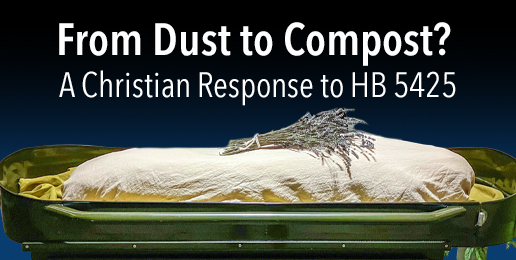
HB 5425 would allow for “natural organic reduction” or “terramation.”
Adriana Pérez of the Chicago Tribune describes this “natural” process where the body is placed into a special vessel, in some cases with organic mulch, wood chips and wildflowers. Over 30 to 45 days with controlled temperature, moisture, and airflow, microbes break down the body.
At the end of the process your loved ones are left with about one cubic yard of “you” and the other elements used in the process.
Kelly Cassidy and Mary Beth Canty are the leading sponsors in the House and Celina Villanueva and Mike Simmons in the Senate, framing the issue primarily as one of personal choice. The Chicago Tribune article mentioned above is a great example of soft advocacy journalism. The two main pillars for human composting are choice and supposed environmental benefits. Sadly, with no solid base for life and morality, how do we decide if this is something that our state should allow?
Here are the key questions. Does it matter what we do with the body after death? Does the Creator of life have any say in this matter or are we merely left with our feelings and preferences? What does God’s Word say on this?
Genesis 1-2 powerfully declare God is the creator of all and the source of all life. Adam and Eve both made in the image of God chose to rebel against God’s command which led to God’s curse which has affected all aspects of life and creation.
God’s Word of judgment spoken to Adam declared this:
For dust you are,
And to dust you shall return. (Gen. 3:19d-e)
Some advocates for human composting suggest that this verse justifies human composting as just another way to dispose of a body after death. But wait a minute. This word to Adam was part of the curse placed on creation not guidelines for disposal of the body. When a body dies, we recognize the curse.
We don’t celebrate the curse.
What does Scripture indicate about the body? Are we merely a collection of trillions of cells? Are we just biological organisms, carbon life forms on two legs? No, we are made in the image of God. We are both physical and spiritual but in a unified way. In life, our bodies are called to be temples of the Holy Spirit (1 Cor. 6:19-20).
Our physical bodies matter in both life and death.
It is significant that the only ground that our father Abraham owned in the Promised Land was a burial ground that was used by his family for generations. Genesis closes with Joseph giving command that his bones be carried from Egypt and brought back to the Promised Land (Gen. 50:25). Joseph made the children of Israel take an oath that they would do this.
This was a physical confession that God would keep His covenant promises about the land. His bones carried the hope forward. Burial has always been, for God’s people, an eschatological act.
The physical body matters in life and in death.
The second key doctrine that should inform our burial practices is the doctrine of the resurrection. Christian burial reflects not just the here and now but the promise of life to come.
The burial of the body is done with the assurance of resurrection.
John 5:28 Do not marvel at this; for the hour is coming in which all who are in the graves will hear His voice 29 and come forth—those who have done good, to the resurrection of life, and those who have done evil, to the resurrection of condemnation.
Advocates for human composting try to use environmental concerns as justification in the face of traditional burial or even cremation. But is an environmental argument justification for this process that dehumanizes the body that was made in God’s likeness?
Natural burial — without embalming, without concrete vaults, in a biodegradable container — achieves the same environmental goal without reducing a person to a cubic yard of compost.
A helpful statement by U.S. Conference of Catholic Bishops points out significant problems with two of these newer “environmental” methods, alkaline hydrolysis and human composting:
After the alkaline hydrolysis process, there are about 100 gallons of liquid into which the greater part of the body has been dissolved and this liquid is treated as wastewater. At the end of the human composting process, the body has completely decomposed along with accompanying plant matter to yield a single mass of compost, with nothing distinguishably left of the body to be laid to rest in a sacred place.
Even cremation, whatever its limitations, yields identifiable remains that can be interred. These remains ideally are then buried (inhumation) or placed in a columbarium (inurnment). This is definitely not the case for human composting.
Our nation was established on Christian principles — however imperfectly realized — and a just society should protect the dignity of its most vulnerable, including those who can no longer speak for themselves. The body in death should be properly committed to the earth, not discarded or composted.
I understand that proponents might be very sincere in their arguments, but sincerity is not the same thing as truth. Let’s advocate for simpler, more accessible natural burial options to reduce costs and that do not cause as much damage to God’s creation.
The Heidelberg Catechism opens with the confession:
That I with body and soul, both in life and in death, am not my own, but belong to my faithful Savior Jesus Christ…
Our bodies belong to Jesus Christ, not the compost bin!
TAKE ACTION: Click HERE to email your state senator and ask him or her to vote NO on HB 5425. The Illinois House passed this legislation on Friday by a vote of 64 to 36. Please pray that it stalls out in the Illinois Senate.
Human beings bear the image of God. Our bodies are not organic waste. They belong to the One who made them and who will raise them on the last day. How a community treats its dead is a statement about what it believes the living are worth.