
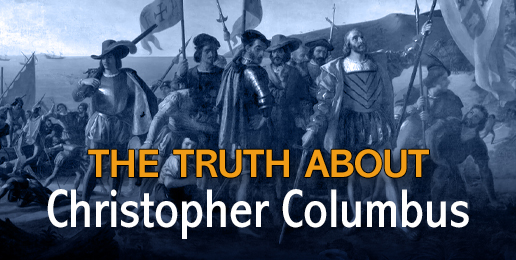
“Columbus sailed the ocean blue in 1492.”
If you were educated like me, this is probably the phrase you most remember Christopher Columbus by.
In school, we often hear of his desire to sail West, yet many never learn the true reasons behind his voyage or the true character of Christpher Columbus himself.
For generations, Europe had relied upon trade routes to Asia to be able to access precious materials such as spices and silks. However, many of these territories along the trade routes were ruled by the Muslim world. In 1453, the Ottoman Turks conquered Constantinople, bringing this ancient capital under the control of strong Muslim rule.
“We ourselves allowed Constantinople, the capital of the East, to be conquered by the Turks. And while we sit at home in ease and idleness, the arms of those barbarians are advancing to the Danube…. In the Eastern imperial city they have massacred the successor of Constantine, along with his people, desecrated the temples of the Lord, sullied the noble edifice of Justinian with their hideous cult of Muhammad.” –Aeneas Silvius Piccolomini (Pope Pius II)
Sailors who continued on the traditional routes to Asia were often exploited by these Muslim nations– being killed or sold into slavery.
Spain’s response was to find an alternate trade route. In 1492, funded by King Ferdinand and Queen Isabella of Spain, Columbus sailed west with three ships seeking to find an alternative trade route to Asia.
Christopher Columbus’ journey West would include more voyages– his second in 1493, his third in 1498, and his final voyage in 1502.
In school Christopher Columbus used to be celebrated as a hero. Nowadays, the famous “Christopher Columbus Day” has been changed to “Indigenous Peoples Day”– an attempt to right the “wrongs” that Columbus committed in his times in the Americas.
But are those stories true? Did Christopher Columbus really treat Natives with atrocities? The real history of Christopher Columbus paints an entirely different picture.
Throughout Columbus’ four voyages to the Americas, he interacted with two Native tribes– the Tainos and the Caribs.
Historical records reveal Columbus praising the Taino as “the best people in the world” and “a better race there cannot be.” In fact, historic authors David and Tim Barton record that Columbus advocated for the Taino’s full equality and citizenship.
The Caribs, however, were a completely different story. Records show that the Caribs routinely raided, enslaved, raped, and cannibalized the Taino people. When Columbus left for Spain to return with more people, supplies and ship, he returned to find the Taino people and some of his men enslaved by the Caribs.
“Columbus liberated the enslaved women they found in the huts and proceeded to fight the Caribs whenever they engaged him…
Despite Columbus’ approach to native peoples, which was certainly among the most humane of any explorer at that time, many authors today assert that he sought to destroy and pillage all Indians…” (The American Story: The Beginning)
Of the Natives that traveled back to Spain, the captured Natives were members of the Carib tribe which were captured in warfare. The others were willing members of the Taino tribe. In fact, historical records show that one such Taino member even became an official member of Spanish court and another willingly took Columbus’ last name and traveled with him as an interpreter on his voyages.
There is much more to be said about Christopher Columbus– his character, his zeal for God’s Word, and his devotion to the Christian faith which time and space do not permit.
If you are interested in learning about the true history of America, I highly recommend purchasing “The American Story” book series from WallBuilders. With the Christmas season fast approaching, this series would make an excellent gift for your children or grandchildren.
Our culture is bent on destroying monuments of Christopher Columbus and are seeking to rewrite and reinterpret the historical records regarding his voyages and his character.
Don’t let them convince you. Learn and know America’s true history.