Why character, not paperwork, is what keeps predators away from children.
In 1998 my son, who was working for me as a research assistant at the time, gave me a book and told me I should read it. It was Robert Hare’s Without Conscience, a book about psychopaths. Hare, a Canadian researcher, also created a test, the PCL-R, to measure psychopathy.
The reason my son alerted me to the book was that I was working on a case that required me to conduct a threat assessment of a man who had become a great concern to my client. The man didn’t fit the normal profile of someone who might pose a threat. He wasn’t mentally ill; there were no indications of paranoia; he had no criminal history; there was no documented pattern of violence in his past; he didn’t drink or use drugs. On the positive side, he seemed likable, easygoing, helpful, and made friends easily.
But there was something very off about him, and I could not put my finger on what it was exactly.
My client was terrified of him, while everyone else involved in the case—the lawyers, the court, the psychologists, the other experts—thought my client was seeing things that weren’t there.
I read the book, and it opened me to a new perspective.
By then, I had been an investigator for almost thirty years, and I had met men like him before. What I had not had was a name for what I was seeing, or a way to measure it. So I went to Canada and took Hare’s training. Based on everything I learned in the case, I evaluated the man and prepared a threat assessment. I was called to testify and put on the record what I thought, the danger the man posed, why, and what I thought he might do next.
The judge was incredulous and called my testimony outrageous, overreaching, disconnected from any facts. I didn’t have the court-recognized clinical credentials to arrive at such conclusions, you see. We had to bring in a nationally known forensic psychologist with a long list of publications to say the same thing in more acceptable language for the court, and even he leaned mostly on the older, better-known tests, not primarily on the PCL-R. The court was not ready to hear that you could read a man’s character and know what he would do.
During the course of the case, the man wound up doing everything I predicted. It was inevitable.
I have thought about that case for twenty-seven years, because it taught me two things. The first is that the danger a man poses is written in his character, and you can read it before he acts. The second is that likability has nothing to do with how dangerous someone might be. Some of the most likable people I have ever met are also among the most dangerous I have ever encountered.
I have seen him many times
I have almost sixty years investigating people who prey on others, and scores of them who preyed on children. These predators act against others in many different ways, whether they present as run-of-the-mill conmen, political extremists, child molesters, mobsters, serial killers, or even unscrupulous businessmen. The manifestations of their evil differ, but the pattern of their character is the same.
For the child predator, his pattern often looks like this.
- He is the best volunteer you have.
- He shows up early and stays late.
- He takes the shifts nobody wants.
- He remembers your kids’ names and asks about your mother’s surgery.
- He is available to babysit for free, to drive the kids to the tournament, to take the boy whose father left on a fishing trip.
- He has a story about himself that is a little too good, and he tells it well.
- He is quick to explain why a rule should not apply to him this once, and the explanation always sounds reasonable.
- When someone finally raises a concern, he is hurt, then indignant, and most of the parents defend him.
- He has no criminal record. He will pass your background check.
Carla van Dam, a psychologist who has interviewed more than three hundred admitted child molesters, put it in four words: he is too good to be true.
Three numbers
You don’t need a mountain of studies to understand the problem or to know how to fix it. You need three numbers.
One in thirty. Gene Abel, the researcher who got admitted offenders to tell the truth under a federal promise of confidentiality, found that a child molester is arrested about once for every thirty offenses he commits. A clean record does not mean a clean man. It means he has not been caught yet.
Ninety-five percent. Abel found that a small group of persistent offenders, the men with an ongoing sexual interest in children, commit about ninety-five percent of the sex acts committed against children. These are not the drunk uncle or the confused teenager. They are men who start young, keep going for decades, and average a dozen victims each. The worst of them, the ones who go after other people’s boys, average a hundred and fifty.
Zero. Most of them are never caught at all. Not once. They are married, employed, respected, and active in the community. That is not an accident. It is the plan. Respectability is how they get access and how they keep it.
And one more, from inside the schools. Charol Shakeshaft has spent forty years studying school employees who abuse students. In her 2025 book, Organizational Betrayal, her figure for how many abusers the criminal-record and licensing checks identify is fewer than 0.2%. In the cases she reviewed where a teacher was convicted, only 39 percent of the schools had even completed a background check, and none had trained a single adult to recognize the warning signs. About one student in ten reports sexual misconduct by a school employee before graduating. The check the whole system relies on catches almost no one.
Put those numbers together, and you see what the background check does. It removes the small number of predators who have already been convicted. Then it provides every organization a false sense of security about everyone else.
We used to know this
Here is what should not surprise us, but often does. The character standard is not a new idea. It is an old one, one we walked away from years ago.
For most of the 20th century, every organization that hired people to work with children always asked the most important question: what kind of person is this? Teachers were expected to be examples for the young. The courts said so, explicitly, and they never changed that ruling.
In 1969 the California Supreme Court threw out the revocation of a teacher’s credential for private conduct that had nothing to do with his work, and people remember that case as the end of the character standard. If you read the case, you find that’s not true. The court kept the standard and said only that the conduct had to bear on fitness to teach. Conduct that bears on a child’s safety bears on fitness.
Ten years later, the U.S. Supreme Court said teachers serve as role models and may be required to act like it.
The law never told us to stop asking about character. We stopped on our own. We were told that judging character was old-fashioned, unfair, and that what people do in private is their own business. Then we turned over the decisions to computerized criminal history screening programs.
There is a difference between having good character and having no criminal history. A huge difference.
The focus
What we should be focusing on is this: Virtuous people do not sexually abuse children.
Every person who does abuse a child reveals exactly what his character is. In the time leading up to and in carrying out their actions, they lie to the parents; they lie to the pastor or the principal; they use the trust of a whole community as a tool to get at a child, and they feel nothing about it. Not one of those things is compatible with someone who has a conscience. So instead of asking whether someone has been caught, ask whether they have the character of someone who might. That is a question you can actually answer, and you can answer it before they touch a child.
Even the researchers who refuse to profile end up here. Shakeshaft argues that you cannot pick abusers out by sex, age, job, or marital status, and she is right. But she found consistent characteristics that set them apart, starting with this: they are takers, not givers. Drawing on the Jesuit writer James Martin, she names the two traits that keep coming back, narcissism and grandiosity — the Pied Piper, the beloved teacher, the charismatic founder whom adults trust because of his standing. She would not call that profiling. Neither do I. It is character.
Eighty years of research on people without a conscience, by psychiatrists, psychologists, and researchers who used different tools and different words, describes the same person. Charming on the surface. Grand about himself. A liar. A manipulator. Bored by ordinary life. Indifferent to the people he uses. No remorse. You do not need a clinician to see those things. You need to pay attention and know what you are looking for.
What to look for
I boil it down to nine words in three groups, from the least dangerous to the most dangerous.
The self-focused: self-serving, boastful, blaming. Everything comes back to them. They talk about themselves. When something goes wrong, it is always someone else’s fault. Most people with these traits are narcissists, and there are a lot of them. But every predator starts here.
The exploiter: deceptive, manipulative, prone to boredom. They lie, sometimes for no reason at all. They get people to do what they want and leave them thinking it was the other’s idea. They need excitement, and rules bore them. These traits are harder to see, because hiding them is their skill. This is the predator.
The uncaring: impulsive, indifferent, remorseless. They do not feel what other people feel. They are not sorry. This is the psychopath, and this is the person Abel was counting.
Then there is the pattern around the person, and the pattern has been measured.
A 2023 study compared adults who had been abused as children with adults who had not, and asked what a trusted grown-up had done with each of them. Every grooming behavior was more common in the abused group, and one stood out: children abused by a trusted adult outside the home were 33 times more likely to have been separated from their family and friends.
Isolation is the tell.
Does he push the limits of the rules about being alone with children and always have a good reason? Does he seek out the lonely child, the one whose parents are absent or distracted? Does he give gifts, keep secrets, arrange to be the one who drives? Does he cultivate the parents as carefully as he cultivates the child? Does his story about himself hold up when you check it?
None of these is a verdict. A boastful man is usually just boastful. But when several of them show up in the same person, and that person is working hard to be close to your children, you are looking at the pattern, and the pattern is rare.
How it works
The method is simple enough to write on one page.
Make character the center of every decision. Not the absence of a record. The record check stays, but it is the beginning of screening, not the end.
Treat access to children as a privilege, not a right. The burden is on the applicant to show he is worthy of it. A degree and a clean record do not meet that burden.
A lie on the application disqualifies. Any material misrepresentation or omission does, automatically, disqualify. You cannot trust a liar, even one who is not a predator. And there are more of them than you think: in a 2022 survey, 58 percent of people seeking jobs in education admitted they had lied on a résumé at least once.
Watch for the pattern, not the flag. One red flag is a reason to look harder. Their convergence is a reason to act.
Nobody decides alone. Every organization needs a small team that receives concerns, protects the people who bring them, and weighs the indicators together. People must feel safe reporting a vague feeling, because that feeling is usually right.
Keep looking. Screening is not a form you file at the start. It is how you know the people around your children, all the time, for as long as they are there.
That last point is the heart of it. In almost every case I have investigated or read about, when a predator was finally caught, someone stepped forward to say they had sensed something wrong long before. Shakeshaft’s numbers say the same thing: in seven out of ten of her convicted-teacher cases, the warning signs had been seen and reported to an adult beforehand, and nothing was done. In three out of four, other people had noticed. Supervision was increased in two percent. They did not know what it was. They did not know whom to tell. They did not want to be the one who judged. This method gives that person a vocabulary and a place to take it.
The objection
The objection I hear most is this: you will turn away good people.
Yes, sometimes. And every organization already turns people away for a bad interview, a thin résumé, or a gap in the schedule. We are not deciding whether someone goes to prison. We are deciding whether they get to be alone with other people’s children. Someone who is turned away can coach somewhere else, or nowhere. A child who is harmed does not get a second chance at innocence.
The other objection is more subtle, and I understand it, because I have felt it. Who am I to judge another person’s character?
The answer is that you already do, every day, with your own children and your own friends. You are not being asked to do anything new. You are being asked to do it on purpose, with the right things in mind, for children who are not yours and cannot do it for themselves. Furthermore, this is something parents and principals and boards and pastors and elders and supervisors of all kinds have been doing throughout history.
The person you are looking for is counting on you not to. He has read the room. He knows that nice people give the benefit of the doubt, accept the excuse rather than confront, doubt their own judgment, and want to be liked. Those are not weaknesses of bad organizations. They are the ordinary virtues of good ones, and he uses every one of them to his own benefit.
What to do this week
If you lead a school, a church, a youth program, a camp, a team, or a troop, here is where to start.
- Put the character standard in writing as your screening policy. One paragraph will do. Say that access to children is a privilege the applicant must earn, that material misrepresentation disqualifies, and that character comes first.
- Name your team. Three people who will receive concerns, protect the people who bring them, and look harder together.
- Train every adult, not just the screeners. The predator counts on the untrained bystander. Give everyone the nine words and the grooming pattern.
- Go back through your current roster with new eyes. Not to accuse anyone. To know them.
- Tell the parents what you are doing and why. They will not object. They have been waiting for someone to say it.
Public schools will do some of this through the process the law requires, and the indicators are grounds to look harder and act through those channels. Churches and private organizations have far more room. That extra latitude should not be considered a luxury but a duty.
The organization that can screen for character and chooses not to has failed its children more plainly than the one whose hands are partly tied.
The last word
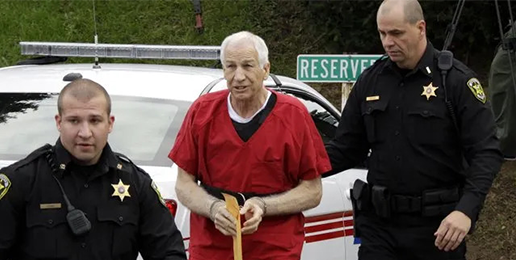
In November 1990, President George H.W. Bush recognized The Second Mile, a charity in State College, Pennsylvania, as the nation’s 294th Point of Light. Its founder was Jerry Sandusky, a celebrated football coach who welcomed foster children into his home and later published an autobiography titled Touched.
Then came a warning. In 1998, a mother reported that Sandusky had showered with her 11-year-old son. Police investigated, but the district attorney declined to prosecute. The case was closed, and Sandusky continued operating his charity and bringing boys into his home for another decade.
In 2012, a jury convicted him on forty-five counts of sexual abuse of minor boys. The charity dissolved in 2016.
Sandusky did not fool Penn State by hiding. He fooled it by being visible. He was one of the best-known volunteers in the country, the man with the President’s letter on the wall, and the children he harmed were the ones the charity existed to help. Nothing in his personnel file could have stopped him, because his file was perfect.
What could have stopped him was an adult who knew what to look for, had a place to take it, and was not embarrassed to say out loud that the most generous man at the college was too good to be true.
In 1998 a judge called that kind of statement, my statement, regarding a man’s character and potential for danger, outrageous, overreaching, and disconnected from the facts. It was not. His character was the only thing that adequately described him and was the only thing worth knowing.
It doesn’t take a degree or any special expertise to screen out people who pose a threat to children or others in an organization. It takes common sense. It takes looking at character qualities rather than being swayed by appearance, charm, charisma, or likability. This method costs nothing, and the courts never took it away. We just stopped using it.
It is time to start again.
The full framework, with its documented research and legal history, is published as a companion piece, Securing Our Future: A Character-First Framework for Protecting Children.