The Insiders, Part Two
This past Thursday, the U.S. Senate Homeland Security and Governmental Affairs Committee voted eight to five along party lines to hold Dr. Anthony Fauci in contempt of Congress. He appeared before the committee under subpoena on July 29 and invoked the Fifth Amendment more than a hundred times. Chairman Rand Paul says he will send the resolution directly to the Justice Department rather than to the U.S. Senate floor, where it would require sixty votes.
Two further votes were entered against by proxy, for the record only; some outlets reported the tally as eight to seven on that basis. Whether a committee can certify a contempt referral to the Justice Department without a vote of the full U.S. Senate is itself contested.
In my article, The Insiders, I wrote that I had seen a pattern repeating across institutions, in which people entrusted with carrying out a task wrote their own authorization in language that no one examined closely. When the review finally comes, the reviewing body cannot render a verdict because it would have to judge itself along with the official.
Some allege that Anthony Fauci defied legal restrictions on gain-of-function research when he authorized and funded such research at the Wuhan lab in China.
That is wrong.
He never had to defy anything. He agreed, in public, with the specific restraint imposed in 2014 and then, within his own agency, determined that the restraint did not affect him.
The Authorization, In His Own Byline
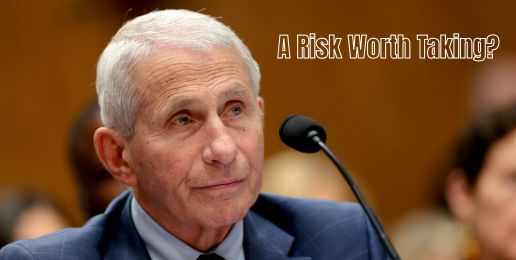
On December 30, 2011, the Washington Post published an opinion piece titled “A flu virus risk worth taking.” The bylines read Anthony Fauci, director of the National Institute of Allergy and Infectious Diseases; Gary Nabel, director of the Vaccine Research Center; and Francis Collins, director of the National Institutes of Health.
The piece defended experiments that made H5N1 avian influenza transmissible between ferrets. Its authors did not hide what that meant. They wrote that important information and insights can come from generating a potentially dangerous virus in the laboratory. They acknowledged that a bird flu virus transmissible to humans could arise in ways that laboratory studies would not predict, and that it was unclear whether the laboratory virus would behave in people as it did in ferrets. They wrote that safeguarding against accidental release or deliberate misuse was imperative.
Consider what this means. The men who ran the agencies that funded research accurately described the danger in public but nevertheless concluded that the work should proceed.
At the July 29 hearing, U.S. Senator Paul read from what he believed was this op-ed. It wasn’t. Paul said Fauci had written in support of the research in the Washington Post and then characterized what Fauci had written this way: that even if a pandemic should occur, the knowledge is worth the risks.
That sentence is not in the op-ed. Fauci wrote it ten months later, in the journal mBio, in October 2012. He asked — what if a scientist becomes infected and the outbreak that follows triggers a pandemic — and answered, in his own words:
“Scientists working in this field might say—as indeed I have said—that the benefits of such experiments and the resulting knowledge outweigh the risks.”
Paul had the man right but the document wrong. That single sloppy citation gave the Fauci defenders room to declare that Paul was wrong and that the whole hearing was a sham. The fact-checker who caught it, Dr. Céline Gounder, nevertheless acknowledged that the quotation was fair as a paraphrase of a different document.
In that same October 2012 editorial, Fauci wrote something else significant. The National Institute of Allergy and Infectious Diseases, he wrote, strongly supports continuing the voluntary moratorium on gain-of-function experiments, pending the resolution of critical policy issues.
Remember that. In print, in the journals, and before Congress, this is a man who endorsed restraint. What he really believed can be discerned from the subsequent actions of those who worked for him.
Francis Collins, who ran the National Institutes of Health and was Fauci’s superior, co-signed the argument. Collins was the man who would have, or should have, written the restraining instructions. The instructions were meant to constrain Fauci.
The Pause That Paused Nothing
On October 17, 2014, after a series of laboratory accidents, the White House imposed a funding pause on gain-of-function projects that could reasonably be expected to make influenza, MERS, or SARS viruses more transmissible or more lethal in mammals. This came in writing from the White House, outside the agency. It is also as close to a binding order as this subject ever got. In thirteen years, the federal government never issued one.
The details matter, though.
The pause did not apply to research already funded, and work on viruses as they occur in nature was exempt unless testing was reasonably expected to increase transmissibility or pathogenicity. An exception could be granted, in the document’s own words, by the head of the federal funding agency if that official determined the research was urgently necessary to protect public health or national security. The official being restrained decided when the restraint applied to him.
The pause affected eighteen federally funded projects and contracts; seven of them received exemptions. Those are the figures the Congressional Research Service published in 2022. Its own updated report, issued in March 2025, drops the exemption count altogether and gives a different total for the projects reviewed. Years later, CRS reported that it was unable to identify with certainty which projects were ultimately paused.
The EcoHealth Alliance grant did not require an exemption.
The U.S. Department of Health and Human Services action referral memorandum of May 15, 2024 states this clearly: NIAID determined that the work was ultimately not subject to either the gain-of-function pause or the Potential Pandemic Pathogen Care and Oversight (P3CO) policies.
NIAID reached that conclusion about NIAID’s own grant. Internal emails later obtained by U.S. Right To Know show that the grant managers and the review committee arrived at it largely on EcoHealth’s assurances and the Wuhan Institute of Virology’s international reputation, and then skipped further formal review. One official on the chain was still asking afterward whether anyone had verified the Chinese lab’s biosafety level.
NIAID made that determination. I cannot document that Anthony Fauci personally signed it; the names on those emails are staff members. What I can document is that he has defended the determination ever since — in press statements, in written answers, and under oath — for five years. A determination a man defends for five years is one he owns.
Here is what actually happened. In the journal, Fauci said the moratorium should continue. In the newspaper, he said the research was worth the risk. And in the grant file, his institute concluded that the rule everyone was arguing about did not apply to the money going to Wuhan.
That is not a man defying an order. That is a man agreeing with the order in public while deciding its meaning in private. It is worse than defiance because defiance would have left a clear record.
In December 2017, the pause gave way to a permanent framework. Everything that followed depended on how the framework defined the research it governed.
The Definition, Read Closely
The framework that replaced the pause was called P3CO — Potential Pandemic Pathogen Care and Oversight. The White House guidance itself was recommended rather than binding; the HHS framework adopted that December governed HHS funding decisions, requiring department-level review of research reasonably anticipated to create, transfer, or use an enhanced potential pandemic pathogen. Everything depends on the interpretation of that phrase.
Here is what it means in the government’s own words.
The guidance defines a potential pandemic pathogen as one that satisfies both of the following:
“It is likely highly transmissible and likely capable of wide and uncontrollable spread in human populations, and it is likely highly virulent and likely to cause significant morbidity and/or mortality in humans.”
It then defines the enhanced version:
“An enhanced PPP is a PPP resulting from the enhancement of a pathogen’s transmissibility and/or virulence. Wild-type pathogens that are circulating in or have been recovered from nature are not enhanced PPPs, regardless of their pandemic potential.”
The people who write these policies must have advanced degrees in the art of obtuse writing.
What this says is that the thing you begin with has to already be both. Already spreading widely among people. Already killing them. The rule was written in the shadow of the 2012 H5N1 experiments, where scientists took a virus that was killing more than half the people it infected and made it easier to catch. That is the picture the drafters had in their heads: a dangerous pathogen made worse.
Now consider a bat coronavirus that has never infected a human being. It is not highly transmissible in human populations. It is not transmissible in human populations at all. It is not virulent in humans because it does not reach them. It fails both conditions and is therefore not a potential pandemic pathogen.
Take that virus into a laboratory and give it the ability to infect human cells. Under the framework as written, you have not created an enhanced potential pandemic pathogen. You cannot have. The definition requires that you started with one.
The rule covered making a dangerous thing worse. It did not cover making a harmless thing dangerous.
That is the defense that has never failed, and it is the one they reach for first. When the FBI put the question to NIAID in May 2020, the institute’s written answer quoted the wild-type carve-out back at the Bureau verbatim, and added that the 2014 pause had named SARS-CoV, not SARS-related coronaviruses — a second narrowing, and a more aggressive one than the first.
NIAID also argued the science. The chimeras, it told the Bureau, “would not be considered GoF since the results did not confer attributes that were not already exhibited by the wild type versions of the viruses,” and it pointed to figures showing no statistical difference in weight loss or lung viral titers against the wild type. That is the same position Ralph Baric takes when he says there was no gain in function. It sits uneasily beside NIH’s own later disclosure that one chimera grew a thousand to ten thousand times better than its parent, and it is a claim that can be tested by anyone with the data.
The definitional argument cannot be tested. That is why it is the one that has held.
Every denial he has issued — that NIH and NIAID never funded gain-of-function research on coronaviruses and that the Wuhan work did not meet the government’s definition — is correct under the definition they wrote. His statements can be true even as the work of altering the virus is knowingly dangerous, because the definition was created to allow for both.
The National Science Advisory Board for Biosecurity — the government’s own advisory body, not a partisan committee — addressed the framework and found that the definitions did not adequately cover pathogens that fall short of the threshold for likely high virulence but whose enhancement could still pose a severe threat to public health or national security.
The board warned that requiring a pathogen to be both highly transmissible and highly virulent could result in overlooking some research.
The board wrote the repair itself, in plainer language than the policy it was fixing. It recommended that review be required for research reasonably anticipated to enhance the transmissibility or virulence of any pathogen — and here it wrote the words out — potential pandemic pathogens and non-potential pandemic pathogens alike, whenever the resulting organism would meet the definition. It lowered the bar from highly to moderately or highly, required only one of the two conditions instead of both, and scrapped the blanket exemptions. It also added a third condition the earlier framework had not needed: that the resulting pathogen be likely to pose a severe threat to public health, to the capacity of public health systems to function, or to national security. The recommendation was never adopted.
The Rule Nobody Wrote
Ask yourself what a sane restriction would cover, and the absurdity of the narrow reading becomes clear.
A rule that protects you only from a dangerous organism becoming more dangerous leaves you entirely unprotected against what any reasonable person would fear most: something harmless being made lethal.
No one sitting down to prevent a laboratory-made pandemic would write a rule that stops a scientist from worsening a killer while permitting him to manufacture one. Put that proposition to any hundred Americans, and none of them will accept it.
So I went looking for who wrote it that way, expecting to find the drafting fight. What I found instead was that in 2014, nobody wrote it that way at all.
Here is the operative sentence from the October 2014 pause, in the words it was published in. New government funding would not be released for gain-of-function research projects that may be reasonably anticipated to confer attributes to influenza, MERS, or SARS viruses such that the virus would have enhanced pathogenicity and/or transmissibility in mammals via the respiratory route.
It sets its scope by virus family — influenza, MERS, SARS — and asks nothing about whether the organism already sickens anyone. Its test is what the resulting virus has, not what the starting one had. And it says in mammals, not in humans, which means a bat coronavirus engineered to sicken humanized mice fits that original definition.
Nowhere in the 2014 pause is there a requirement that the work begin with something already dangerous to people. That requirement does not exist. It was created on January 9, 2017, in policy guidance from the White House Office of Science and Technology Policy, and was finalized in the HHS framework that December — written during the very deliberative process the pause had created, and adopted the same day the pause was lifted and NIH restarted funding.
The relaxation of the original intent did not originate within NIAID. It came from a White House policy process and followed a recommendation from the National Science Advisory Board for Biosecurity — the same board quoted above. In May 2016, that board proposed carving out a smaller category, gain-of-function research of concern, on the entirely defensible ground that most gain-of-function work is routine and harmless, and that only a small subset carries risk warranting extra oversight.
The 2017 guidance was written to capture that recommendation. Nobody at the agency that benefited drafted the sentence that exempted it from the recommendation.
It is worth naming the pen, because the document does not. The 2017 guidance carries no signature. It opens in Section 1 with no author line, no issuing official, and no signature block — a policy that appeared in the name of an office rather than a person, as did the HHS framework that followed it in December. But there is a name behind it. The interagency committee that produced the guidance was chaired by Gerald L. Epstein, then the Office of Science and Technology Policy’s Assistant Director for Biosecurity and Emerging Technologies, serving under OSTP Director John Holdren.
Epstein disclosed the chairmanship himself in a footnote to a 2025 history of the policy he helped write. He had also served as a non-voting member of the very advisory board whose recommendation he then converted into policy — which is to say the link between the board and the rule ran through him, not through anyone at NIAID.
Fauci was asked about all of this under oath, and his answers are on the record. In a transcribed interview with the U.S. House Select Subcommittee on the Coronavirus Pandemic in May 2024, counsel asked whether he had been involved in crafting the 2014 pause. He said no. Asked who had been, he said:
“No, I don’t. I assumed it was OSTP was involved, I believe. But the honest answer, I don’t know who crafted it.”
Asked whether he had been involved in drafting the P3CO guidance, he said no again. Pressed on whether it was strange that his own institute would have had no hand in a policy it would have to work under, he allowed that the drafters
“may have tapped into some of our subject matter experts at the program level” — and then added, “But I certainly was not involved in the drafting of these.”
Nobody has ever put a name, a date, or a document to those program-level experts. No released email, no report of the Government Accountability Office, and no congressional finding places Anthony Fauci in that drafting room. On this narrow question the record does not merely fail to implicate him. It points the other way.
This means the definition was not built to order.
A drafting error is something you fix when it is pointed out. This one was pointed out — by the same board in its final report — and the agency that created it did not close it. The definition was used on the agency’s own grant and then defended under oath for the better part of a decade, while the people asking about it were told they did not understand the science.
It was pointed out earlier than that, and by the drafter. Epstein concedes more than his defenders may realize. He writes that the enhanced-potential-pandemic-pathogen terminology “was subject to its own misinterpretation,” because the phrase “could readily be taken to be the result of enhancing something that was already a PPP” — which, he insists, was never what the text required. He also writes that the guidance handled the exemptions for surveillance and vaccine work “in a way that contradicted the NSABB’s explicit recommendation”: where the board had offered those activities as examples that would generally not need review but would still be reviewed if they enhanced a pathogen enough, the guidance turned them into flat exemptions.
That is the man who chaired the drafting committee acknowledging in a scientific journal that his text came out looser than the board that recommended it intended. The gap was not concealed. It was described in the literature by the person who made it — and still not closed.
Consider what the drafting history shows about the language at the center of this fight. The governing term has been rewritten six times in thirteen years and has carried six different names. The 2011 ferret experiments were not labeled gain-of-function when they were conducted; they were called dual-use research of concern, and the phrase was attached to them retroactively in late 2012. The 2014 pause used the phrase in its title without defining it. An advisory board carved out a narrower category, gain-of-function research of concern, in 2016.
The 2017 guidance dropped the phrase entirely in favor of potential pandemic pathogen. A 2024 policy coined a fifth term, pathogen with enhanced pandemic potential, and was superseded one day before it took effect. The replacement brought the phrase partway back as dangerous gain-of-function research, and the current policy took effect on July 20 of this year, nine days before the hearing, and nobody mentioned it.
This means that for the eight years from January 2017 to May 2025 — the entire span of the Wuhan grant, the pandemic, and every congressional hearing about both — the phrase at the center of every public argument over this research appeared in no federal regulation. Not in the United States Code, not in the Code of Federal Regulations, not in any rule with the force of law behind it. It survived only in agency guidance and agency notices, which the agency could read as it pleased.
There was no dictionary.
What the Senators Were Asking
Which brings us to whether Fauci understood what was being asked of him. Here, the record is not ambiguous.
In July 2021, U.S. Senator Rand Paul asked Fauci directly. The Wuhan research, Paul said,
“matches, indeed epitomizes the definition of gain-of-function research, done entirely in Wuhan, for which there was supposed to be a federal pause.”
Paul was asking about conduct during the pause, measured against the pause’s own language — the 2014 sentence, which contains no requirement that the pathogen be dangerous to humans from the outset.
Fauci answered that the paper Paul was citing “was judged by qualified staff up and down the chain as not being gain-of-function.” He did not say which definition that staff had applied. Only one of the two available yields that answer, and it is the one written in 2017.
He did not merely reach for a narrower dictionary. He answered a question about 2014 using an edition published in 2017, and he did not say so.
Every senator in that room, and every citizen watching, understood the term gain-of-function to mean what any literate person means by it: a pathogen given an ability it did not have before. That is also what the rule in force at the time meant.
Two definitions were available to him. The first was the rule in force when the money went out, which asked only what the resulting virus could do. The second was the rule written afterward, which asked what the starting virus already was. He was asked about the first and answered using the second. Either answer can be defended in isolation. Set them side by side, and they describe a man who knew exactly how much room the change had left him.
Fauci used the Clinton defense in a more complicated way. It depends on what the meaning of the word is, is.
There is a narrow shelter in the law for answers of this kind, and naming it shows how narrow it is. In Bronston v. United States, decided unanimously in 1973, the U.S. Supreme Court held that a literally true answer cannot sustain a perjury conviction, even when it misleads, because the burden falls on the questioner to press for precision. That rule protects a witness from a prosecutor. It does not make him honest. It establishes only that this particular species of deceit is difficult to punish, which is a fact about the reach of the law, not about the man.
Congress asked Anthony Fauci in plain English whether the National Institutes of Health had funded gain-of-function research. He understood what his questioners meant because the rule in effect when his institute made that grant meant the same thing they did. He answered them using a dictionary printed afterward and did not mention that he had switched the meanings.
A man who holds two definitions and hands you the wrong one on purpose has lied to you. That he can produce a document justifying the substitution is no defense. The document is the technique. And according to the U.S. Supreme Court, he still can’t be prosecuted for perjury.
There is one more voice worth hearing on this, and it is the least convenient one available to me. The chairman of the committee that wrote the 2017 guidance has said in print that Fauci was entitled to the answer he gave. Writing in Applied Biosafety in 2025, Epstein traced the confrontation directly to the ambiguity in the language. Senator Paul, he wrote, used gain-of-function to mean research that increased a virus’s pathogenic properties, “which the Wuhan research did,” while Fauci used it to mean research requiring departmental review, “which NIH had determined the Wuhan research did not.” Then the concession:
“Some may disagree with NIH’s decision here, but given the subjective judgments necessary to interpret the trigger language in the P3CO policy, NIH was within its rights to have made that call.”
That is the strongest defense available to Anthony Fauci, and it comes from the author of the rule. It deserves an answer rather than a silence.
Here is the answer. Epstein is addressing whether NIH had the authority to make a judgment call under an ambiguous rule. He is not addressing whether a witness may answer a question about 2014 using a definition written in 2017 and then decline to mention the substitution. A funding officer exercising discretion under language he finds unclear is doing his job, and I will grant him every inch of that. A witness under oath, asked in plain English about conduct that occurred under an earlier rule, is not exercising discretion. He is answering a question. Epstein defends the grant decision. He says nothing about the testimony, and the two are not the same act.
It is a lie built to survive a fact-check, the only kind an insider ever needs. The ordinary liar says something false and waits to be caught. This one arranged the language first, so every word he said was true.
Throughout my career, I’ve watched men write their own rules and create their own insider language. That is the most reliable indicator in this business. But this case is the harder, more troubling variant, because Fauci did not hold the pen. He did not have to. Someone else’s reasonable compromise landed on his desk with a hole in it. His institute applied that hole to its own grant, and when the government’s own biosecurity board reported that the hole was there, the agency that benefited from it left it open. When a man’s entire defense rests on the definition of the act he is accused of, the investigation is no longer about the act. It is about who held the pen — and, when nobody did, about who made sure it was never picked up again.
Richard Ebright of Rutgers says the EcoHealth work met the 2014 definition unequivocally. In May 2021, Francis Collins said that NIH and NIAID had never approved any coronavirus gain-of-function grant. Both men are describing the same experiments in the same laboratory.
Supplying the Answer, Then Citing It Back
On March 17, 2020, Nature Medicine published “The Proximal Origin of SARS-CoV-2,” which concluded that the virus was not a laboratory construct or a purposefully manipulated virus. It became the citation of record. Facebook used the natural-origin consensus to suppress lab-leak discussion, expanding the ban in February 2021 to cover the claim that the virus was man-made and not lifting it until May 26 of that year.
The published acknowledgments named neither Fauci nor Collins. That was the point. In a private email on March 6, 2020, eleven days before publication, the lead author thanked Fauci, Collins, and Jeremy Farrar of the Wellcome Trust for their “advice and leadership.” The thanks were real. They were simply not printed.
On June 11 of this year, Senator Paul released a March 6, 2020 email in which Collins forwarded a message from one of the paper’s authors to NIH officials, with a note:
“This is work that Tony, Jeremy, Larry, and I helped with, but are appropriately not mentioned explicitly in the paper.”
Fauci then presented that paper to the public and to the intelligence community as the independent judgment of outside experts. In sworn testimony in 2024, he denied having influenced it.
This is exactly the Siefkes mechanism—insider substitution—and I was not seeking to prove the parallel. He did not write the rule, but he helped shape the finding. The finding is published under other names, and he cites it back as though it came from somewhere other than himself. The review collapses because the reviewer had a hand in what was being reviewed.
The Mechanism, in a Charging Instrument
On April 16 of this year, a federal grand jury in Maryland indicted David M. Morens, 78, who served as a senior advisor in the NIAID Office of the Director from 2006 through 2022. He was Fauci’s own advisor. The charges include conspiracy against the United States, destruction or falsification of records in a federal investigation, concealment or removal of records, and aiding and abetting.
The Justice Department alleges that after NIH terminated the bat coronavirus grant, Morens and two co-conspirators agreed in writing to conduct their communications through his personal Gmail account rather than his NIH account, specifically in anticipation that those communications would be sought under the Freedom of Information Act. The indictment quotes his own words. In February 2021, he wrote that he had learned from the FOIA officer at his agency how to make emails disappear. That November, he wrote that his Gmail was safe from FOIA.
An indictment is an allegation. Morens is entitled to the presumption of innocence, and I extend that presumption to him. But compare the allegation to the pattern. This is not a man who broke a rule and hoped nobody noticed. This is a man alleged to have identified the specific mechanism by which the public would learn what he was doing and to have written down, in advance, how to defeat it.
Two Documents, Two Days Apart
On January 17, 2025, following an eight-month investigation, the U.S. Department of Health and Human Services formally debarred EcoHealth Alliance and its former president, Peter Daszak, for five years. The findings: EcoHealth facilitated gain-of-function research in Wuhan without proper oversight, ignored government oversight requests, failed to report experiments in which the viruses exceeded permitted growth thresholds, and filed a required research report almost two years late. Daszak’s employment was terminated effective January 6.
On January 19, 2025, President Joe Biden issued a full and unconditional pardon to Fauci for any federal offenses committed between January 1, 2014, and the date of the pardon, arising from his service as director of NIAID, as a member of the White House Coronavirus Task Force or the COVID-19 Response Team, or as chief medical adviser to the president.
I am not going to say those two acts were coordinated. I’m not convinced they were, and “No Conductor Required,” an earlier piece of mine, is the frame I keep returning to precisely because coordination is rarely the explanation and is almost never necessary. But an institution that debars the contractor and pardons the official within forty-eight hours has told you where it places responsibility, and the answer is: outside the building. Protect your own.
The pardon is also why we are where we are now. Because his conduct through January 2025 cannot be prosecuted, Senator Paul argues, Fauci had no valid Fifth Amendment privilege to assert. Fauci’s counsel disagrees. Lawyers will settle that question, and I have no confident prediction about it.
What Was Actually Lost
Here is where I part ways with some people on my side of this argument.
I cannot tell you, unequivocally, that American money created SARS-CoV-2. Neither can anyone else. The debarment letter documents facilitation of dangerous research and failure to oversee it. It does not establish causation.
The White House treats a lab-related incident as the most likely origin. That is not proven. Many virologists still argue for natural spillover, and Ralph Baric, whose federal pay was frozen in 2025 and who was suspended and referred for debarment this year, disputes that his experiments were gain-of-function.
Six years in, with the full weight of the federal government applied to the question, it is frustrating that we cannot answer it with certainty.
And now look at why. The one instruction that ever came from outside was determined, within the agency, not to apply. The rule that replaced it was written so that the category of virus in question fell outside its scope. NIH had placed a condition in the grant requiring EcoHealth to report immediately if a virus grew ten times better than expected; the agency’s own deputy director conceded that EcoHealth failed to do so, and the report arrived about two years late.
The senior advisor is charged with routing his correspondence around the disclosure law. The paper that settled the public question was shaped by the men it exonerated, who arranged not to appear on it. And the official at the center has now declined, more than a hundred times under subpoena, to say anything at all.
That is the catastrophe.
Not a proven lab leak — a permanent inability to determine whether there was one. The insiders did not merely make a dangerous judgment call. They dismantled, piece by piece, every instrument built to check that judgment. Millions are dead worldwide, and the record that would tell us whether our own money helped kill them has holes put there on purpose.
I want to be fair about motive. I do not think Anthony Fauci wanted a pandemic. I think he sincerely believed, for decades, that this research was the only way to stay ahead of one. That is the finding of The Insiders, and it is the frightening part.
A man who believes that will not defy an order. He will do something far more enduring: he will agree with it, and then, sincerely and in the paperwork, he will find that it does not apply to the work he thinks matters.
Oversight and holding government officials accountable are not just the responsibility of a professional class. We are all responsible. And because of that, we get the government we deserve.
A Final Note
In March 2020, Chinese Foreign Ministry spokesman Zhao Lijian tweeted that it might be the U.S. Army that brought the epidemic to Wuhan, and demanded that America make public its data. State media pushed the claim that the virus had been created in the United States and planted in China in the fall of 2019. Chinese social media carried it from late February. It was a coordinated campaign, and it was so far outside the evidence that China’s own ambassador in Washington, Cui Tiankai, publicly refused to defend it.
At the time the allegation was laughable.
I am not laughing now. Not because Zhao was right — he was not. But strip away the part he invented and look at what is left. He said American hands were on the origin of this pandemic. He meant it as a lie.
But it may turn out to have been true in a way he never intended and could not have known. It is well documented now that American money paid for bat coronavirus research at the Wuhan Institute of Virology, that part of that research was directed at determining whether bat coronaviruses could be made infectious to human cells, and that a lab-related accident is now the position the United States government itself has taken as the most likely source of the pandemic.
The propagandist reached for the most damaging thing he could invent. He may have stumbled into the truth by accident.
And there is the other half of what he said. He demanded that we make our data public.
We could not then. We cannot now. The grantee filed its report almost two years late. The senior advisor is under indictment for routing his correspondence around the disclosure law. The paper that settled the public question was shaped by four men who arranged not to be named in it. And the official at the center of all of it has now invoked the Fifth Amendment more than a hundred times under subpoena.
A Chinese propagandist asked for our records, and six years later the honest answer is that records which could answer many of the questions are missing and that those records were disappeared on purpose by people who now refuse to talk.
Good government requires a majority of citizens to be both informed and engaged. You can decide whether you are one of them.